

Growth Hormone Axis Research: Hypothalamic, Pituitary and Peripheral Signaling


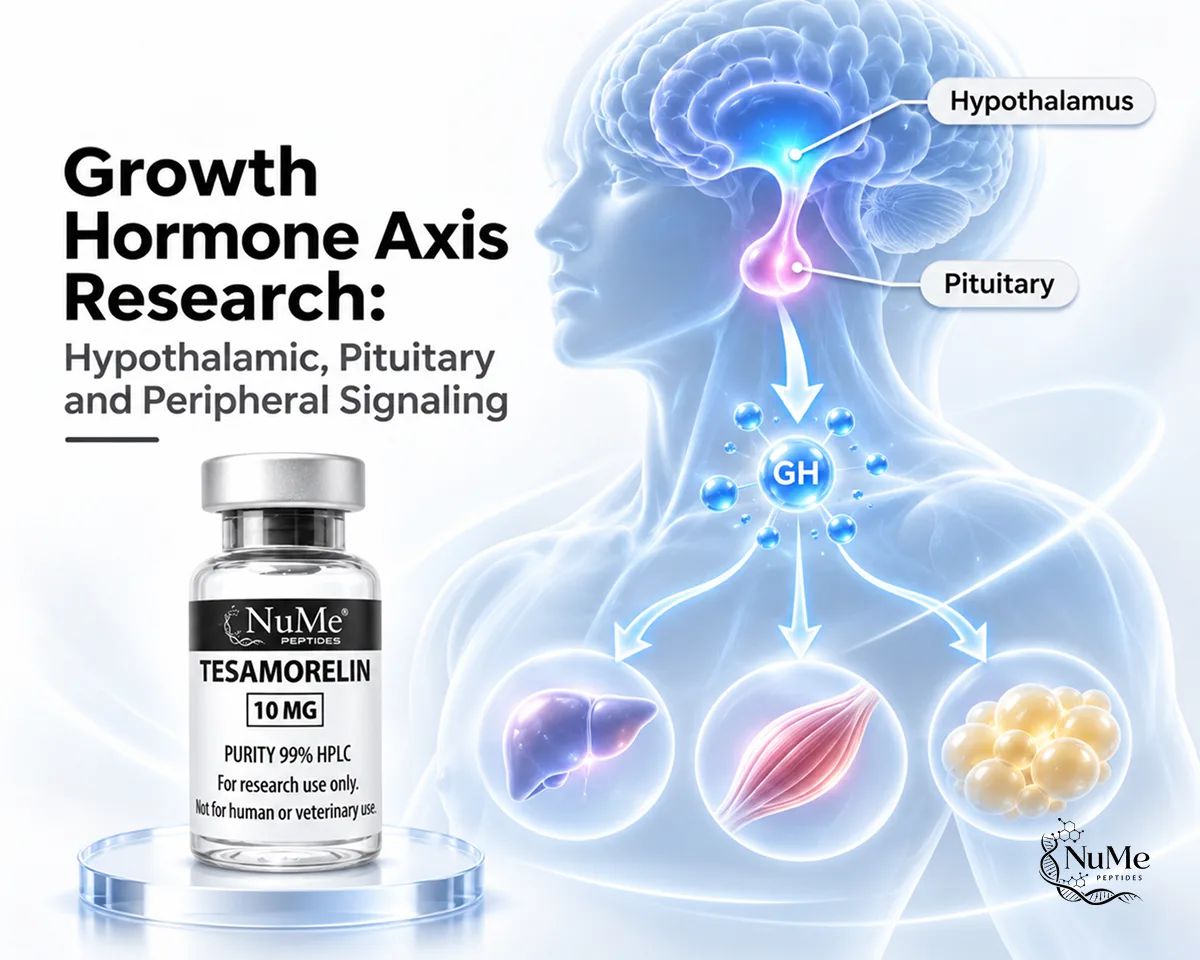
The growth hormone axis is a coordinated endocrine network connecting the hypothalamus, pituitary gland, peripheral tissues, growth hormone receptors, and insulin-like growth factor 1 (IGF-1). Rather than functioning as a simple pathway in which the pituitary releases GH and target tissues respond, the system depends on multiple stimulatory, inhibitory, and feedback signals operating at different biological levels.
Modern growth hormone axis research examines how growth hormone-releasing hormone (GHRH), somatostatin, ghrelin-related signaling, pituitary somatotrophs, growth hormone receptors, and IGF-1 interact over time. Researchers also study GH pulsatility, receptor signaling, metabolic conditions, age, sleep, nutrition, and endocrine feedback.
Peptides such as CJC-1295, Sermorelin, Ipamorelin, GHRP-6, and Tesamorelin provide different experimental approaches for modifying this axis. Some act through the GHRH receptor, while others act through growth hormone secretagogue pathways, allowing researchers to study separate regulatory layers.
Explore the NuMe Peptides US Shop for research-focused compounds associated with growth hormone secretion, endocrine signaling, and laboratory investigation.
What Is the Growth Hormone Axis?
The growth hormone axis, also known as part of the somatotropic axis, includes the neuroendocrine and peripheral systems that regulate GH secretion and biological activity.
At the hypothalamic level, several signals influence pituitary somatotrophs.
GHRH stimulates GH synthesis and secretion. Somatostatin provides inhibitory control, while ghrelin and growth hormone secretagogue receptor signaling add another stimulatory pathway.
The pituitary then releases GH into circulation in a pulsatile pattern.
After entering the bloodstream, GH interacts with growth hormone receptors in multiple tissues, including the liver. Hepatic GHR activation stimulates production of circulating IGF-1, while peripheral tissues can also produce IGF-1 locally.
A recent review describes GH physiology as a complex interaction of endocrine, paracrine, and autocrine signaling. GH secretion is regulated by GHRH, somatostatin, ghrelin, GH and IGF-1 feedback, together with variables such as age, sex, sleep, nutrition, stress, and metabolic state. (Iglesias & Guerrero-Pérez, 2026)
This means the axis can be considered across three broad levels:
- Hypothalamic regulation: GHRH, somatostatin, ghrelin-related signaling.
- Pituitary output: synthesis and pulsatile release of GH.
- Peripheral signaling: GHR activation, IGF-1 production, metabolism, and tissue responses.
These layers continuously communicate through feedback mechanisms.
How Do Hypothalamic Signals Regulate Growth Hormone Secretion?
The hypothalamus plays a central role in determining when and how strongly pituitary GH is released.
GHRH
GHRH is produced by hypothalamic neurons and delivered to the anterior pituitary through the hypophyseal portal circulation.
It binds the GHRH receptor on somatotroph cells and activates intracellular cAMP-related signaling, promoting both GH synthesis and secretion.
GHRH is especially important for generating GH secretory pulses.
Somatostatin
Somatostatin provides the major inhibitory influence within the axis.
Rather than permanently suppressing GH, somatostatin tone changes over time. Lower inhibitory tone can allow stronger responses to GHRH, whereas increased somatostatin activity reduces pituitary responsiveness.
The alternating balance between GHRH and somatostatin contributes substantially to the pulsatile pattern of GH secretion described in modern neuroendocrine research. (Iglesias & Guerrero-Pérez, 2026)
Ghrelin and Secretagogue Signaling
A third major pathway involves the growth hormone secretagogue receptor, or GHS-R1a.
Ghrelin is its endogenous ligand, while synthetic peptides such as GHRP-6 and Ipamorelin act through the same broad receptor system.
Importantly, secretagogue signaling does not operate independently of GHRH.
In healthy men, researchers blocked endogenous GHRH before administering GHRP-6. The intervention eliminated most of the GH response, reducing the maximum increase in GH from approximately 33.8 to 6.2 µg/L. (Pandya et al., 1998)
This finding shows that hypothalamic regulation is integrated: GHRH and GHS-R pathways can work together to determine the final pituitary response.
Explore the Growth Hormone research collection for peptides associated with GH-axis, GHRH, and endocrine signaling studies.
What Role Does the Pituitary Gland Play in the Growth Hormone Axis?
The anterior pituitary is the central endocrine output organ for circulating GH.
Somatotroph cells receive hypothalamic signals and integrate stimulatory and inhibitory input before releasing GH into circulation.
GH secretion is highly pulsatile.
Concentrations can rise sharply during secretory bursts and then fall substantially between pulses. This is why one random GH measurement may provide limited information about total secretion.
Pituitary researchers therefore examine several parameters:
- GH pulse frequency;
- pulse amplitude;
- mean GH;
- trough GH;
- total secretion;
- area under the curve;
- responsiveness to stimulation.
The pituitary also preserves important regulatory features when experimentally stimulated.
CJC-1295 research illustrates this point. In healthy adults, the long-acting GHRH analogue increased mean GH concentrations approximately two- to ten-fold for six days or longer and increased IGF-1 approximately 1.5- to three-fold for nine to eleven days. (Teichman et al., 2006)
Despite this prolonged stimulation, subsequent research found that GH secretion remained pulsatile. Mean and trough GH increased, but pulse frequency and magnitude were largely preserved. (Ionescu & Frohman, 2006)
This demonstrates an important feature of the pituitary: increasing stimulatory drive does not necessarily remove the endogenous architecture of GH secretion.
How Are Peripheral Growth Hormone Signals Studied?
Once GH enters the circulation, researchers shift from secretion to receptor signaling and downstream biological effects.
The growth hormone receptor is expressed in multiple tissues, including liver, adipose tissue, muscle, bone, and other organs.
When GH binds GHR, the receptor activates intracellular signaling pathways including:
- JAK2/STAT5;
- MAPK/ERK;
- PI3K/Akt.
These pathways regulate gene expression, metabolism, cellular growth, protein synthesis, and other biological processes.
One particularly important consequence of hepatic GHR activation is increased IGF-1 production.
IGF-1 then circulates systemically and interacts with IGF-1 receptors in target tissues. Local tissues can also produce IGF-1, creating additional autocrine and paracrine signaling.
Modern GH research therefore distinguishes between direct GH activity and downstream IGF-1 effects.
Peripheral signaling can be investigated through:
- circulating IGF-1;
- receptor phosphorylation;
- STAT5 activity;
- metabolic markers;
- changes in body composition;
- tissue-specific gene expression.
Tesamorelin research provides a human example of how upstream stimulation can produce measurable peripheral effects.
In adults with HIV-associated abdominal fat accumulation, Tesamorelin increased IGF-1 and reduced visceral adipose tissue compared with placebo. (Falutz et al., 2010)
A separate randomized study in adults with abdominal obesity and reduced GH secretion also reported increased IGF-1 together with changes in visceral adipose tissue and several metabolic measures. (Makimura et al., 2012)
These studies show how researchers connect upstream pituitary stimulation with downstream peripheral signaling.
Which Peptides Are Investigated Across the Growth Hormone Axis?
CJC-1295
CJC-1295 is a long-acting GHRH analogue designed to prolong GHRH receptor stimulation.
The classic molecule contains a Drug Affinity Complex that enables albumin binding and substantially extends its circulating half-life.
Human studies demonstrated sustained increases in GH and IGF-1 after administration. (Teichman et al., 2006)
CJC-1295 is therefore useful experimentally for studying prolonged hypothalamic-pituitary stimulation and its downstream effects.
Sermorelin
Sermorelin corresponds to the active 1-29 amino-acid region of GHRH.
It acts at the pituitary GHRH receptor and stimulates endogenous GH release.
Unlike long-acting CJC-1295, Sermorelin represents a shorter-acting GHRH pathway model and is useful for studying pituitary responsiveness to relatively brief receptor stimulation.
Researchers should distinguish Sermorelin from growth hormone secretagogues because it acts through GHRHR rather than GHS-R1a.
Explore Sermorelin 10 mg for laboratory research involving GHRH receptor signaling and endogenous growth hormone regulation.
Ipamorelin
Ipamorelin is a synthetic pentapeptide growth hormone secretagogue.
Its original pharmacological characterization showed potent GH release in pituitary and animal models, with relatively selective GH stimulation compared with some earlier GHRPs. (Raun et al., 1998)
Ipamorelin therefore enters the GH axis through the secretagogue/ghrelin receptor pathway rather than the GHRH receptor.
This makes it useful for comparing different mechanisms of upstream stimulation.
Explore Ipamorelin 10 mg for laboratory research involving growth hormone secretagogue signaling and GH-axis regulation.
GHRP-6
GHRP-6 is one of the foundational peptide secretagogues used in GH-axis research.
It acts through the GHS-R-related system but depends substantially on endogenous GHRH for maximal GH release.
Human antagonist experiments demonstrated that blocking GHRH removed most of the GH response to GHRP-6. (Pandya et al., 1998)
This makes GHRP-6 particularly useful for studying interactions between hypothalamic GHRH and secretagogue pathways.
Explore GHRP-6 10 mg for laboratory research involving secretagogue signaling and endogenous GH regulation.
Tesamorelin
Tesamorelin is a synthetic GHRH analogue that stimulates endogenous pituitary GH secretion.
Its downstream activity has been evaluated extensively in human clinical research.
Randomized studies have shown increased IGF-1 alongside reductions in visceral adipose tissue in adults with HIV-associated abdominal fat accumulation. (Falutz et al., 2010)
A 2026 meta-analysis of randomized trials similarly found that Tesamorelin increased IGF-1 and produced measurable changes in body composition in the studied HIV-associated lipodystrophy population. (Tesamorelin Meta-Analysis, 2026)
Tesamorelin therefore provides a useful example of an upstream GHRH pathway peptide with documented downstream endocrine and peripheral effects.
Explore Tesamorelin 10 mg for laboratory research involving GHRH signaling and the growth hormone–IGF axis.
FAQs About Growth Hormone Axis Research
What is the growth hormone axis?
It is the endocrine network connecting hypothalamic regulators, pituitary GH secretion, peripheral GH receptors, IGF-1 production, and feedback mechanisms.
Which hypothalamic hormones regulate GH?
GHRH stimulates GH secretion, while somatostatin inhibits it. Ghrelin-related GHS-R signaling adds another stimulatory pathway. (Iglesias & Guerrero-Pérez, 2026)
Why is GH secretion pulsatile?
Changing interactions among GHRH, somatostatin, ghrelin-related signaling, and endocrine feedback create periods of stronger and weaker pituitary secretion.
How are CJC-1295 and Sermorelin different from Ipamorelin?
CJC-1295 and Sermorelin act primarily through the GHRH receptor. Ipamorelin acts through the growth hormone secretagogue receptor pathway.
How does GHRP-6 fit into GH-axis research?
GHRP-6 stimulates GH through secretagogue signaling, but its maximal effect depends strongly on endogenous GHRH activity. (Pandya et al., 1998)
How is Tesamorelin studied within the axis?
Tesamorelin activates GHRH signaling upstream, increasing endogenous GH and downstream IGF-1. Human trials have used these responses to study metabolic and body-composition outcomes. (Falutz et al., 2010)
Current growth hormone axis research shows that GH biology cannot be reduced to one hormone or one receptor.
The hypothalamus regulates pituitary secretion through GHRH, somatostatin, and ghrelin-related signaling. The pituitary converts these inputs into pulsatile GH release. Peripheral tissues then respond through GHR signaling and downstream IGF-1 production.
CJC-1295, Sermorelin, and Tesamorelin provide experimental access to the GHRH side of the axis. Ipamorelin and GHRP-6 investigate the secretagogue pathway. Their effects then converge at the level of endogenous GH secretion and subsequent peripheral signaling.
These distinctions allow researchers to study the axis at multiple levels without treating all GH-releasing peptides as mechanistically identical.
The most informative experiments therefore examine not only whether GH increases, but where the signal originated, how the pituitary responded, and what downstream peripheral changes followed.
Explore the NuMe Peptides US Shop for research-focused compounds associated with growth hormone secretion, endocrine signaling, and laboratory investigation.
Disclaimer: This content is provided for scientific and educational purposes only. Research peptides discussed here are presented in a laboratory research context and are not described as products for human consumption, diagnosis, treatment, cure, or prevention of disease.