

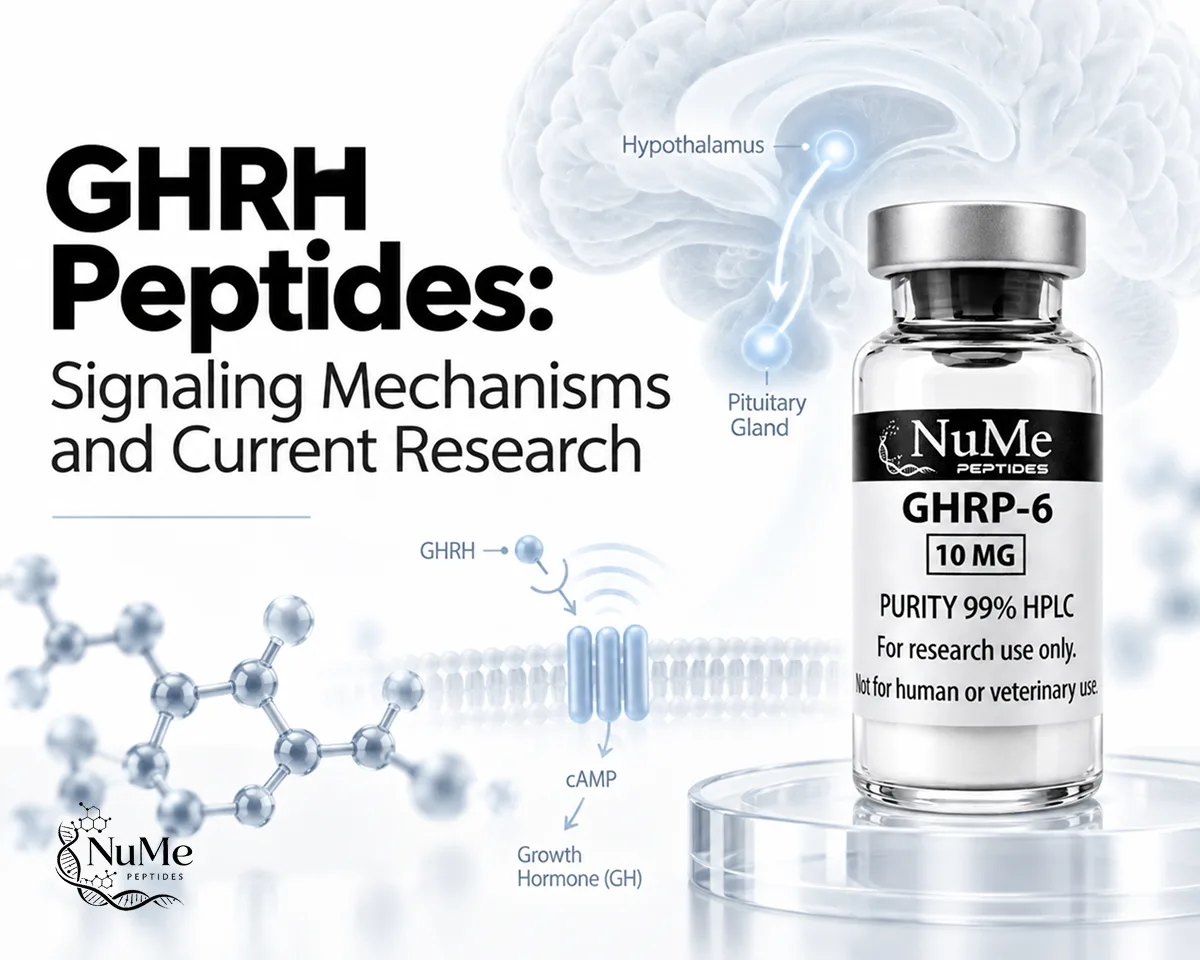
GHRH Peptides: Signaling Mechanisms and Current Research


GHRH Peptide Research examines how growth hormone-releasing hormone and related synthetic peptides interact with the hypothalamic-pituitary axis to regulate growth hormone (GH) synthesis and secretion. Unlike growth hormone-releasing peptides such as GHRP-6 or Ipamorelin, which primarily engage the ghrelin receptor, GHRH-related compounds act mainly through the growth hormone-releasing hormone receptor (GHRH-R) on pituitary somatotroph cells.
This distinction is central to understanding compounds such as Sermorelin, Tesamorelin, and modified GHRH fragments commonly described as CJC-1295 (No DAC). Although these peptides share a relationship with endogenous GHRH, their sequences, stability, pharmacokinetics, and supporting evidence are not identical.
For researchers looking for peptide materials for laboratory investigation, visit the Nume Peptides to explore the available research peptide collection.
What Is Growth Hormone-Releasing Hormone?
Growth hormone-releasing hormone is a hypothalamic peptide that stimulates GH synthesis and secretion from somatotroph cells in the anterior pituitary. The biologically active human hormone contains 44 amino acids, although shorter N-terminal fragments retain substantial GH-releasing activity.
GHRH functions within a regulatory network rather than acting independently. GH secretion is influenced by:
- hypothalamic GHRH;
- inhibitory somatostatin signalling;
- ghrelin and GHS-R1a activity;
- circulating GH;
- insulin-like growth factor 1;
- sleep and circadian rhythms;
- nutritional and metabolic status.
A recent review describes GHRH as an important regulator not only of GH secretion but also of GH synthesis and somatotroph biology. Feedback from GH, IGF-1, and somatostatin helps prevent uncontrolled stimulation of the axis. (Montero-Hidalgo et al., 2025)
Why shorter GHRH fragments matter
Early studies demonstrated that the first 29 amino acids of GHRH retain strong biological activity. In healthy volunteers, GRF(1-29), GRF(1-40), and GRF(1-44) all produced significant increases in circulating GH. (Losa et al., 1984)
This observation became important for the development of shorter analogues such as Sermorelin and modified GHRH peptides.
| GHRH-related signal | General description | Primary research target |
|---|---|---|
| Endogenous GHRH | Hypothalamic peptide | GHRH receptor |
| Sermorelin | GHRH(1-29)-NH2 | GHRH receptor |
| Tesamorelin | Stabilized GHRH analogue | GHRH receptor |
| CJC-1295-related peptides | Modified GHRH analogues | GHRH receptor |
Explore research compounds studied for GH secretion, GHRH signaling, and secretagogue pathways in the Growth Hormone collection.
How Does the GHRH Signaling Pathway Work?
GHRH exerts its main endocrine effects by binding to GHRH-R, a G-protein-coupled receptor expressed on pituitary somatotrophs.
Receptor activation primarily engages Gs proteins and stimulates adenylyl cyclase. This increases intracellular cyclic adenosine monophosphate, or cAMP, which activates protein kinase A and downstream signalling involved in GH production and secretion. (Halmos et al., 2025)
A simplified pathway can be represented as:
- GHRH-related peptide binds GHRH-R.
- Gs protein becomes activated.
- Adenylyl cyclase activity increases.
- Intracellular cAMP rises.
- Protein kinase A becomes activated.
- Calcium-dependent secretory processes are influenced.
- GH synthesis and release increase.
GHRH-R signalling can also interact with MAPK-related pathways involved in cellular growth and differentiation. However, for endocrine GHRH Peptide Research, the cAMP–PKA pathway remains one of the most important mechanisms examined. (Vassilakopoulou et al., 2019)
How this differs from GHRP signalling
GHRH peptides and GHRPs should not be grouped together mechanistically. GHRH analogues primarily stimulate the GHRH receptor, whereas GHRPs such as GHRP-6 and Ipamorelin primarily interact with the ghrelin receptor, GHS-R1a. The two pathways can interact and produce amplified GH responses, but they begin at different receptors.
How Are GHRH-Related Peptides Studied in Research?
Researchers investigate GHRH-related peptides through receptor studies, pituitary cell models, endocrine challenge tests, pharmacokinetic experiments, and controlled human trials.
Endocrine challenge studies
One of the most established approaches is to administer a defined GHRH-related compound and measure GH concentrations over time.
Researchers commonly assess:
- baseline GH concentration;
- maximum GH response;
- time to peak GH;
- GH area under the curve;
- IGF-1 concentrations;
- duration of the endocrine response;
- variability between participants.
Studies using GHRH(1-29)-NH2 demonstrated clear dose-dependent differences in the timing and persistence of GH responses. (Low-Dose GHRH Study, 1994)
Pharmacokinetic studies
Modification of GHRH peptides often aims to change stability or duration of exposure. Researchers therefore examine both pharmacokinetics and pharmacodynamics.
Important measurements may include:
- circulating peptide concentration;
- elimination half-life;
- GH response duration;
- IGF-1 response;
- receptor activity.
This is particularly important when comparing short GHRH fragments with stabilized analogues.
Human clinical research
Some GHRH analogues have progressed much further clinically than others. Tesamorelin, for example, has been evaluated in large randomized controlled trials, while direct published human evidence for products described commercially as CJC-1295 (No DAC) is substantially more limited.
Which GHRH-Related Peptides Are Investigated in Research?
Sermorelin
Sermorelin is the amidated 1-29 fragment of human GHRH. Early human studies demonstrated that GHRH(1-29)-NH2 stimulated GH release with molar potency similar to longer GHRH fragments. (Losa et al., 1984)
Additional research comparing GHRH(1-29)-NH2 with modified analogues confirmed strong GH-releasing activity while showing that amino-acid substitutions could further modify potency. (Growth Hormone Response Study, 1986)
Sermorelin research has therefore focused on:
- pituitary GH reserve;
- GHRH receptor responsiveness;
- pulsatile GH secretion;
- GH deficiency models;
- relationships between GH and IGF-1.
Tesamorelin
Tesamorelin is a stabilized GHRH analogue with considerably more human clinical evidence than most experimental GHRH-related peptides.
Large studies in people with HIV-associated abdominal fat accumulation demonstrated increases in IGF-1 and reductions in visceral adipose tissue during treatment. A pooled phase III analysis included more than 800 participants and demonstrated sustained endocrine and body-composition effects during continued exposure. (Falutz et al., 2010)
More recent meta-analytic evidence continues to support measurable effects on visceral adipose tissue and IGF-1 in the specific populations studied. (Tesamorelin Meta-Analysis, 2026)
These findings should not be generalized automatically to unrelated populations or research objectives.
CJC-1295 (No DAC)
CJC-1295 terminology requires greater caution.
The best-known published human CJC-1295 study examined a long-acting analogue incorporating a Drug Affinity Complex, or DAC. In healthy adults, this DAC-linked compound produced prolonged increases in GH and IGF-1, with an estimated half-life measured in days. (Teichman et al., 2006)
By contrast, the commercial term “CJC-1295 (No DAC)” is commonly used for shorter-acting modified GRF(1-29)-type materials. These should not be assumed to share the pharmacokinetic profile demonstrated for DAC-linked CJC-1295.
Researchers evaluating a No-DAC product should therefore verify:
- exact amino-acid sequence;
- molecular mass;
- whether DAC chemistry is absent;
- HPLC purity;
- mass-spectrometry identity;
- batch-specific documentation.
| Compound | GHRH relationship | Evidence profile |
|---|---|---|
| Sermorelin | GHRH(1-29)-NH2 | Established endocrine research |
| Tesamorelin | Stabilized GHRH analogue | Extensive controlled human research |
| CJC-1295 with DAC | Long-acting GHRH analogue | Published human PK/PD evidence |
| CJC-1295 (No DAC) | Shorter modified GHRH-type peptide | Direct evidence is more limited |
What Does Current Evidence Show About GHRH Peptide Research?
Current evidence confirms that GHRH receptor activation can increase endogenous GH secretion, but different GHRH-related compounds produce different temporal and pharmacological profiles.
Receptor mechanism is well established
Modern receptor research supports the GHRH-R–Gs–cAMP pathway as a central mechanism regulating pituitary GH synthesis and secretion. (Halmos et al., 2025)
Structural modification changes peptide behaviour
The evidence also shows that changing GHRH sequence or chemical structure can alter:
- resistance to enzymatic degradation;
- duration of exposure;
- receptor potency;
- GH response duration;
- IGF-1 responses.
Researchers should therefore avoid treating Sermorelin, Tesamorelin, and CJC-related peptides as interchangeable simply because all target the GHRH system.
Tesamorelin has the strongest clinical evidence
Among the compounds discussed here, Tesamorelin has the most substantial randomized human evidence. Controlled trials have examined hundreds of participants, whereas Sermorelin literature includes older endocrine and growth studies, and published evidence for CJC-1295 No DAC remains much less clearly defined.
Canadian research context
Tesamorelin has a specific Canadian regulatory history. Health Canada granted a Notice of Compliance for Egrifta containing tesamorelin in 2014, although the current Drug Product Database lists the former Egrifta DINs as cancelled. (Health Canada, 2014)
Health Canada has also warned about unauthorized injectable peptide products sold online, including products labelled CJC-1295 and Sermorelin. Importantly, Health Canada states that a “research use only” label does not automatically exempt a product promoted for human use from Canadian regulatory requirements. (Health Canada, 2026)
These regulatory considerations should remain separate from legitimate laboratory investigation.
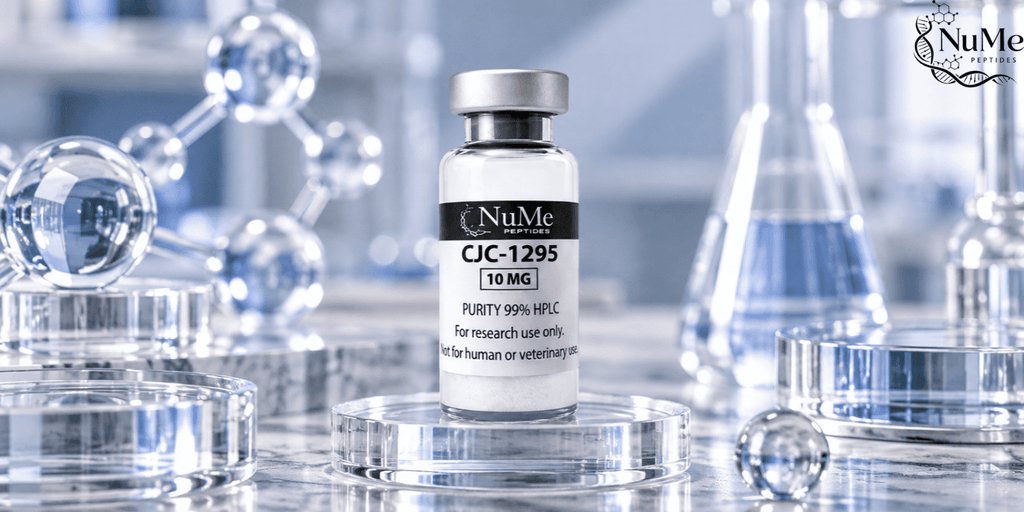
Explore research peptides with ≥99% HPLC-verified purity and batch-specific COA documentation – CJC-1295 (No DAC) (10 mg).
FAQs About GHRH Peptides
Are GHRH Peptides the Same as Growth Hormone?
No. GHRH-related peptides stimulate signalling that can promote endogenous GH release. They are not growth hormone itself.
What Receptor Do GHRH Peptides Target?
Their primary endocrine target is the GHRH receptor on pituitary somatotroph cells.
Is Sermorelin a Full-Length GHRH Peptide?
No. Sermorelin is based on the biologically active GHRH(1-29) sequence rather than the full 44-amino-acid human GHRH molecule.
Is Tesamorelin the Same as Sermorelin?
No. Both are related to GHRH, but Tesamorelin is structurally modified for greater stability and has a different pharmacological and clinical evidence profile.
Is CJC-1295 No DAC the Same as Published CJC-1295 With DAC?
No. Published human studies of long-acting CJC-1295 involved DAC chemistry. Those pharmacokinetic results should not automatically be applied to No-DAC materials.
Does Increased GH Prove a Broader Biological Benefit?
No. Increased circulating GH is an endocrine endpoint. It does not independently establish changes in body composition, recovery, aging, muscle growth, or other clinical outcomes.
Conclusion
GHRH Peptide Research provides a focused way to investigate one of the major stimulatory pathways controlling endogenous GH secretion. GHRH-related peptides act primarily through GHRH-R, leading to cAMP-dependent signalling and increased activity in pituitary somatotrophs.
Sermorelin provides a well-characterized model of the active GHRH(1-29) sequence. Tesamorelin has the strongest controlled human evidence among the compounds discussed, while CJC-1295-related research requires careful differentiation between DAC-linked and No-DAC molecules.
The most accurate research approach therefore evaluates each compound according to its exact molecular identity, receptor pharmacology, stability, pharmacokinetics, GH response, and supporting evidence rather than grouping all GHRH peptides together.
For researchers looking for peptide materials for laboratory investigation, visit the Nume Peptides to explore the available research peptide collection.
Disclaimer: This content is provided for educational and scientific research purposes only. Research peptides are intended for laboratory research only and are not intended for human consumption or medical use.