

Peptides for IGF-1 Research: Growth Hormone Signaling and Current Evidence


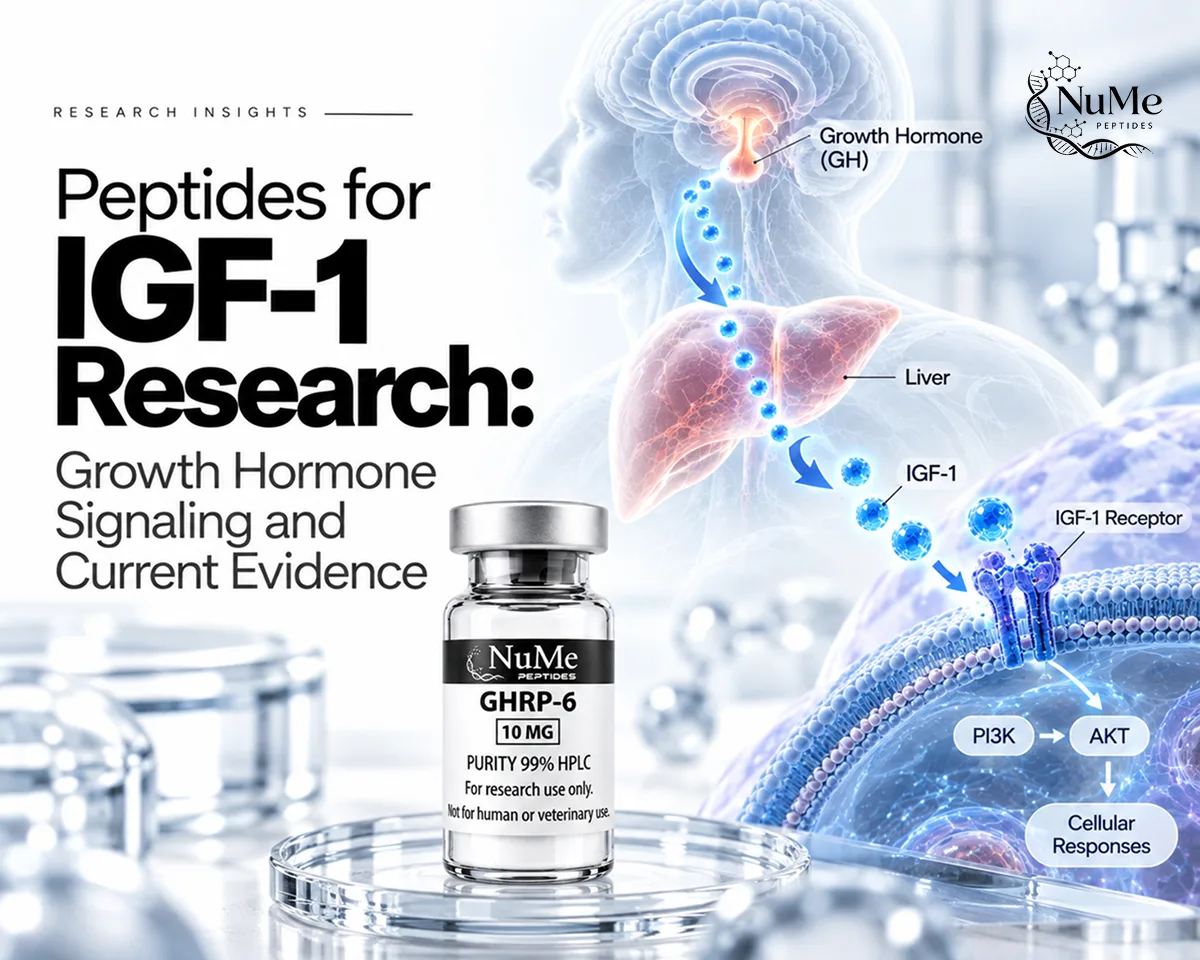
Research into Peptides for IGF-1 Research focuses on how peptide-based compounds may influence the growth hormone–insulin-like growth factor 1 axis, commonly called the GH–IGF-1 axis. This endocrine network connects hypothalamic signalling, pituitary GH secretion, GH receptor activity, hepatic IGF-1 production, peripheral tissue responses, and multiple negative-feedback mechanisms.
Importantly, a peptide that increases GH does not necessarily produce an equivalent increase in IGF-1. IGF-1 production depends on GH receptor sensitivity, nutritional state, insulin signalling, age, liver function, and other physiological variables. Recent reviews therefore describe the GH–IGF-1 axis as a coordinated endocrine system rather than a simple linear pathway. (Bioletto et al., 2025)
CJC-1295-related peptides, Ipamorelin, Sermorelin, and Tesamorelin are all relevant to this field, but they influence upstream GH signalling through different mechanisms and have very different levels of direct IGF-1 evidence.
For researchers looking for peptide materials for laboratory investigation, visit the Nume Peptides to explore the available research peptide collection.
What Is the Relationship Between Growth Hormone and IGF-1?
Growth hormone is produced by somatotroph cells in the anterior pituitary. After entering circulation, GH can act directly on tissues or bind to growth hormone receptors, particularly in the liver, where it stimulates production of IGF-1. IGF-1 then circulates through the bloodstream and also functions through local autocrine and paracrine mechanisms in many tissues. The GH–IGF-1 system contributes to growth, cellular differentiation, protein synthesis, skeletal biology, and metabolic regulation.
A 2026 review describes the GH–IGF-1 axis as a central endocrine system in postnatal growth and tissue homeostasis, with GH receptor activation involving signalling pathways such as JAK2–STAT5, MAPK/ERK, and PI3K–AKT–mTOR. (Tite Haro et al., 2026)
GH and IGF-1 are not interchangeable markers
Although closely linked, GH and IGF-1 behave differently experimentally. GH secretion is pulsatile and may change considerably over short periods, while circulating IGF-1 is generally more stable. Researchers therefore often measure both.
| Marker | Main research significance |
|---|---|
| GH | Indicates pituitary secretory activity |
| Peak GH | Measures acute secretagogue response |
| GH area under the curve | Estimates total GH exposure |
| IGF-1 | Reflects downstream GH-related signalling |
| IGFBP-3 | Provides additional information on the IGF system |
| GH receptor activity | Helps explain tissue sensitivity to GH |
An increase in GH should therefore be considered an upstream endocrine response, while an increase in IGF-1 indicates that downstream components of the axis have also responded.
Explore research compounds studied for GH secretion, GHRH signaling, and secretagogue pathways in the Growth Hormone collection.
How Is the GH–IGF-1 Axis Regulated?
The GH–IGF-1 axis contains multiple stimulatory and inhibitory signals. At the hypothalamic level, growth hormone-releasing hormone stimulates pituitary GH secretion, whereas somatostatin suppresses it. Ghrelin and synthetic growth hormone secretagogues can also stimulate GH through the GHS-R1a receptor.
Once GH enters circulation, it interacts with GH receptors in the liver and other tissues. Hepatic GH signalling is a major driver of circulating IGF-1 production.
Negative feedback maintains endocrine balance
Both GH and IGF-1 participate in feedback mechanisms that regulate further GH secretion. Recent evidence shows that these feedback loops operate at both hypothalamic and pituitary levels. (de Sousa et al., 2025)
Important regulators include:
- GHRH;
- somatostatin;
- ghrelin;
- circulating GH;
- circulating IGF-1;
- insulin;
- nutritional status;
- age and sex;
- sleep and circadian rhythms.
Insulin is particularly relevant to IGF-1 research. Hepatic GH sensitivity depends partly on portal insulin concentrations because insulin influences liver GH receptor expression. This helps explain why GH and IGF-1 concentrations can sometimes become dissociated in obesity, malnutrition, type 1 diabetes, and other metabolic states. (Clemmons, 2025)
This is why Peptides for IGF-1 Research should not be evaluated solely by measuring how much GH a compound releases.
How Are Peptides Studied in GH–IGF-1 Research?
Researchers use several experimental approaches to determine whether a peptide alters the GH–IGF-1 axis.
Acute endocrine challenge studies
These studies measure the immediate GH response after exposure to a peptide. They are particularly useful for determining whether a compound stimulates pituitary secretion.
Researchers may assess:
- baseline GH;
- peak GH concentration;
- time to peak;
- GH area under the curve;
- duration of GH elevation.
Ipamorelin has been examined using this approach. In healthy volunteers, the peptide produced an episodic GH response, with considerable variation in pharmacodynamic responses among participants. (Gobburu et al., 1999)
Longer pharmacodynamic studies
IGF-1 generally requires longer observation than an acute GH peak. Researchers may therefore measure serum IGF-1 over days or weeks to determine whether repeated upstream stimulation produces a sustained downstream response.
Endpoints may include:
- serum IGF-1;
- IGFBP-3;
- integrated GH secretion;
- GH pulse amplitude;
- metabolic markers;
- body-composition endpoints in clinical studies.
A useful distinction is that a peptide may produce a measurable acute GH response without necessarily generating a large or persistent change in IGF-1.
Which Peptides Are Investigated in IGF-1-Related Research?
CJC-1295 (No DAC)
CJC-1295 terminology requires careful interpretation in IGF-1 research. The best-characterized human CJC-1295 study involved the long-acting DAC-linked form rather than a No-DAC peptide. In healthy adults, this long-acting analogue increased mean GH concentrations approximately 2- to 10-fold and mean IGF-1 concentrations approximately 1.5- to 3-fold after experimental administration. IGF-1 remained elevated for several days, reflecting the extended pharmacokinetic profile of the DAC-containing molecule. (Teichman et al., 2006)
Commercially described CJC-1295 (No DAC) generally refers to a shorter-acting modified GHRH(1-29)-type peptide. Results from DAC-linked CJC-1295 therefore should not automatically be assigned to the No-DAC compound. For reproducible research, investigators should verify the exact sequence, molecular mass, and whether DAC chemistry is present.
Ipamorelin
Ipamorelin is a synthetic growth hormone secretagogue that acts through the GHS-R-related pathway rather than directly through GHRH receptors. Human research has clearly demonstrated its ability to stimulate episodic GH release. (Gobburu et al., 1999)
However, the direct human evidence connecting Ipamorelin specifically to sustained IGF-1 elevation is considerably less extensive than the evidence available for Tesamorelin or long-acting CJC-1295 with DAC. This makes Ipamorelin particularly useful for studying the upstream GH-secretion component of the axis.
Sermorelin
Sermorelin corresponds to the amidated GHRH(1-29) fragment and stimulates GH through the GHRH receptor pathway. Human studies of GHRH(1-29)-based compounds have demonstrated increased GH secretion, while some longer-term studies also observed increases in circulating IGF-1.
For example, repeated administration of a GHRH(1-29) analogue in older adults increased integrated GH secretion together with serum IGF-1 and IGFBP-3 during the experimental period. (Corpas et al., 1997)
However, individual studies have produced different IGF-1 responses depending on dosing pattern, age, and study population, illustrating the importance of experimental design.
Tesamorelin
Tesamorelin is a stabilized GHRH analogue with the strongest direct human IGF-1 evidence among the compounds discussed here. In randomized clinical research, Tesamorelin increased IGF-1 while stimulating endogenous GH signalling. A large study involving people with HIV-associated abdominal fat accumulation reported significant increases in IGF-1 alongside changes in visceral adipose tissue. (Falutz et al., 2010)
A 2026 meta-analysis of five randomized trials also found significant increases in IGF-1 associated with Tesamorelin treatment in the populations studied. (Tesamorelin Meta-Analysis, 2026)
| Peptide | Primary upstream pathway | Direct IGF-1 evidence |
|---|---|---|
| CJC-1295 (No DAC) | Modified GHRH pathway | Limited direct No-DAC human evidence |
| Ipamorelin | GHS-R1a-related | Stronger GH than long-term IGF-1 evidence |
| Sermorelin | GHRH receptor | GHRH(1-29) studies show variable IGF-1 responses |
| Tesamorelin | GHRH receptor | Strong human IGF-1 evidence |
What Does Current Evidence Show About Peptides and the GH–IGF-1 Axis?
Current evidence supports the concept that peptide-mediated stimulation of GH can influence downstream IGF-1, but the relationship is not uniform. Three principles are especially important.
Upstream GH response does not guarantee the same IGF-1 response
Ipamorelin demonstrates that researchers can clearly measure GH release after secretagogue exposure. However, longer-term IGF-1 outcomes require separate investigation.
Duration of signalling matters
Long-acting DAC-linked CJC-1295 produced sustained GH and IGF-1 elevation in human research. Shorter-acting peptides may create very different endocrine profiles, even when they target related pathways. (Teichman et al., 2006)
Physiological context modifies the axis
Liver GH sensitivity, insulin exposure, nutrition, age, and feedback signalling can all modify IGF-1 generation. Recent endocrine reviews emphasize that circulating GH and IGF-1 should therefore be interpreted within the broader physiological state rather than in isolation. (Iglesias & Guerrero-Pérez, 2026)
Canadian research context
Health Canada currently identifies CJC-1295 and Ipamorelin among unauthorized synthetic peptide ingredients found in products promoted for human use in Canada. Health Canada also emphasizes that a “research use only” label does not automatically exempt products promoted for human use from regulatory requirements. (Health Canada, 2026)
This regulatory context is separate from legitimate laboratory investigation of the GH–IGF-1 axis.
Explore research compounds studied for GH secretion, GHRH signaling, and secretagogue pathways in the Growth Hormone collection.
FAQs About Peptides for IGF-1 Research
What Is IGF-1?
IGF-1 is a peptide growth factor produced in multiple tissues, with the liver serving as a major source of circulating IGF-1 in response to GH signalling.
Does Higher GH Always Increase IGF-1?
No. GH receptor sensitivity, insulin, nutrition, age, liver function, and feedback mechanisms can influence the IGF-1 response.
Which Peptide Has the Strongest Direct IGF-1 Evidence?
Among the compounds discussed here, Tesamorelin has substantial controlled human evidence demonstrating increases in IGF-1.
Does Ipamorelin Increase IGF-1?
Ipamorelin clearly stimulates GH in human research, but its direct long-term human IGF-1 evidence is less extensive than its GH pharmacodynamic evidence.
Is CJC-1295 No DAC the Same as Long-Acting CJC-1295?
No. Published long-acting CJC-1295 studies involved DAC chemistry. These results should not automatically be applied to No-DAC materials.
Why Measure Both GH and IGF-1?
GH shows pituitary secretory activity, while IGF-1 provides information about downstream activity across the broader GH–IGF-1 axis.
Conclusion
Peptides for IGF-1 Research provide several ways to investigate how upstream growth hormone signalling translates into downstream IGF-1 production.
Ipamorelin primarily provides a model for GHS-R-mediated GH secretion, while Sermorelin and Tesamorelin stimulate the GHRH receptor pathway. Tesamorelin has substantial direct human evidence demonstrating IGF-1 elevation. CJC-1295 research also demonstrates that prolonged GHRH stimulation can substantially influence IGF-1, although DAC-containing and No-DAC compounds must be clearly distinguished.
For accurate interpretation, researchers should evaluate GH secretion, receptor pathway, peptide duration, IGF-1 response, metabolic context, and molecular identity separately.
For researchers looking for peptide materials for laboratory investigation, visit the Nume Peptides to explore the available research peptide collection.
Disclaimer: This content is provided for educational and scientific research purposes only. Research peptides are intended for laboratory research only and are not intended for human consumption or medical use.