

GHRH vs GHRP Research: Comparing Growth Hormone Peptide Pathways in Research


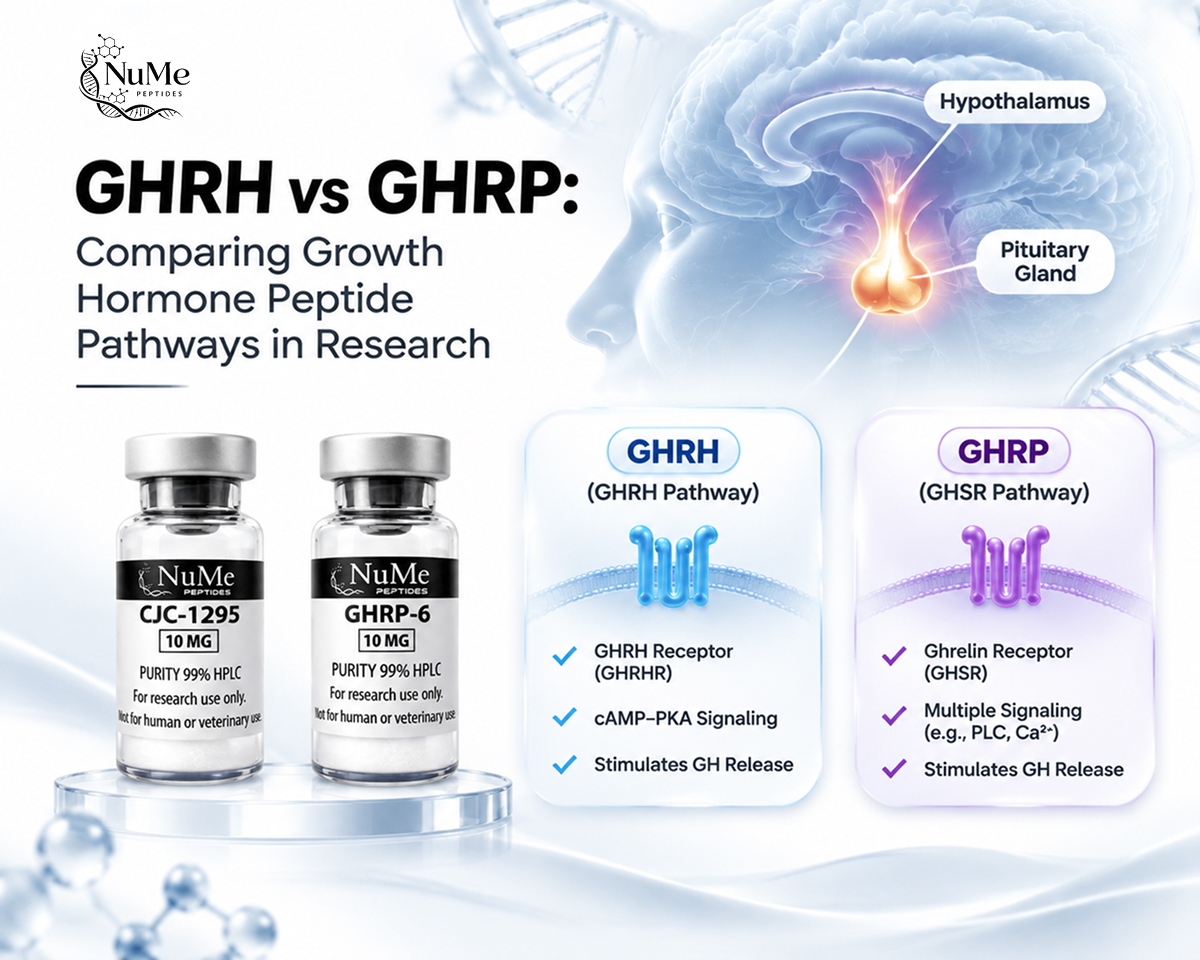
GHRH vs GHRP Research compares two major peptide-based mechanisms used to investigate endogenous growth hormone (GH) secretion. Growth hormone-releasing hormone (GHRH) peptides stimulate the pituitary primarily through the GHRH receptor, while growth hormone-releasing peptides (GHRPs) act mainly through the growth hormone secretagogue receptor, GHS-R1a, now commonly called the ghrelin receptor.
Although both pathways can increase pituitary GH release, they differ in receptor biology, intracellular signalling, interactions with somatostatin, and dependence on endogenous hypothalamic activity. Research also shows that the two pathways can interact strongly, making their comparison useful for understanding how GH secretion is regulated rather than simply how high GH rises after peptide exposure.
For researchers looking for peptide materials for laboratory investigation, visit the Nume Peptides to explore the available research peptide collection.
What Are GHRH and GHRP Peptides?
GHRH is an endogenous hypothalamic hormone that stimulates somatotroph cells in the anterior pituitary. Human GHRH contains 44 amino acids, but its N-terminal region contains much of the biological activity required for pituitary GH release. This finding led to the development of shorter and modified GHRH-related peptides.
Common compounds investigated within the GHRH pathway include:
- Sermorelin, based on GHRH(1-29);
- Tesamorelin, a stabilized GHRH analogue;
- CJC-1295-related peptides, developed from modified GHRH sequences.
GHRPs are structurally different. They were originally developed as synthetic compounds capable of stimulating GH through a pathway distinct from the GHRH receptor. The GHS receptor was cloned in 1996, and ghrelin was identified as its endogenous ligand in 1999. (Howard et al., 1996) (Kojima et al., 1999)
GHRP-6 is one of the classic synthetic peptides in this group, while Ipamorelin was later developed as a more GH-selective secretagogue. (Raun et al., 1998)
| Research group | Examples | Primary receptor pathway |
|---|---|---|
| GHRH-related peptides | Sermorelin, Tesamorelin, CJC-1295-related peptides | GHRH receptor |
| GHRPs / secretagogues | GHRP-6, Ipamorelin | GHS-R1a / ghrelin receptor |
Despite the similar outcome of increased GH secretion, these compounds should not be treated as mechanistically interchangeable.
Explore research compounds studied for GH secretion, GHRH signaling, and secretagogue pathways in the Growth Hormone collection.
How Do GHRH and GHRP Signaling Mechanisms Differ?
The main difference in GHRH vs GHRP Research begins at the receptor level.
GHRH signalling
GHRH-related peptides bind the GHRH receptor on pituitary somatotroph cells. This receptor is primarily coupled to Gs proteins, which activate adenylyl cyclase and increase intracellular cyclic AMP.
The simplified sequence is:
- GHRH-related peptide binds GHRH-R.
- Gs signalling activates adenylyl cyclase.
- Intracellular cAMP increases.
- Protein kinase A pathways become activated.
- Calcium-dependent secretory mechanisms are influenced.
- GH synthesis and release increase.
This pathway directly connects hypothalamic GHRH signalling with pituitary GH secretion.
GHRP signalling
GHRPs such as GHRP-6 and Ipamorelin primarily act through GHS-R1a. This receptor is a G-protein-coupled receptor associated mainly with Gq-related signalling, phospholipase C activation, and intracellular calcium mobilization.
A simplified GHRP pathway includes:
- GHS-R1a activation;
- phospholipase C signalling;
- IP3 and intracellular calcium changes;
- increased somatotroph secretory activity;
- interaction with hypothalamic GHRH and somatostatin systems.
The discovery of ghrelin as the endogenous GHS-R ligand confirmed that this pathway represents a physiological regulatory system distinct from the classical GHRH receptor pathway. (Kojima et al., 1999)
| Feature | GHRH pathway | GHRP pathway |
|---|---|---|
| Main receptor | GHRH-R | GHS-R1a |
| Major G-protein association | Gs | Gq-related |
| Major second messenger | cAMP | PLC/IP3/Ca²⁺ |
| Endogenous signal | GHRH | Ghrelin |
| Main experimental effect | Pituitary GH stimulation | GH secretagogue activity |
How Do Their Receptors and Biological Pathways Compare?
Although GHRH and GHRP signalling begins at different receptors, the two systems converge on pituitary GH secretion. This creates an important interaction between the pathways.
Human research demonstrates that GHRP-6 responses depend substantially on endogenous GHRH. In healthy men, blocking GHRH activity eliminated most of the GH response to GHRP-6, reducing both peak GH and total hormone exposure. (Pandya et al., 1998)
At the same time, earlier human experiments showed that combining GHRH with GHRP-6 produced substantially greater GH responses than either stimulus alone. (Peñalva et al., 1993)
These findings demonstrate an important feature of the GH regulatory network: different receptors can produce interacting endocrine responses.
Role of somatostatin
Somatostatin is also important because it inhibits pituitary GH release. Changes in somatostatin tone can strongly influence the size of a GHRP response. Therefore, a GHRP cannot be evaluated only by measuring receptor binding; its effect occurs within an active hypothalamic-pituitary environment.
Researchers comparing GHRH and GHRP systems often consider:
- endogenous GHRH activity;
- somatostatin tone;
- ghrelin receptor signalling;
- pituitary responsiveness;
- GH pulse timing;
- circulating IGF-1;
- age and metabolic status.
This explains why identical amounts of a secretagogue may produce different GH responses across experimental populations.
Explore research compounds studied for GH secretion, GHRH signaling, and secretagogue pathways in the Growth Hormone collection.
Which GHRH and GHRP Peptides Are Commonly Studied?
Several peptides provide useful research models for comparing the two pathways.
CJC-1295 (No DAC)
CJC-1295-related compounds belong to the GHRH analogue side of the comparison. However, terminology is important because most published human CJC-1295 research involves a long-acting form containing a Drug Affinity Complex, or DAC.
In healthy adults, DAC-linked CJC-1295 produced sustained increases in mean GH and IGF-1, with an estimated half-life of several days. (Teichman et al., 2006)
CJC-1295 (No DAC), however, is commonly used commercially to describe a shorter-acting modified GHRH(1-29)-type peptide. Researchers should not automatically apply the prolonged pharmacokinetic findings from DAC-linked CJC-1295 to a No-DAC material.
Sermorelin
Sermorelin corresponds to GHRH(1-29)-NH2 and represents the biologically active N-terminal region of GHRH.
Research on GHRH(1-29) demonstrates substantial pituitary GH-releasing activity, making Sermorelin-related compounds useful models for studying relatively direct activation of the GHRH receptor pathway.
Compared with GHRPs, Sermorelin research therefore focuses on the classical hypothalamic GHRH–pituitary receptor mechanism rather than ghrelin receptor activation.
Tesamorelin
Tesamorelin is a stabilized GHRH analogue with a comparatively extensive human evidence base. Research has shown that it can increase endogenous GH secretion and circulating IGF-1 while preserving pulsatile characteristics of the GH axis.
Tesamorelin has also been evaluated in controlled human trials involving metabolic and body-composition endpoints, giving it a stronger clinical evidence base than many experimental GH secretagogues.
GHRP-6
GHRP-6 is one of the foundational synthetic GHRPs and has been extensively used to investigate GHS-R-related GH secretion.
Its research history demonstrates two key principles: it can stimulate GH independently of direct GHRH receptor activation, yet full GH responses depend strongly on endogenous GHRH activity. (Pandya et al., 1998)
This makes GHRP-6 particularly useful for studying interaction between the two systems.
Ipamorelin
Ipamorelin is a synthetic pentapeptide growth hormone secretagogue. Early experimental research described it as more selective for GH secretion than several earlier GHRPs, with less ACTH and cortisol stimulation under the experimental conditions tested. (Raun et al., 1998)
Human pharmacokinetic-pharmacodynamic research also demonstrated episodic GH release following Ipamorelin exposure.
| Compound | Research class | Main pathway | Important distinction |
|---|---|---|---|
| CJC-1295 (No DAC) | GHRH analogue | GHRH-R | Must be distinguished from DAC form |
| Sermorelin | GHRH fragment | GHRH-R | Based on GHRH(1-29) |
| Tesamorelin | Stabilized GHRH analogue | GHRH-R | Stronger human evidence base |
| GHRP-6 | GHRP | GHS-R1a | Strong interaction with endogenous GHRH |
| Ipamorelin | GHRP/secretagogue | GHS-R1a | Developed for greater GH selectivity |
Why Are GHRH and GHRP Pathways Compared in Peptide Research?
Researchers compare these pathways because the same final endocrine measurement—higher circulating GH—can arise through different upstream mechanisms.
Receptor-level comparison
GHRH compounds primarily activate GHRH-R, whereas GHRPs activate GHS-R1a. Comparing the pathways helps researchers determine whether a GH response depends more strongly on classical GHRH signalling, ghrelin-receptor signalling, or interaction between both.
Synergistic signalling
The strong GH response observed when GHRH and GHRP-6 were combined demonstrates that simultaneous stimulation of two pathways may produce a greater response than either pathway individually. (Peñalva et al., 1993)
This does not mean every GHRH/GHRP combination will behave identically. Pharmacokinetics, receptor potency, sequence, physiological state, and experimental design remain important.
Pulse patterns and duration
Researchers also compare whether peptides produce:
- a short GH secretory burst;
- increased pulse amplitude;
- changes in basal GH;
- longer overall GH exposure;
- sustained IGF-1 elevation.
For example, Ipamorelin is associated with relatively brief episodic GH release, whereas published DAC-linked CJC-1295 research demonstrates much longer GH and IGF-1 exposure. These are fundamentally different experimental profiles even though both ultimately increase GH.
Downstream outcomes require separate evaluation
A higher GH response does not automatically establish greater IGF-1 production or broader physiological effects. The research sequence is better represented as:
Peptide → Receptor → Pituitary GH secretion → Circulating GH → GH receptor signalling → IGF-1 and tissue responses
Each stage can be measured separately.
Canadian research context
Health Canada has identified unauthorized synthetic peptide products containing compounds such as CJC-1295 and Ipamorelin being promoted for human use in Canada. Health Canada emphasizes that unauthorized products have not been assessed for safety, efficacy, or quality, and that a “research use only” label does not automatically exempt a product promoted for human use from Canadian regulatory requirements. (Health Canada, 2026)
This regulatory context is separate from legitimate laboratory GHRH vs GHRP Research.
Explore research compounds studied for GH secretion, GHRH signaling, and secretagogue pathways in the Growth Hormone collection.
FAQs About GHRH vs GHRP Research
What Is the Main Difference Between GHRH and GHRP Peptides?
GHRH-related peptides primarily stimulate the GHRH receptor, while GHRPs primarily activate GHS-R1a, also called the ghrelin receptor.
Do GHRH and GHRPs Produce the Same GH Response?
Not necessarily. Their receptor targets, intracellular signalling, pharmacokinetics, and interactions with endogenous regulatory hormones differ.
Why Does GHRP-6 Depend on GHRH?
Human research shows that endogenous GHRH contributes substantially to the full GH response produced by GHRP-6, even though the peptide does not primarily act through the GHRH receptor.
Is Ipamorelin a GHRH Peptide?
No. Ipamorelin is a synthetic GH secretagogue associated primarily with the GHS-R1a pathway.
Are Sermorelin and Tesamorelin GHRPs?
No. Both are GHRH-related peptides that primarily act through the GHRH receptor pathway.
Can CJC-1295 With DAC Research Be Applied toCJC-1295 (No DAC)?
Not automatically. DAC dramatically prolongs peptide exposure, so the pharmacokinetic and endocrine findings from DAC-linked CJC-1295 should not be assumed for No-DAC material.
Conclusion
GHRH vs GHRP Research demonstrates that endogenous GH secretion can be stimulated through at least two interacting peptide pathways. GHRH-related compounds such as Sermorelin, Tesamorelin, and CJC-1295-related peptides primarily engage the GHRH receptor, while Ipamorelin and GHRP-6 primarily act through GHS-R1a.
The most important difference is not simply which pathway produces more GH. Researchers instead compare receptor mechanisms, intracellular signalling, hormone pulsatility, duration of exposure, dependence on endogenous GHRH and somatostatin, and downstream IGF-1 responses.
GHRH and GHRP pathways also interact strongly, which makes their comparison particularly useful for understanding the broader hypothalamic-pituitary GH regulatory network.
For researchers looking for peptide materials for laboratory investigation, visit the Nume Peptides to explore the available research peptide collection.
Disclaimer: This content is provided for educational and scientific research purposes only. Research peptides are intended for laboratory research only and are not intended for human consumption or medical use.