

Growth Hormone Pulse Research: Peptide Signaling and Secretion Patterns


Growth Hormone Pulse Research examines how growth hormone (GH) is released in discrete secretory episodes rather than at a constant rate. These pulses vary in amplitude, frequency, duration, and timing, creating a dynamic endocrine pattern influenced by hypothalamic signalling, sleep, age, sex, metabolic state, and feedback from GH and insulin-like growth factor 1 (IGF-1).
Peptides such as Ipamorelin, GHRP-6, CJC-1295-related compounds, and Sermorelin are useful experimental tools because they act at different points within the regulatory network controlling pituitary GH secretion. Importantly, increasing average GH concentration is not necessarily the same as increasing pulse frequency or pulse amplitude. Researchers therefore distinguish among basal secretion, peak concentration, trough GH, integrated hormone exposure, and downstream IGF-1 responses.
For researchers looking for peptide materials for laboratory investigation, visit the Nume Peptides to explore the available research peptide collection.
What Is Pulsatile Growth Hormone Secretion?
Growth hormone is produced by somatotroph cells in the anterior pituitary, but its secretion does not remain stable throughout the day. Instead, periods of relatively low GH concentration are interrupted by distinct secretory bursts. This pulsatile behaviour allows the endocrine system to vary both the amount and timing of GH exposure.
Research into GH pulsatility therefore goes beyond a single serum measurement. A blood sample taken between secretory bursts may show relatively low GH even when total daily secretion is substantial, while a sample collected during a pulse may appear considerably higher.
Common measurements used in Growth Hormone Pulse Research include:
- pulse amplitude, describing the magnitude of an individual GH burst;
- pulse frequency, indicating how often secretory episodes occur;
- trough or basal GH between major pulses;
- pulse duration and timing;
- integrated GH secretion over several hours;
- total area under the GH concentration curve;
- downstream IGF-1 as a broader marker of GH-axis activity.
Frequent blood sampling combined with mathematical deconvolution has shown that observed plasma GH profiles can underestimate the true number of secretory events. Human studies have demonstrated that deconvolution analysis may identify pulses that are difficult to distinguish from conventional concentration curves alone. (Veldhuis et al., 1992)
| GH measurement | Research significance |
|---|---|
| Peak GH | Maximum concentration during a secretory event |
| Pulse amplitude | Strength of an individual burst |
| Pulse frequency | Number of secretory events over time |
| Trough GH | Hormone concentration between pulses |
| Integrated secretion | Overall GH output during the study period |
| IGF-1 | Downstream activity of the broader GH axis |
These distinctions become particularly important when peptides are studied because different compounds may influence different aspects of the secretory pattern.
Explore research compounds studied for GH secretion, GHRH signaling, and secretagogue pathways in the Growth Hormone collection.
What Biological Signals Regulate Growth Hormone Pulses?
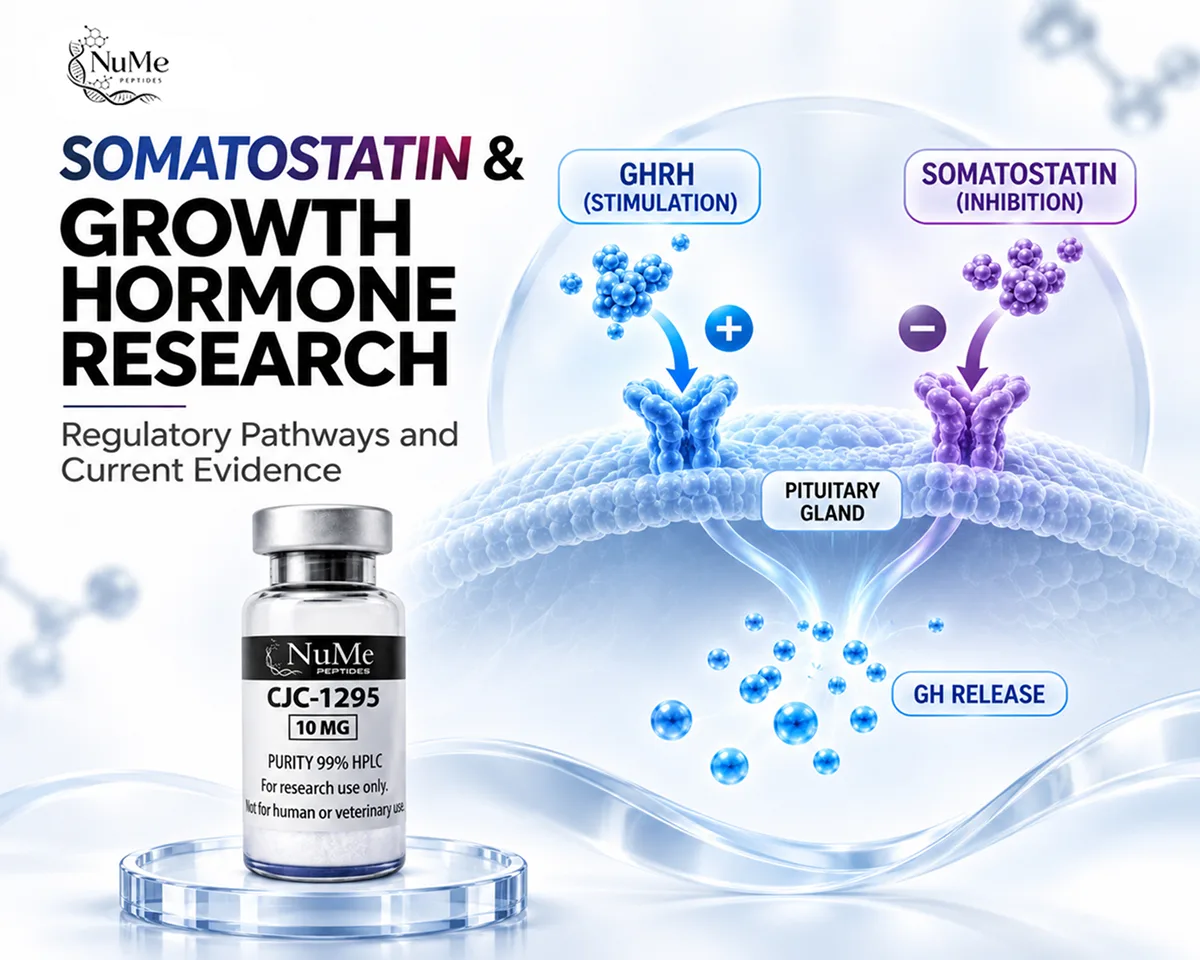
GH pulsatility is generated through interaction among several neuroendocrine systems rather than by one regulatory hormone. Growth hormone-releasing hormone (GHRH) provides an important stimulatory signal, while somatostatin suppresses pituitary GH secretion. Ghrelin and the growth hormone secretagogue receptor, GHS-R1a, contribute an additional stimulatory pathway.
GHRH and pulse amplitude
Human experiments using GHRH antagonists have provided direct evidence that endogenous GHRH contributes strongly to spontaneous GH pulses. Blocking GHRH signalling substantially reduced pulsatile GH secretion and lowered pulse amplitude, showing that endogenous GHRH plays an important role in determining the size of individual secretory bursts. (Jaffe et al., 1993)
Somatostatin and inhibitory control
Somatostatin acts as an inhibitory counterbalance to GHRH. Rather than simply switching GH secretion off, changing somatostatin tone can modify pituitary responsiveness and help determine when a new secretory event occurs. Studies using repeated GHRH stimulation suggest that increased somatostatin activity may contribute to reduced GH responses after repeated stimulation. (Veldhuis et al., 1996)
Sleep and physiological timing
Sleep is another major regulator of GH pulsatility. Detailed sampling studies have shown that GH secretory activity increases during habitual sleep periods, with large nocturnal pulses contributing substantially to daily secretion. (Veldhuis et al., 1992)
Several factors therefore influence the final GH pulse pattern:
- GHRH stimulates pituitary GH release.
- Somatostatin provides inhibitory control.
- Ghrelin and GHS-R1a add an additional stimulatory pathway.
- Sleep and circadian timing modify pulse intensity.
- GH and IGF-1 participate in negative feedback.
- Age, nutritional state, and metabolic conditions influence responsiveness.
This regulatory network helps explain why identical peptide exposure can produce different GH profiles in different experimental settings.
How Are Growth Hormone Pulses Studied in Research?
Investigating GH pulsatility requires more detailed experimental methods than measuring a single hormone concentration. Researchers often combine frequent blood sampling with pharmacokinetic analysis and mathematical modelling.
Frequent blood sampling
Studies commonly collect blood every 10–20 minutes for several hours or overnight. This creates a detailed concentration-time profile that allows individual secretory events to be identified.
In research involving long-acting CJC-1295 with DAC, samples were collected repeatedly across a 12-hour overnight period. Researchers were able to evaluate mean GH, trough GH, pulse amplitude, and pulse frequency separately rather than relying on one pre- and post-exposure measurement. (Ionescu & Frohman, 2006)
Deconvolution analysis
Deconvolution methods attempt to reconstruct the underlying secretory events responsible for the observed plasma concentration profile. These models can help estimate:
- secretory burst mass;
- pulse timing;
- interpulse intervals;
- basal secretion;
- total GH output.
This approach is useful because overlapping pulses or hormone clearance can obscure the original pituitary secretory pattern.
Peptide challenge studies
Peptides may also be administered as controlled endocrine challenges. Researchers then compare GH concentrations before and after exposure to determine how the compound changes secretion.
Ipamorelin provides a useful example. In healthy male volunteers, Ipamorelin produced a distinct episodic GH response, with concentrations rising to a peak before declining again. The same research also demonstrated substantial variability between individuals in the magnitude of the pharmacodynamic response. (Gobburu et al., 1999)
A complete pulse study may therefore assess both the immediate peptide-triggered response and how that response fits within the pre-existing physiological rhythm.
Explore research compounds studied for GH secretion, GHRH signaling, and secretagogue pathways in the Growth Hormone collection.
Which Peptides Are Investigated in Growth Hormone Pulse Research?
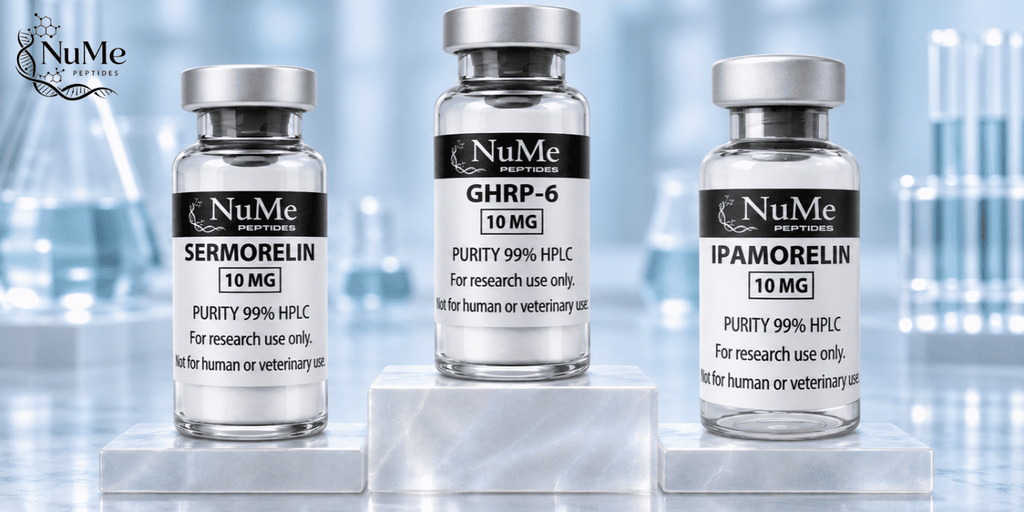
Peptides used in Growth Hormone Pulse Research can broadly be divided into GHS-R-related secretagogues and GHRH-related compounds.
| Peptide | Primary pathway | Pulse-related research relevance |
|---|---|---|
| Ipamorelin | GHS-R1a-related | Episodic GH secretagogue response |
| GHRP-6 | GHS-R1a-related | Interaction with endogenous GHRH |
| CJC-1295 | GHRH receptor | Sustained GHRH stimulation and pulsatility research |
| Sermorelin | GHRH receptor | GHRH(1-29)-based GH stimulation |
Ipamorelin
Ipamorelin is a synthetic pentapeptide growth hormone secretagogue. Human pharmacokinetic-pharmacodynamic studies have shown that it can produce a clearly defined episode of GH release rather than maintaining GH at a continuously elevated concentration.
In healthy volunteers, the GH response occurred shortly after exposure and subsequently declined, while researchers also observed considerable variability in the size of the response between participants. (Gobburu et al., 1999)
This makes Ipamorelin useful for studying how a relatively brief GHS-R-related signal is translated into an acute pituitary GH burst. However, an experimentally induced GH episode should not automatically be interpreted as reproducing the entire physiological overnight pulse pattern.
GHRP-6
GHRP-6 is a synthetic hexapeptide associated with the GHS-R-related pathway. Its research value is particularly important because it demonstrates the interaction between ghrelin-receptor signalling and endogenous GHRH.
In healthy men, administration of a GHRH antagonist markedly reduced the GH response to GHRP-6. Both peak GH and total GH exposure decreased, indicating that maximal GHRP-6 activity depends substantially on endogenous GHRH signalling. (Mallo et al., 1998)
Overnight research has also shown that repeated GHRP-6 exposure can increase nocturnal GH while influencing additional endocrine markers such as ACTH and cortisol. This broader response illustrates why different secretagogues should not be assumed to have identical endocrine selectivity. (Huhn et al., 1995)
CJC-1295 and the No-DAC distinction
CJC-1295 requires careful interpretation because published human pulsatility research largely involves the long-acting DAC-linked form.
Following DAC-linked CJC-1295 exposure, researchers observed increases in mean and trough GH while pulsatile secretion remained detectable. Pulse frequency and pulse magnitude were not substantially disrupted, indicating that prolonged GHRH receptor stimulation did not eliminate the underlying secretory rhythm. (Ionescu & Frohman, 2006)
A separate study showed that long-acting CJC-1295 increased circulating GH for several days and increased IGF-1 for an even longer period. (Teichman et al., 2006)
These findings should not automatically be applied to CJC-1295 (No DAC). No-DAC terminology generally refers to a shorter-acting modified GHRH-type peptide, and direct human pulsatility evidence for this molecular form is much more limited.
For reproducible research, investigators should verify:
- exact amino-acid sequence;
- molecular mass;
- presence or absence of DAC chemistry;
- HPLC purity;
- identity testing;
- batch-specific documentation.
Sermorelin
Sermorelin corresponds to GHRH(1-29)-NH2 and acts through the pituitary GHRH receptor. Human studies have shown that this N-terminal fragment retains substantial GH-releasing activity compared with longer GHRH sequences. (Barron et al., 1985)
Research involving nightly GHRH administration has also demonstrated increases in nocturnal GH output and pulse amplitude without necessarily producing a corresponding increase in pulse frequency. (Corpas et al., 1997)
This pattern supports the idea that GHRH stimulation may influence the size of existing GH pulses more strongly than the number of pulses produced.
What Does Current Evidence Show About Peptides and Growth Hormone Secretion Patterns?
Current evidence indicates that peptide-mediated GH stimulation cannot be characterized accurately using peak GH alone. Different compounds may alter pulse amplitude, basal secretion, integrated exposure, or the duration of endocrine stimulation in different ways.
GHRH strongly influences pulse amplitude
Blocking endogenous GHRH markedly reduces spontaneous pulsatile secretion, while GHRH-based stimulation can increase GH pulse amplitude. Together, these findings support an important role for GHRH in determining the magnitude of secretory bursts. (Jaffe et al., 1993)
GHS-R secretagogues operate within the existing regulatory network
GHRP-6 demonstrates that GHS-R-related compounds do not operate independently of normal hypothalamic regulation. Endogenous GHRH substantially contributes to the final GH response, meaning that receptor activation alone does not fully determine pulse characteristics. (Mallo et al., 1998)
Ipamorelin similarly demonstrates an episodic GH response, but the direct evidence describing its effects on normal overnight pulse frequency and amplitude is less extensive than its acute pharmacodynamic evidence.
Prolonged GHRH stimulation can preserve pulsatility
Long-acting DAC-linked CJC-1295 provides one of the most interesting findings in the field. Despite higher mean and trough GH concentrations, the physiological pulse pattern remained detectable. This suggests that prolonged GHRH stimulation does not completely override other regulatory systems, such as somatostatin and endogenous hypothalamic rhythms. (Ionescu & Frohman, 2006)
A useful framework for interpreting GH pulse studies is:
Peptide signal → Hypothalamic/pituitary interaction → GH pulse pattern → Integrated GH exposure → IGF-1 response
Each stage represents a separate research endpoint, and changes at one level do not guarantee equivalent changes at another.
Canadian research context
Health Canada has identified unauthorized synthetic peptide products containing compounds such as CJC-1295 and Ipamorelin in the Canadian market, while GHRP-6 has also appeared in Canadian enforcement actions involving unauthorized injectable peptide products. Health Canada emphasizes that unauthorized products have not undergone review for therapeutic safety, efficacy, and quality. (Health Canada, 2026)
This regulatory context is separate from legitimate laboratory investigation of GH pulsatility and endocrine signalling.
Explore research compounds studied for GH secretion, GHRH signaling, and secretagogue pathways in the Growth Hormone collection.
FAQs About Growth Hormone Pulse Research
What Is a Growth Hormone Pulse?
A growth hormone pulse is a temporary burst of pituitary GH secretion followed by a decline toward lower concentrations. Multiple secretory episodes occur throughout the day and night rather than GH remaining continuously elevated.
Why Are GH Pulses Important in Research?
Pulse amplitude, frequency, timing, and basal secretion provide more information about pituitary regulation than a single GH measurement. They help researchers distinguish between an acute secretagogue response and a broader change in endogenous GH dynamics.
Does Ipamorelin Produce Pulsatile GH Release?
Human pharmacodynamic studies show that Ipamorelin can generate a distinct episodic GH response. However, this does not prove that it reproduces the full physiological pattern of spontaneous overnight GH pulses.
How Does GHRP-6 Affect GH Secretion?
GHRP-6 stimulates GH release through GHS-R-related signalling, but human research indicates that maximal responses depend substantially on endogenous GHRH activity.
Does CJC-1295 Eliminate Natural GH Pulses?
Published human research using DAC-linked CJC-1295 found that pulsatile secretion remained present despite increased mean and trough GH. These findings should not automatically be applied to CJC-1295 No DAC.
Does Sermorelin Increase GH Pulse Frequency?
GHRH(1-29)-related research has demonstrated increases in nocturnal GH output and pulse amplitude in some experimental settings without necessarily increasing pulse frequency.
Conclusion
Growth Hormone Pulse Research demonstrates that GH secretion is defined by more than a single hormone concentration. Pulse amplitude, frequency, trough secretion, total exposure, sleep-related timing, and downstream IGF-1 responses all contribute to the overall endocrine pattern.
Ipamorelin provides a model of episodic GHS-R-related GH release, while GHRP-6 demonstrates the interaction between GHS-R signalling and endogenous GHRH. Sermorelin-related research shows how GHRH stimulation can influence pulse amplitude, while DAC-linked CJC-1295 demonstrates that prolonged GHRH stimulation can raise mean GH without eliminating pulsatility.
The most accurate experimental approach therefore evaluates both how much GH is secreted and the pattern in which that secretion occurs.
For researchers looking for peptide materials for laboratory investigation, visit the Nume Peptides to explore the available research peptide collection.
Disclaimer: This content is provided for educational and scientific research purposes only. Research peptides are intended for laboratory research only and are not intended for human consumption or medical use.