

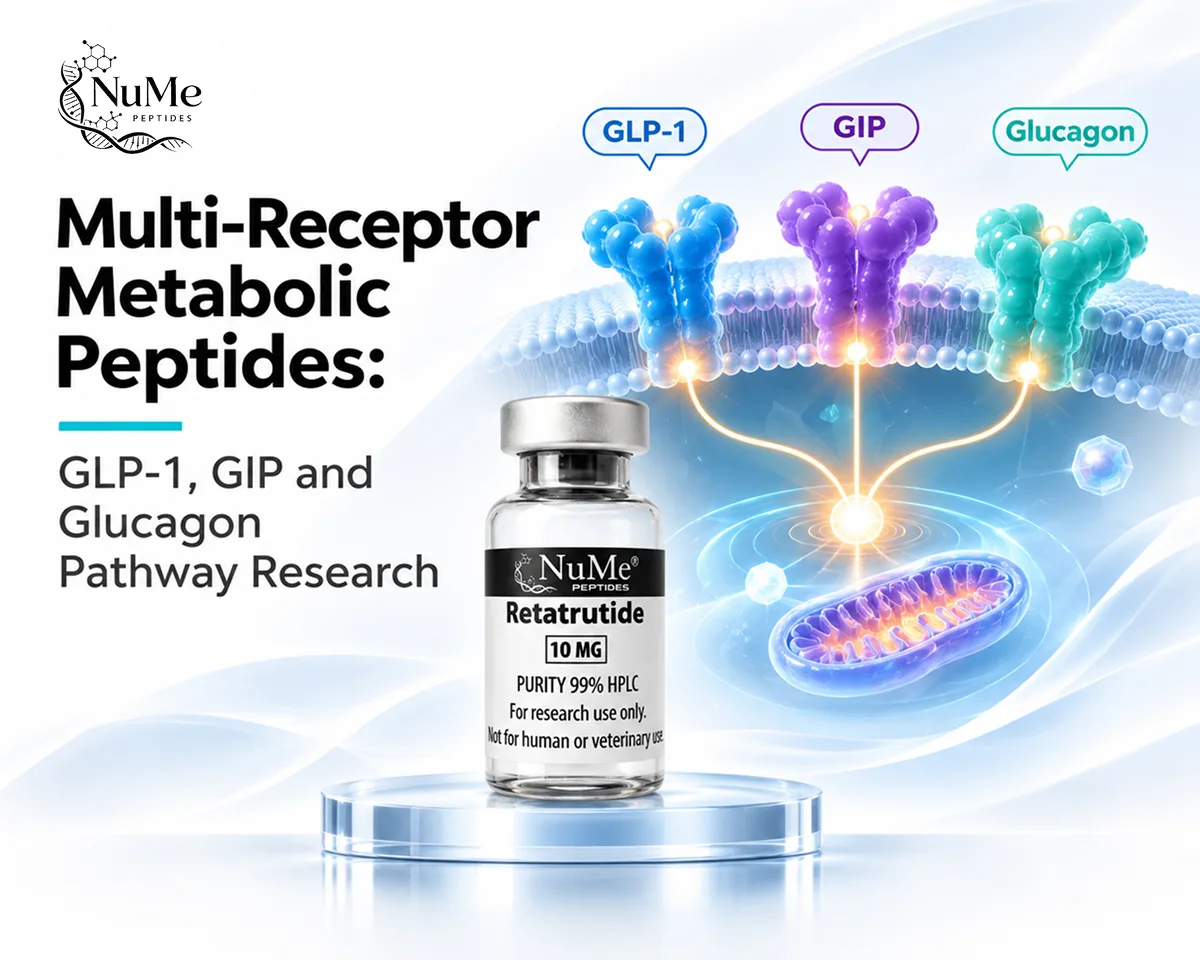
Multi-Receptor Metabolic Peptides: GLP-1, GIP and Glucagon Pathway Research


Multi-Receptor Metabolic Peptide Research examines what happens when a single molecular construct activates more than one metabolic hormone receptor. Rather than studying GLP-1, GIP, or glucagon pathways independently, this approach investigates how coordinated receptor activity changes endocrine signaling, nutrient handling, energy balance, and downstream metabolic responses.
Tirzepatide provides a dual-receptor model through combined GIP and GLP-1 receptor agonism. Retatrutide extends this concept by activating GIP, GLP-1, and glucagon receptors within one peptide. Semaglutide, a selective GLP-1 receptor agonist, provides a useful single-pathway reference for understanding what additional receptor engagement may contribute.
This distinction is important because multi-receptor peptides are not simply “stronger” versions of single-receptor compounds. Their biological effects depend on receptor potency, signaling bias, tissue distribution, pharmacokinetics, and the balance among pathways.
For researchers looking for peptide materials for laboratory investigation, visit the Nume Peptides to explore the available research peptide collection.
What Is Multi-Receptor Agonism in Metabolic Research?
Multi-receptor agonism refers to the ability of one molecule to activate two or more receptor systems. In metabolic peptide research, this approach is often described as unimolecular polypharmacology because several pharmacological activities are built into a single molecular structure.
A single GLP-1 receptor agonist such as Semaglutide primarily provides one receptor input. Tirzepatide combines two receptor pathways, while Retatrutide integrates three.
| Compound | Receptor profile | Research model |
|---|---|---|
| Semaglutide | GLP-1R | Single-receptor reference |
| Tirzepatide | GIPR + GLP-1R | Dual-receptor agonism |
| Retatrutide | GIPR + GLP-1R + GCGR | Triple-receptor agonism |
The objective is not necessarily to activate every receptor equally. In fact, receptor imbalance may be an intentional feature of a compound. Tirzepatide has greater functional engagement of GIPR than GLP-1R and displays biased GLP-1 receptor signaling favoring cAMP generation over β-arrestin recruitment and receptor internalization. This pharmacological profile differs from simply combining native GIP and GLP-1. (Willard et al., 2020)
Retatrutide also has an unequal receptor profile. In human receptor cAMP assays, its activity relative to each corresponding native ligand was substantially greater at GIPR, while its GLP-1R and glucagon receptor potency was lower than the respective endogenous hormones. These values are within-receptor comparisons and should not be interpreted as direct receptor-occupancy ratios in tissues. (Li et al., 2024)
Multi-receptor research therefore focuses on pathway balance rather than simply counting how many receptors a molecule can activate.
Explore laboratory research into dual GLP-1/GIP receptor signaling, incretin pathways, and metabolic regulation with Tirzepatide (10 mg).

How Do GLP-1, GIP and Glucagon Receptor Pathways Differ?
GLP-1R, GIPR, and GCGR belong to the class B G-protein-coupled receptor family, but their physiological roles are not identical.
GLP-1 receptor signaling
GLP-1R activation is associated with glucose-dependent insulin secretion, modulation of glucagon release, gastrointestinal motility, and central signals related to nutrient intake.
Semaglutide is useful as a reference because its primary pharmacological target is GLP-1R. Comparing Semaglutide with dual or triple agonists allows researchers to examine whether additional receptor engagement produces biological responses that cannot be explained by GLP-1 activation alone.
GIP receptor signaling
GIPR is strongly involved in nutrient-responsive insulin secretion. GIP signaling is also investigated in adipose tissue, lipid handling, and broader nutrient partitioning.
The contribution of GIPR becomes especially important when studying Tirzepatide because its receptor profile is weighted toward GIPR rather than being a perfectly balanced GIPR–GLP-1R agonist. (Willard et al., 2020)
Glucagon receptor signaling
GCGR adds a fundamentally different metabolic signal. Glucagon receptor activation promotes hepatic glucose production but is also associated with lipid metabolism, amino-acid metabolism, and energy expenditure.
This creates an apparent biological tension: glucagon can raise hepatic glucose output, while GLP-1 and GIP pathways support glucose-dependent insulin responses. Triple-agonist research investigates whether these pathways can be balanced so that glucagon-associated energetic effects are retained without losing overall metabolic control.
| Receptor | Major research functions | Role in multi-agonist design |
|---|---|---|
| GLP-1R | Insulin signaling, glucagon modulation, gastric and neural pathways | Foundation for incretin-based signaling |
| GIPR | Insulin response and nutrient partitioning | Adds complementary incretin activity |
| GCGR | Hepatic metabolism and energy expenditure | Adds a distinct metabolic pathway |
The scientific question is therefore not whether one pathway is “better,” but how combined receptor activation changes the integrated metabolic response.
Why Are Multiple Metabolic Receptors Studied Together?
Metabolic regulation is inherently distributed across multiple organs and hormone systems. Pancreatic islets, liver, gastrointestinal tissues, adipose tissue, skeletal muscle, and the central nervous system all contribute to whole-body energy regulation. A single receptor pathway cannot fully reproduce this network.
Combining complementary biological signals
GLP-1 and GIP both influence glucose-dependent insulin secretion, but they do so through distinct receptor systems. Adding GIPR signaling to GLP-1R activation creates an opportunity to study whether the two pathways produce complementary or synergistic responses.
Tirzepatide provides direct evidence that this combination behaves differently from selective GLP-1R activation. In SURPASS-2, Tirzepatide was compared directly with Semaglutide in 1,879 participants with type 2 diabetes. Tirzepatide produced greater reductions in HbA1c and body weight at the studied doses, demonstrating that the dual-receptor profile can produce a clinically distinct integrated response. (Frías et al., 2021)
This does not prove that GIPR activation alone explains the difference. Pharmacokinetics, receptor potency, signaling bias, dose, and other molecular properties also contribute.
Adding a pathway with an opposing metabolic component
Triple agonism introduces an additional challenge because glucagon signaling can stimulate hepatic glucose output. Researchers therefore investigate whether incretin activity can counterbalance this effect while preserving glucagon-related changes in energy expenditure and substrate metabolism.
Preclinical studies underlying Retatrutide development found that adding glucagon receptor activity to GIPR and GLP-1R signaling increased energy expenditure in animal models. This provides part of the mechanistic rationale for triple agonism. Structural studies have since shown how Retatrutide can physically engage all three receptor systems. (Li et al., 2024)
Thus, multi-receptor agonism is best understood as pathway engineering rather than receptor accumulation.
Explore laboratory research into GLP-1 receptor signaling, incretin pathways, and metabolic regulation with Semaglutide (10 mg).

Which Compounds Are Investigated in Multi-Receptor Metabolic Research?
Tirzepatide
Tirzepatide is a lipidated peptide agonist targeting both GIPR and GLP-1R. Its importance in Multi-Receptor Metabolic Peptide Research comes from demonstrating that a single molecule can integrate two incretin pathways while maintaining a distinctive pharmacological profile.
Research shows that Tirzepatide acts similarly to native GIP at GIPR but behaves differently from native GLP-1 at GLP-1R. At GLP-1R, it preferentially promotes cAMP signaling while showing comparatively weak β-arrestin recruitment and receptor internalization. (Willard et al., 2020)
This means its biological behavior cannot be predicted solely from the labels “GIP agonist” and “GLP-1 agonist.”
Retatrutide
Retatrutide, also known as LY3437943, is a lipidated 39-amino-acid peptide designed to activate GIPR, GLP-1R, and GCGR. Cryo-electron microscopy studies have characterized Retatrutide bound to each of the three receptors, demonstrating that the same peptide can be recognized through different molecular interactions across GLP-1R, GIPR, and GCGR. (Li et al., 2024)
Importantly, Retatrutide is not equipotent across all three pathways. Its GIPR component is relatively strong, while GLP-1R and GCGR activities are lower relative to their corresponding endogenous ligands. The resulting biological response therefore reflects an intentionally asymmetric receptor profile.
Semaglutide as a single-pathway reference
Semaglutide is not a multi-receptor agonist. Its value in this research framework is as a comparator representing selective GLP-1 receptor activation.
Using Semaglutide as a reference helps researchers ask several questions:
- Does adding GIPR activity alter the response compared with GLP-1R alone?
- Does adding GCGR produce effects beyond dual incretin signaling?
- Are differences caused by receptor number or by receptor balance?
- How much of the observed response remains attributable to GLP-1R?
This comparator approach is more scientifically useful than simply ranking Semaglutide, Tirzepatide, and Retatrutide as single, dual, and triple “strength levels.”
What Does Current Evidence Show About Multi-Receptor Signaling?
Current evidence supports multi-receptor agonism as a distinct pharmacological strategy, but the evidence varies by compound.
Dual agonism has established human evidence
Tirzepatide has extensive clinical evidence demonstrating that dual GIPR–GLP-1R signaling can produce metabolic outcomes distinct from selective GLP-1R agonism. The direct SURPASS-2 comparison is particularly informative because it compared Tirzepatide with Semaglutide rather than placebo alone. At 40 weeks, all tested Tirzepatide doses were superior to Semaglutide 1 mg for change in HbA1c, while body-weight reductions were also greater. (Frías et al., 2021)
However, this should not be interpreted as proof that activating two receptors will always outperform one receptor. Comparisons are compound-, dose-, population-, and endpoint-specific.
Triple agonism now has phase 3 evidence
Retatrutide progressed from preclinical and phase 2 research into peer-reviewed phase 3 trials during 2026. The TRIUMPH-1 phase 3 trial evaluated Retatrutide for 80 weeks in adults with obesity without diabetes and confirmed substantial effects on body weight while also evaluating knee osteoarthritis and obstructive sleep apnea subgroups. (Jastreboff et al., 2026)
A separate 2026 phase 3 study, TRIUMPH-2, evaluated Retatrutide in adults with obesity and type 2 diabetes, further extending the human evidence base for triple-receptor signaling. (Bellido et al., 2026)
These trials establish clinical effects of the molecule but do not isolate the precise contribution of each receptor. Determining how much comes from GIPR, GLP-1R, or GCGR remains a mechanistic research question.
Receptor count is not the key variable
The most important lesson from current research is that receptor number alone is an incomplete descriptor.
Researchers must consider:
- potency at each receptor;
- signaling efficacy;
- signaling bias;
- receptor internalization;
- peptide exposure and half-life;
- tissue-specific receptor expression;
- downstream pathway interactions.
A triple agonist can therefore have weaker activity at one receptor than a dual agonist while still producing a different integrated metabolic phenotype.
Canadian research and regulatory context
In Canada, Health Canada states that authorized Semaglutide products and Tirzepatide products are prescription drugs approved for specific indications. Unauthorized versions sold outside approved channels remain distinct from those authorized medicines.
Retatrutide remains identified by Health Canada among unauthorized synthetic peptide ingredients promoted for human use. Health Canada also reported Retatrutide among unauthorized injectable peptide products involved in enforcement and contamination advisories in November 2026. (Health Canada, 2026)
Health Canada further states that a “Research Use Only” label does not itself authorize a product for human use or exempt it from Canadian regulatory requirements. Laboratory research and approved human drug use must therefore remain clearly separated. (Health Canada, 2026)
Explore research compounds for metabolic signaling, energy regulation, and longevity pathways in the Metabolic & Longevity collection.

FAQs About Multi-Receptor Metabolic Peptides
What Is a Multi-Receptor Metabolic Peptide?
It is a peptide designed to activate more than one metabolic receptor. Tirzepatide targets GIPR and GLP-1R, while Retatrutide targets GIPR, GLP-1R, and GCGR.
Is Tirzepatide a Balanced Dual Agonist?
No. Research indicates that Tirzepatide has greater GIPR engagement and a distinctive biased signaling profile at GLP-1R.
Why Is Semaglutide Included in Multi-Receptor Research?
Semaglutide provides a selective GLP-1R reference, allowing researchers to compare single-receptor signaling with dual and triple agonism.
What Makes Retatrutide Different From Tirzepatide?
Retatrutide adds glucagon receptor activity to GIPR and GLP-1R agonism, creating a triple-receptor signaling system.
Does Triple Agonism Mean Three Receptors Are Activated Equally?
No. Retatrutide has different potency at each receptor. Receptor balance is a fundamental part of its pharmacology.
Is Retatrutide Authorized in Canada?
Health Canada currently identifies Retatrutide among unauthorized synthetic peptide ingredients marketed for human use in Canada. Its clinical research evidence should not be confused with Canadian authorization for sale.
Conclusion
Multi-Receptor Metabolic Peptide Research is shifting metabolic pharmacology from individual receptor activation toward deliberate pathway integration. Tirzepatide demonstrates how GIPR and GLP-1R signaling can be incorporated into one dual agonist, while Retatrutide adds glucagon receptor activity to create a more complex triple-receptor system.
Semaglutide remains valuable as a single-pathway comparator because it helps distinguish the contribution of additional receptor systems from the established effects of GLP-1R activation.
Current evidence shows that the most meaningful question is not whether a compound targets one, two, or three receptors. Instead, researchers must examine receptor potency, signaling bias, pathway balance, pharmacokinetics, and tissue-specific responses together.
For researchers looking for peptide materials for laboratory investigation, visit the Nume Peptides to explore the available research peptide collection.
Disclaimer: This content is provided for educational and scientific research purposes only. Research peptides are intended for laboratory research only and are not intended for human consumption or medical use.