
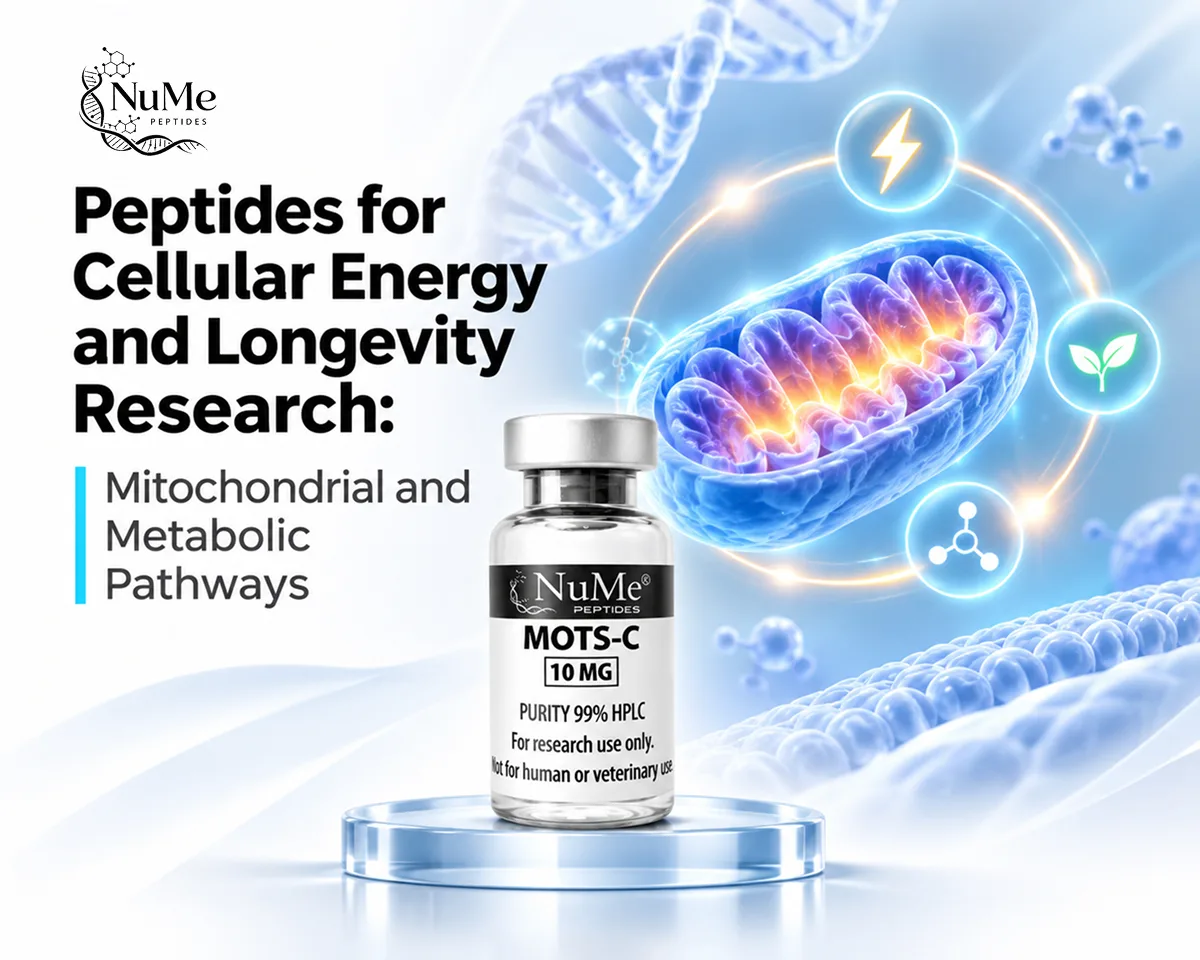
Peptides for Cellular Energy and Longevity Research: Mitochondrial and Metabolic Pathways


Peptides for Cellular Energy and Longevity Research are investigated to understand how cellular bioenergetics, mitochondrial quality control, metabolic stress responses, and aging-related pathways interact. Energy production and longevity are closely connected because cells must continuously generate ATP while maintaining mitochondrial membranes, controlling redox balance, repairing damaged components, and adapting to changing nutrient availability.
MOTS-C, SS-31, NAD+, and Epithalon represent different experimental entry points into this network. MOTS-C is a mitochondria-derived signaling peptide linked with metabolic stress adaptation; SS-31 is a synthetic mitochondria-targeting tetrapeptide investigated for mitochondrial membrane function; NAD+ is a metabolic coenzyme involved in redox reactions and stress-responsive enzymes; and Epithalon is studied mainly in relation to telomerase and telomere biology.
For researchers looking for peptide materials for laboratory investigation, visit the Nume Peptides to explore the available research peptide collection.
How Are Cellular Energy and Longevity Connected?
Aging is associated with changes across multiple biological systems, including genomic stability, proteostasis, nutrient sensing, autophagy, mitochondrial function, cellular senescence, and inflammatory signaling. Mitochondrial dysfunction is included among the recognized hallmarks of aging but does not operate independently from the others. (López-Otín et al., 2023)
Cells require energy not only for contraction, transport, and biosynthesis but also for maintenance. DNA repair, protein turnover, autophagy, membrane transport, and organelle quality control all require metabolic resources.
A useful way to understand the energy–longevity relationship is through three functions:
| Cellular function | Energy-related role | Aging-related significance |
|---|---|---|
| Maintenance | Supports repair and quality control | Limits accumulation of damaged components |
| Adaptation | Adjusts fuel use during stress | Helps cells respond to changing demands |
| Recovery | Restores function after metabolic challenge | Preserves physiological reserve |
A 2026 review proposed the concept of mitochondrial “homeodynamics,” emphasizing maintenance, adaptation, and recovery rather than simply measuring mitochondrial abundance or ATP at one time point. It also noted that no mitochondrial intervention has yet been shown to slow aging or extend lifespan in healthy humans. (Chmielewski, 2026)
This distinction is central to Peptides for Cellular Energy and Longevity Research. A compound may improve one mitochondrial marker without demonstrating broader effects on organismal aging.
Explore laboratory research into mitochondrial function, cardiolipin binding, and electron transport chain efficiency with SS-31 (10 mg).

Which Mitochondrial Pathways Are Associated With Cellular Aging?
Several mitochondrial processes connect cellular energy production with age-related functional decline.
Oxidative phosphorylation and energetic reserve
Mitochondria generate ATP through oxidative phosphorylation. NADH and FADH2 donate electrons to the electron transport chain, creating a proton gradient that drives ATP synthase.
Researchers commonly examine:
- basal and maximal respiration;
- ATP-production capacity;
- respiratory reserve;
- coupling efficiency;
- mitochondrial recovery after stress.
SS-31 research is relevant to this area. In aged mice, SS-31 improved maximum mitochondrial ATP production and oxidative phosphorylation coupling while reducing mitochondrial hydrogen peroxide emission. (Campbell et al., 2019)
These results show changes in mitochondrial function in an animal model, not evidence of human lifespan extension.
Mitochondrial quality control and mitophagy
Cells continuously identify, repair, remodel, or remove dysfunctional mitochondria. Mitophagy selectively eliminates damaged mitochondria before they accumulate and interfere with metabolism.
This process interacts with:
- mitochondrial fission and fusion;
- proteostasis;
- mitochondrial biogenesis;
- autophagy;
- metabolic stress responses.
Reviews of aging biology emphasize that both excessive and insufficient mitochondrial quality control may be harmful, making balance more important than simply increasing turnover. (Zimmermann et al., 2024)
Mitonuclear stress signaling
Mitochondria also communicate with the nucleus. MOTS-C provides an experimental example of this process. Under metabolic stress, MOTS-C can translocate to the nucleus and influence stress-responsive gene expression through an AMPK-dependent mechanism. The same research identified interactions with transcriptional programs containing antioxidant response elements. (Kim et al., 2018)
This makes MOTS-C relevant to energy–longevity research because it connects mitochondrial status with broader cellular adaptation.
NAD+ and cellular redox state
NAD+ and NADH transfer electrons during metabolic reactions and are fundamental to mitochondrial energy metabolism. NAD+ also serves as a substrate for enzymes involved in DNA repair, stress signaling, autophagy, and other aging-related processes.
NAD+ availability can decline with age in some tissues and experimental models. However, NAD+ biology should be distinguished from claims about NAD+ supplementation. (Lautrup et al., 2024)
How Are Peptides Studied Across Energy and Longevity Research?
Research at the intersection of cellular energy and longevity requires multiple endpoints. A compound that alters ATP production may not alter cellular senescence, while a change in telomere length does not automatically indicate improved mitochondrial health.
Researchers commonly measure:
- ATP production and ATP/ADP balance;
- oxygen consumption and respiratory reserve;
- mitochondrial membrane potential;
- NAD+/NADH balance;
- mitochondrial ROS;
- mitophagy and autophagy markers;
- stress-response gene expression;
- telomerase activity and telomere length;
- cellular senescence markers;
- tissue or whole-organism functional capacity.
MOTS-C illustrates why a multi-level approach matters. In mice, the peptide affected nuclear genes related to metabolism and proteostasis, altered skeletal-muscle metabolism, and improved physical capacity in older animals. (Reynolds et al., 2021)
A useful experimental hierarchy is:
Molecular target → Mitochondrial response → Cellular adaptation → Tissue function → Healthspan outcome → Lifespan outcome
Evidence becomes progressively more difficult to establish as researchers move from molecular biology toward organism-level longevity.
Explore laboratory research into telomerase activity, melatonin-related pathways, and cellular longevity with Epithalon Nasal Spray.

Which Peptides and Compounds Are Investigated in Cellular Energy and Longevity Research?
The four compounds occupy different positions within the energy–aging network.
| Compound | Molecular class | Primary research connection | Evidence emphasis |
|---|---|---|---|
| MOTS-C | Mitochondria-derived peptide | Metabolic stress and mitonuclear signaling | Mainly preclinical |
| SS-31 | Synthetic tetrapeptide | Mitochondrial membrane and energetic resilience | Preclinical + human research |
| NAD+ | Endogenous coenzyme | Redox metabolism and NAD-dependent signaling | Extensive biology; intervention evidence mixed |
| Epithalon | Synthetic tetrapeptide | Telomerase and telomere regulation | Mainly cell-based evidence |
MOTS-C: linking energy stress with adaptation
MOTS-C is a 16-amino-acid peptide encoded within the mitochondrial genome. Its relevance comes from its ability to connect metabolic status with stress-responsive cellular signaling.
Rather than directly increasing ATP, MOTS-C research centers on AMPK-dependent signaling, mitonuclear communication, metabolism, and cellular adaptation to energetic stress. Research in aging mice has also connected MOTS-C with muscle homeostasis and physical capacity. (Reynolds et al., 2021)
SS-31: supporting mitochondrial energetic resilience
SS-31, also called elamipretide, is a mitochondria-targeting tetrapeptide associated with the inner mitochondrial membrane and cardiolipin.
In aged mouse skeletal muscle, SS-31 has been investigated for effects on:
- ATP-production capacity;
- oxidative phosphorylation coupling;
- mitochondrial redox balance;
- functional endurance.
These findings support its use as a research model for mitochondrial resilience rather than as evidence of lifespan extension. (Campbell et al., 2019)
NAD+: connecting metabolism with cellular maintenance
NAD+ is not a peptide. It is an endogenous coenzyme that connects energy metabolism with multiple cellular maintenance processes. In addition to redox reactions, NAD+ is consumed by enzymes such as sirtuins and PARPs, linking metabolic state to protein regulation, DNA repair, stress responses, and mitochondrial biology.
A 2026 systematic review covering 33 human intervention studies found that NR and NMN generally increased NAD-related biomarkers, but effects on metabolic, vascular, functional, and other healthspan outcomes were inconsistent or endpoint-specific. No qualifying clinical outcomes trials established injected NAD+ itself as an anti-aging intervention. (Gallagher & Emmanuel, 2026)
Epithalon: a different longevity pathway
Epithalon, commonly written as Epitalon in published research, differs from the other three compounds because its main experimental connection is telomere biology rather than mitochondrial energetics. An early human fibroblast study reported increased telomerase activity and telomere elongation following Epithalon exposure. (Khavinson et al., 2003)
More recent cell research published in 2025 also reported telomere-length changes associated with hTERT and telomerase activity in normal cells while examining alternative lengthening mechanisms in cancer cell lines. (Al-Dulaimi et al., 2025)
These studies support further telomere-focused investigation but do not demonstrate prolonged human lifespan.
What Are the Current Evidence Gaps in Energy and Longevity Research?
The major challenge is determining whether molecular changes translate into meaningful and durable biological outcomes.
Biomarker improvement is not rejuvenation
Higher ATP production, increased NAD+ metabolites, improved telomerase activity, or lower oxidative stress can all be useful findings. None individually proves slower aging.
Recent mitochondrial-aging literature specifically warns against interpreting a biomarker moving toward a younger reference range as evidence of rejuvenation. (Chmielewski, 2026)
Preclinical translation remains limited
MOTS-C and many SS-31 aging observations come from cellular or animal models. These models are valuable for mechanistic research, but their results do not automatically translate into human healthspan or lifespan.
NAD+ intervention evidence is heterogeneous
NAD+ metabolism is fundamental biology, but increasing NAD-related biomarkers does not guarantee downstream improvement. Human studies report variable results depending on population, intervention, duration, tissue, and endpoint. (Gallagher & Emmanuel, 2026)
Telomere length is only one aging dimension
Telomere biology is relevant to cellular replication, but longevity depends on many interacting systems. Telomerase activation also requires careful interpretation because telomere-maintenance mechanisms are relevant to proliferative biology, including cancer-cell biology.
Human longevity evidence is absent
Current evidence does not establish that MOTS-C, SS-31, NAD+-based interventions, or Epithalon extend lifespan in healthy humans. Their research value lies in investigating pathways associated with metabolic resilience, mitochondrial maintenance, and cellular aging.
Canadian regulatory context
Health Canada identifies MOTS-C, SS-31, and Epitalon among synthetic peptides found in unauthorized products promoted for human use in Canada. Health Canada also states that a “Research Use Only” label does not authorize a product for human use or exempt it from Canadian regulatory requirements. (Health Canada, 2026)
On November 6, 2026, Health Canada also issued a warning concerning contaminated unauthorized injectable peptide and non-peptide products that included MOTS-C and NAD+. Laboratory research should therefore remain clearly separated from human therapeutic use.
Explore research compounds for metabolic signaling, energy regulation, and longevity pathways in the Metabolic & Longevity collection.

FAQs About Peptides for Cellular Energy and Longevity Research
What connects mitochondrial energy production with cellular aging?
Mitochondria support ATP generation, redox control, metabolic signaling, and cellular stress adaptation. Age-related changes in mitochondrial maintenance and recovery can therefore influence broader cellular function.
Is MOTS-C an energy-producing peptide?
No. MOTS-C is primarily studied as a mitochondria-derived signaling peptide that influences cellular responses to metabolic stress.
How does SS-31 differ from MOTS-C?
SS-31 is studied mainly for mitochondrial membrane, cardiolipin, redox, and bioenergetic effects. MOTS-C is more strongly associated with metabolic stress signaling and mitonuclear communication.
Is NAD+ a peptide?
No. NAD+ is a metabolic coenzyme involved in energy metabolism, redox reactions, DNA repair, and NAD-dependent signaling.
How does Epithalon fit into cellular energy research?
Epithalon is not primarily an energy-metabolism compound. It provides a complementary aging-research model focused on telomerase and telomere biology.
Do these compounds extend lifespan?
Current evidence does not establish human lifespan extension from MOTS-C, SS-31, NAD+, or Epithalon. Their research value lies in studying pathways connected to metabolic resilience and cellular aging.
Conclusion
Peptides for Cellular Energy and Longevity Research sit at the intersection of mitochondrial function, metabolic signaling, cellular maintenance, and aging biology. MOTS-C helps researchers investigate mitochondrial stress signaling, while SS-31 provides a model for mitochondrial membrane function and energetic resilience. NAD+ connects redox metabolism with cellular maintenance pathways, and Epithalon extends the framework toward telomerase and telomere biology.
The key distinction is between modifying an aging-associated pathway and demonstrating slower aging itself. ATP production, NAD+ levels, telomere length, mitochondrial coupling, and stress-response signaling are useful experimental endpoints, but none alone establishes longevity.
For researchers looking for peptide materials for laboratory investigation, visit the Nume Peptides to explore the available research peptide collection.
Disclaimer: This content is provided for educational and scientific research purposes only. Research peptides are intended for laboratory research only and are not intended for human consumption or medical use.