
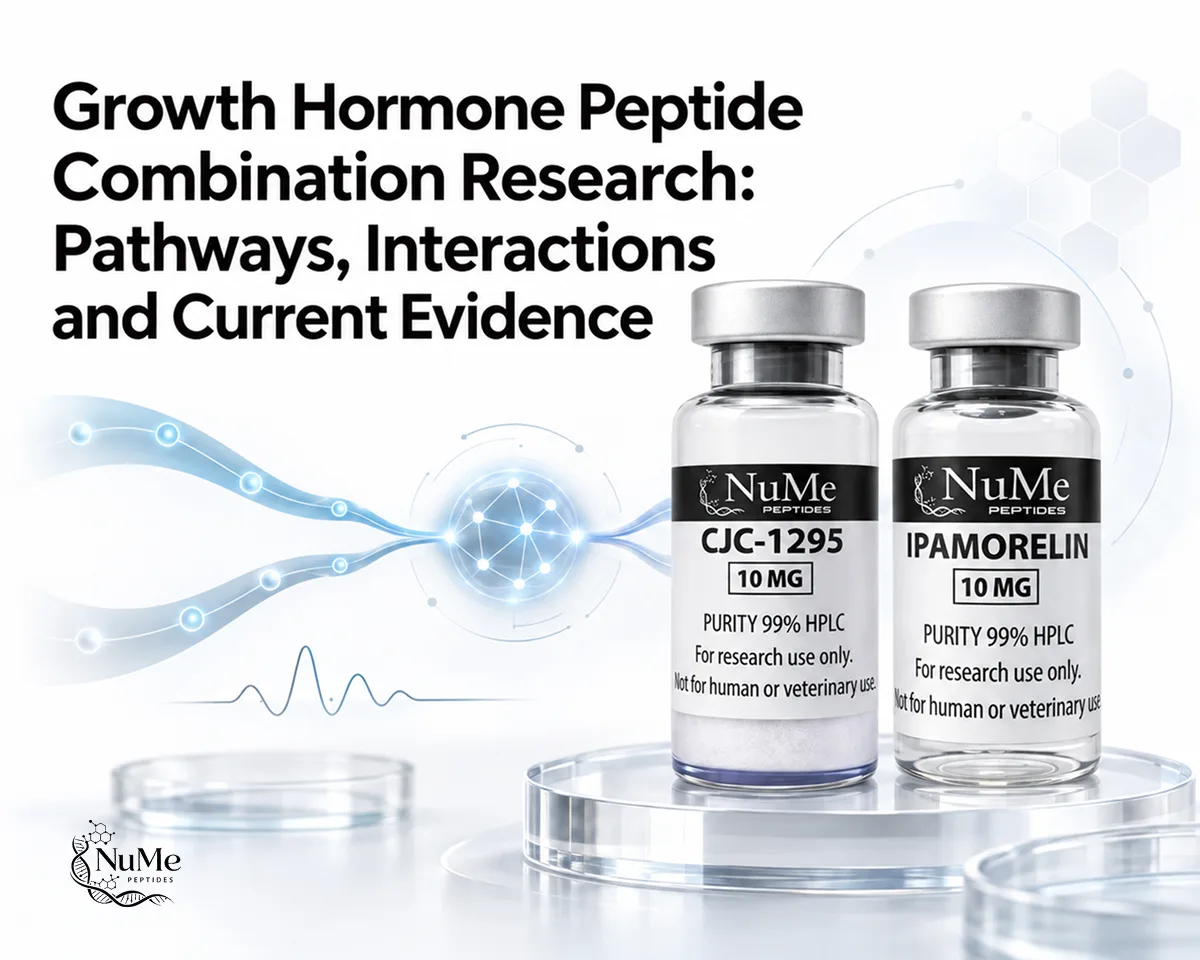
Growth Hormone Peptide Combination Research: Pathways, Interactions and Current Evidence


Growth Hormone Peptide Combination Research examines what happens when two peptide pathways involved in endogenous growth hormone (GH) secretion are studied together. The main research rationale comes from combining a growth hormone-releasing hormone (GHRH) pathway signal with a growth hormone secretagogue receptor pathway signal.
This distinction matters because the two peptide classes do not simply duplicate one another. GHRH-related peptides primarily activate the GHRH receptor on pituitary somatotrophs, while compounds such as Ipamorelin act through the growth hormone secretagogue receptor, GHS-R1a, also known as the ghrelin receptor. Older human studies using GHRH together with GHRP-6 demonstrated that simultaneous stimulation of these pathways can produce a larger GH response than either signal alone. (Peñalva et al., 1993)
However, evidence for a pathway interaction should not be confused with direct evidence for every modern peptide blend. In particular, the published human literature on GHRH plus GHRPs cannot automatically establish the effects of a specific CJC-1295 + Ipamorelin formulation.
For researchers looking for peptide materials for laboratory investigation, visit the Nume Peptides to explore the available research peptide collection.
Why Are Growth Hormone Peptides Combined in Research?
Researchers combine GH-related peptides primarily to investigate whether two different upstream receptor systems interact when regulating pituitary GH secretion.
The GHRH pathway begins with activation of the GHRH receptor. This receptor primarily signals through Gs proteins, adenylyl cyclase, and cyclic AMP. By contrast, GHRPs and ghrelin-related secretagogues activate GHS-R1a, which is associated mainly with Gq-related signalling, phospholipase C activity, and intracellular calcium mobilization.
Because both pathways ultimately influence somatotroph cells, researchers can compare whether dual stimulation changes:
- peak GH concentration;
- total GH exposure;
- GH pulse amplitude;
- timing of secretion;
- IGF-1 responses;
- pituitary responsiveness;
- effects of endogenous somatostatin and GHRH.
The scientific rationale is therefore based on pathway complementarity rather than the assumption that combining two peptides simply doubles the effect.
Human research supports an interaction between the systems. In one study, GHRH and GHRP-6 each increased GH when administered separately, while their combined administration generated a substantially greater secretory response. (Peñalva et al., 1993)
| Research variable | GHRH-related pathway | GHRP-related pathway |
|---|---|---|
| Primary receptor | GHRH-R | GHS-R1a |
| Major signalling | Gs/cAMP | Gq/PLC/Ca²⁺ |
| Endogenous counterpart | GHRH | Ghrelin |
| Main experimental target | Somatotroph GH release | Somatotroph and hypothalamic GH regulation |
| Combination interest | Complementary receptor activation | Interaction with endogenous GHRH |
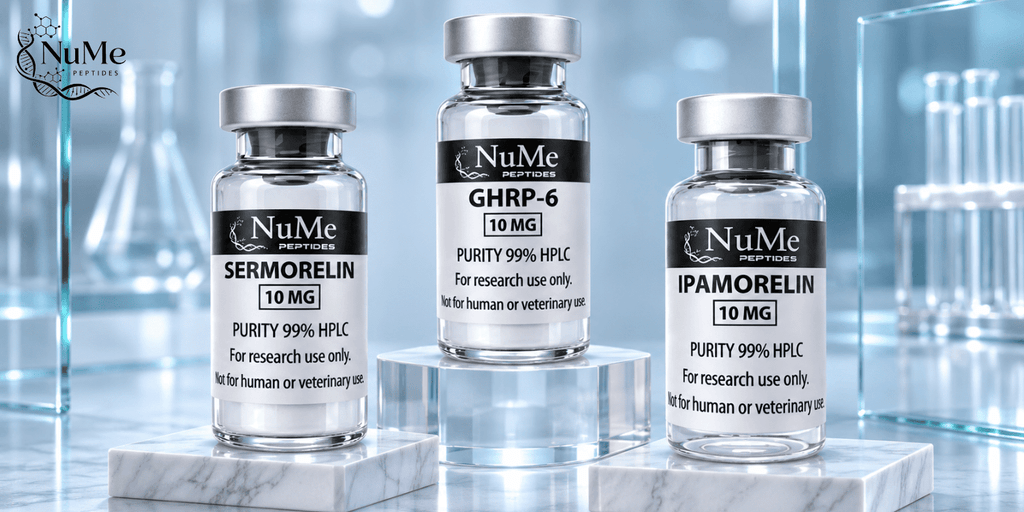
Explore laboratory research into GHRH signaling, pituitary growth hormone release, and GH-axis regulation with Sermorelin (10 mg).
How Can GHRH and GHRP Pathways Interact?
The two pathways are distinct at the receptor level but strongly connected within the hypothalamic-pituitary system.
One of the most important findings comes from experiments in which endogenous GHRH signalling was blocked before GHRP-6 administration. In nine healthy men, a GHRH antagonist eliminated most of the GH response to GHRP-6. This demonstrated that GHRP activity does not operate completely independently of endogenous GHRH. (Pandya et al., 1998)
This interaction can be understood through several mechanisms:
- GHRH directly stimulates pituitary somatotrophs.
- GHS-R1a activation provides a second stimulatory signal.
- GHRP signalling may influence hypothalamic GHRH activity.
- Somatostatin tone can modify both responses.
- The resulting GH output reflects the balance among all three systems.
Research in people with obesity also illustrates this principle. Although obesity is often associated with reduced GH responses to conventional stimuli, combined GHRH and GHRP-6 produced a marked GH discharge in an experimental study, suggesting that pituitary secretory capacity could remain substantial when both pathways were stimulated. (Cordido et al., 1993)
These studies are useful mechanistically, but they involved GHRH and GHRP-6—not CJC-1295 and Ipamorelin. That distinction is essential when evaluating modern peptide combinations.
How Are Growth Hormone Peptide Combinations Studied?
Combination studies require more than measuring one GH concentration. Researchers need to determine whether the observed response represents additive, synergistic, prolonged, or otherwise altered secretion.
Endocrine challenge studies
A common design compares several experimental conditions:
- peptide A alone;
- peptide B alone;
- peptide A + peptide B;
- placebo or baseline condition.
Researchers then compare peak GH, area under the curve, and response timing. This design is particularly valuable because a large response to two compounds together does not automatically demonstrate synergy. True synergy requires the combined response to exceed what would reasonably be expected from the individual responses.
Receptor and pathway studies
Cell-based or pituitary models can help establish whether compounds act through distinct receptor systems. These studies may measure:
- receptor activation;
- cAMP signalling;
- intracellular calcium;
- GH secretion;
- receptor antagonism;
- downstream signalling.
Pharmacokinetic studies
Combination research should also consider how long each peptide remains biologically available. A short-acting GHS-R agonist and a prolonged GHRH analogue may overlap very differently from two short-acting compounds.
For example, published human research on CJC-1295 examined the long-acting DAC-linked form. A single exposure increased mean GH concentrations for six days or longer and IGF-1 for approximately 9–11 days, with an estimated half-life of 5.8–8.1 days. (Teichman et al., 2006)
By comparison, human Ipamorelin research demonstrated a much shorter pharmacokinetic profile accompanied by an episodic GH response. (Gobburu et al., 1999)
These different time courses are one reason exact molecular identity matters in combination research.
Explore research compounds studied for GH secretion, GHRH signaling, and secretagogue pathways in the Growth Hormone collection.
Which Peptide Combinations Are Investigated in Growth Hormone Research?
GHRH + GHRP-6
The strongest classic human evidence for combination research involves GHRH together with GHRP-6. Studies demonstrated that both compounds could stimulate GH independently and that simultaneous administration could produce a much larger GH response. This work helped establish the concept that GHRH-R and GHS-R-related systems interact within pituitary GH regulation. (Peñalva et al., 1993)
The same general research model has been studied in different populations, including adults with altered GH secretion and people with obesity. However, response magnitude varies with endocrine status, age, metabolic state, and pituitary function.
Explore laboratory research into GHS-R1a signaling, growth hormone release, and appetite-related pathways with GHRP-6 (10 mg).
CJC-1295 + Ipamorelin
CJC-1295 + Ipamorelin is frequently discussed as a modern example of pairing a GHRH-related peptide with a GHS-R-related peptide. Mechanistically, the rationale is understandable: CJC-1295-related compounds target the GHRH pathway, whereas Ipamorelin is a growth hormone secretagogue.
However, the evidence must be described carefully. Recent reviews characterize CJC-1295 and Ipamorelin as investigational GH-axis peptides and emphasize the limited clinical evidence available for emerging peptide combinations. Direct controlled human evidence for this exact pair remains lacking.
This means findings from older GHRH + GHRP-6 studies cannot simply be transferred to a fixed CJC-1295 + Ipamorelin (10 mg + 5 mg) research blend.
The evidence hierarchy is better represented as:
| Evidence question | Current evidence |
|---|---|
| Do GHRH and GHRP pathways interact? | Supported by human research |
| Can GHRH + GHRP-6 increase GH together? | Supported by human research |
| Does CJC-1295 stimulate GH? | Human evidence exists for the DAC form |
| Does Ipamorelin stimulate GH? | Human pharmacodynamic evidence exists |
| Is CJC-1295 + Ipamorelin directly validated in humans? | Direct controlled evidence remains insufficient |
| Is a specific 10 mg + 5 mg blend clinically established? | No |
For research involving a fixed blend, analytical identity is especially important because combination concentration alone does not establish which molecular form of CJC-1295 is present.
CJC-1295 (No DAC) + Ipamorelin
The No-DAC distinction adds another limitation. Published human CJC-1295 trials primarily involve the long-acting DAC-linked compound. CJC-1295 (No DAC) is commonly used to describe a shorter modified GHRH(1-29)-type peptide, but it should not be assumed to share the same half-life or endocrine profile as CJC-1295 with DAC.
Researchers comparing CJC-1295 (No DAC), Ipamorelin, and a combined material should therefore verify:
- exact amino-acid sequences;
- molecular masses;
- DAC status;
- HPLC purity;
- mass-spectrometry identity;
- peptide ratio;
- batch-specific documentation.
For researchers comparing these formats directly, NuMe Peptides offers individual CJC-1295 (No DAC), Ipamorelin, and CJC-1295 + Ipamorelin (10 mg + 5 mg) research listings with supporting product documentation.
What Are the Limitations of Current Peptide Combination Research?
The major limitation is that mechanistic rationale is stronger than direct evidence for many modern commercial combinations.
Historical studies used different peptides
Much of the foundational combination research used native GHRH or GHRH fragments together with GHRP-6. These experiments demonstrate pathway interaction but do not directly establish how CJC-1295 and Ipamorelin behave together.
CJC-1295 nomenclature is inconsistent
“CJC-1295” can refer to chemically different materials. Published human research focused largely on the DAC-linked version, whereas many modern research listings use the term CJC-1295 No DAC for a shorter modified GHRH peptide.
Therefore, researchers should not apply pharmacokinetic data from one molecular form to another without confirming identity.
Combination studies need proper controls
A scientifically informative combination experiment ideally includes both components separately as well as together. Without these comparator groups, researchers cannot determine whether a response is:
- caused mainly by one compound;
- simply additive;
- genuinely synergistic;
- modified by pharmacokinetic interaction.
Hormone responses are not clinical outcomes
Most classic GHRH/GHRP studies evaluated GH concentrations. An increased GH response does not independently establish changes in muscle mass, fat loss, recovery, sleep, longevity, or another downstream outcome.
Recent sports-medicine reviews continue to classify CJC-1295 and Ipamorelin among investigational GH-axis peptides for which clinical efficacy and safety evidence remain limited. (Mayfield et al., 2026)
Canadian research context
Health Canada currently identifies both CJC-1295 and Ipamorelin among unauthorized synthetic peptide ingredients found in products promoted for human use in Canada. Health Canada states that unauthorized peptide products have not been assessed for safety, efficacy, and quality, and Canadian regulators have strengthened enforcement in response to increased online promotion.
This regulatory context should remain separate from legitimate laboratory Growth Hormone Peptide Combination Research.
Explore research compounds studied for GH secretion, GHRH signaling, and secretagogue pathways in the Growth Hormone collection.
FAQs About Growth Hormone Peptide Combination Research
Why Are GHRH and GHRP Peptides Studied Together?
They activate different receptor systems that both influence pituitary GH secretion. Studying them together helps researchers understand how those pathways interact.
Is CJC-1295 + Ipamorelin Proven to Be Synergistic?
Not directly. Older human studies support interaction between GHRH and GHRP pathways, but that does not prove synergy for the specific CJC-1295 + Ipamorelin pair.
Has Ipamorelin Been Studied in Humans?
Yes. Human pharmacokinetic-pharmacodynamic research demonstrated an episodic GH response following Ipamorelin exposure. (Gobburu et al., 1999)
Has CJC-1295 Been Studied in Humans?
Yes, but the main published human studies examined the long-acting DAC-linked form. These findings should not automatically be applied to CJC-1295 No DAC.
Why Does the CJC-1295 Form Matter in a Combination?
DAC dramatically changes peptide persistence. A long-acting CJC-1295 molecule and a shorter No-DAC GHRH analogue can create very different exposure patterns when combined with another secretagogue.
What Should Combination Research Measure?
Useful endpoints include receptor activity, peak GH, GH area under the curve, pulse characteristics, IGF-1, pharmacokinetics, and appropriate single-compound controls.
Conclusion
Growth Hormone Peptide Combination Research is based on a well-supported biological principle: GHRH-R and GHS-R1a are distinct but interacting pathways involved in endogenous GH regulation. Classic human studies using GHRH and GHRP-6 demonstrate that simultaneous stimulation can substantially change the pituitary GH response.
However, this evidence should not be overstated. CJC-1295 and Ipamorelin have each been studied independently, but direct controlled human evidence for their specific combination remains limited. The distinction between CJC-1295 with DAC and CJC-1295 No DAC further limits direct extrapolation from older studies. The most accurate research approach therefore evaluates receptor mechanism, molecular identity, pharmacokinetics, individual-compound responses, and the combined response separately.
For researchers looking for peptide materials for laboratory investigation, visit the Nume Peptides to explore the available research peptide collection.
Disclaimer: This content is provided for educational and scientific research purposes only. Research peptides are intended for laboratory research only and are not intended for human consumption or medical use.