

Peptides for Glucose Metabolism Research: Signaling Pathways and Current Evidence


Peptides for Glucose Metabolism Research are studied to understand how peptide-mediated signalling influences insulin secretion, glucagon activity, hepatic glucose production, nutrient absorption, and postprandial glucose control. Rather than being controlled by a single hormone, glucose homeostasis depends on continuous communication among the pancreas, gastrointestinal tract, liver, skeletal muscle, adipose tissue, and central nervous system.
Incretin-related peptides are particularly important because they connect nutrient intake with pancreatic hormone responses. Semaglutide primarily targets the GLP-1 receptor, Tirzepatide activates both GIP and GLP-1 receptors, and Retatrutide extends this concept by targeting GIP, GLP-1, and glucagon receptors. Their different receptor profiles make them useful models for comparing how individual and combined hormonal pathways influence glucose metabolism.
For researchers looking for peptide materials for laboratory investigation, visit the Nume Peptides to explore the available research peptide collection.
How Is Glucose Metabolism Regulated?
Blood glucose is maintained within a dynamic range through coordinated processes involving glucose absorption, storage, utilization, and production. After food intake, glucose enters the circulation and stimulates pancreatic beta cells to release insulin. Insulin promotes glucose uptake and storage while suppressing excessive hepatic glucose production.
During fasting, the balance shifts. Lower insulin activity and increased counter-regulatory signalling allow the liver to release glucose through glycogenolysis and gluconeogenesis, helping maintain glucose availability for glucose-dependent tissues.
Several processes contribute to overall glucose homeostasis:
- intestinal glucose absorption;
- pancreatic insulin secretion;
- pancreatic glucagon secretion;
- hepatic glycogen synthesis and breakdown;
- hepatic gluconeogenesis;
- skeletal-muscle glucose uptake;
- adipose-tissue metabolism;
- incretin hormone signalling.
Glucagon plays an important counter-regulatory role. Secreted by pancreatic alpha cells, it acts primarily on the liver to stimulate glycogenolysis and gluconeogenesis when additional circulating glucose is required. (Dhanvantari et al., 2025)
Insulin and glucagon therefore operate as part of an integrated system rather than as simple opposing switches. Changes in nutrient status, gastrointestinal hormones, neural input, and insulin sensitivity can all alter the final glucose response.
| Metabolic process | Primary research relevance |
|---|---|
| Insulin secretion | Promotes glucose utilization and storage |
| Glucagon signalling | Supports hepatic glucose production |
| Hepatic glucose output | Influences fasting glucose |
| Muscle glucose uptake | Major pathway for peripheral glucose disposal |
| Gastric emptying | Influences the rate of post-meal glucose appearance |
| Incretin signalling | Connects nutrient intake with pancreatic responses |
Explore laboratory research into GLP-1 receptor signaling, incretin pathways, and metabolic regulation with Semaglutide (10 mg).

Which Hormonal Pathways Influence Glucose Metabolism?
Among the many hormones involved in glucose regulation, insulin, glucagon, GLP-1, and glucose-dependent insulinotropic polypeptide (GIP) are particularly relevant to peptide research.
GLP-1 signalling
GLP-1 is secreted from intestinal enteroendocrine cells following nutrient exposure. Its receptor is expressed in several tissues, including pancreatic islets. GLP-1 receptor activation enhances insulin secretion in a glucose-dependent manner, meaning the insulinotropic effect is closely linked to prevailing glucose concentrations.
GLP-1 signalling can also reduce glucagon secretion during hyperglycemia and influence gastrointestinal motility. Delayed gastric emptying can reduce the rate at which nutrients enter the small intestine and therefore modify postprandial glucose appearance. (Santos-Hernández et al., 2024)
GIP signalling
GIP is another major incretin hormone released after nutrient intake. It acts through the GIP receptor and contributes substantially to nutrient-stimulated insulin secretion.
Its biology is more complex than GLP-1 because GIP can influence both insulin and glucagon secretion depending on metabolic conditions. Contemporary research therefore considers GIP signalling a context-dependent component of glucose homeostasis rather than simply another GLP-1-like pathway. (Müller et al., 2026)
Glucagon receptor signalling
Glucagon receptor activation differs fundamentally from incretin signalling because glucagon can increase hepatic glucose output. This creates an interesting research question for multi-receptor compounds such as Retatrutide: how can glucagon receptor agonism coexist with improved glycemic outcomes?
The answer appears to involve the balance among GLP-1, GIP, and glucagon receptor activities rather than the action of one receptor in isolation. The glucagon component may influence hepatic and energy metabolism while the incretin components provide important glycemic counterbalance.
How Are Peptides Studied in Glucose Metabolism Research?
Research designs range from molecular receptor experiments to controlled human metabolic studies. Because glucose regulation involves several organs and hormones, researchers generally measure multiple endpoints rather than relying on fasting glucose alone.
Common endpoints include:
- fasting plasma glucose;
- postprandial glucose;
- glycated hemoglobin (HbA1c);
- fasting and meal-stimulated insulin;
- glucagon;
- insulin sensitivity;
- beta-cell function;
- gastric emptying;
- glucose area under the curve.
Meal tolerance testing
Mixed-meal tests allow researchers to observe glucose, insulin, and glucagon responses following nutrient exposure. They are particularly useful for incretin research because GLP-1 and GIP normally participate in postprandial regulation.
A randomized metabolic study comparing Tirzepatide and Semaglutide found that both influenced glucose and glucagon responses, while Tirzepatide was associated with greater improvements in insulin sensitivity and measures of beta-cell glucose sensitivity. (Mather et al., 2024)
Glucose clamp studies
Hyperinsulinemic-euglycemic clamp techniques provide more direct measurements of insulin sensitivity. A 2025 study using this approach found improved glucose infusion rates after Tirzepatide exposure in participants with obesity and type 2 diabetes, supporting a measurable change in insulin sensitivity. (Yamazaki et al., 2025)
Longer-term glycemic markers
HbA1c reflects average glucose exposure over a much longer period than a single fasting measurement. Clinical studies therefore commonly combine HbA1c with fasting glucose and meal-related endpoints when evaluating sustained metabolic effects.
Explore laboratory research into dual GLP-1/GIP receptor signaling, incretin pathways, and metabolic regulation with Tirzepatide (10 mg).

Which Peptides Are Investigated in Glucose-Related Research?
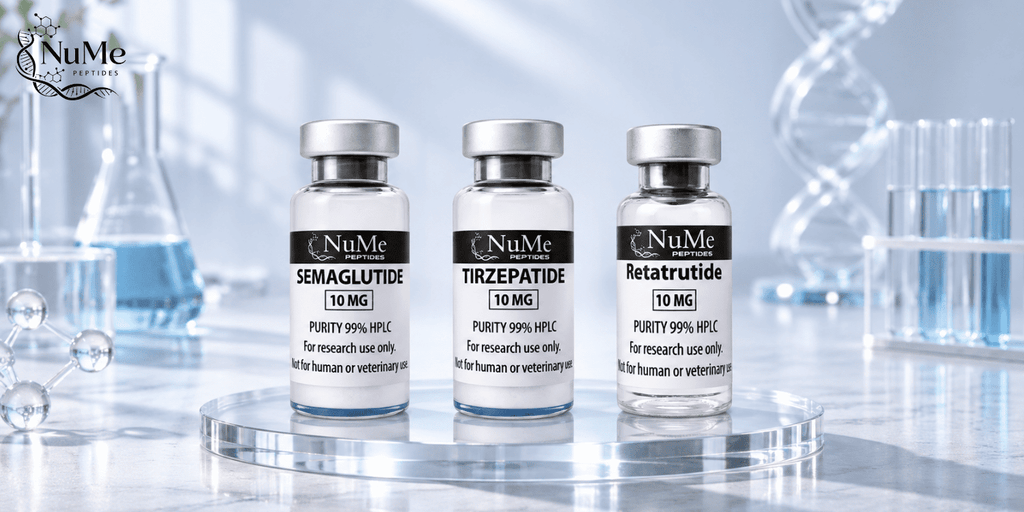
Semaglutide, Tirzepatide, and Retatrutide provide three distinct receptor models for studying glucose metabolism.
| Peptide | Main receptor profile | Key glucose-research focus |
|---|---|---|
| Semaglutide | GLP-1R | Insulin, glucagon, postprandial regulation |
| Tirzepatide | GIPR + GLP-1R | Dual incretin signalling and insulin sensitivity |
| Retatrutide | GIPR + GLP-1R + GCGR | Incretin–glucagon pathway integration |
Semaglutide
Semaglutide is a GLP-1 receptor agonist and provides a comparatively selective model for studying prolonged GLP-1R activation.
Its glucose-related effects involve several interacting mechanisms, including glucose-dependent insulin secretion, modulation of glucagon, altered gastric emptying, and changes in nutrient intake. These mechanisms affect fasting and postprandial glucose through different routes.
The SUSTAIN 1 randomized trial provides direct human evidence of sustained glycemic effects. In participants with type 2 diabetes, Semaglutide significantly reduced HbA1c compared with placebo over 30 weeks. (Sorli et al., 2017)
From a research perspective, Semaglutide therefore serves as a useful reference point when comparing single GLP-1 receptor activation with newer multi-receptor approaches.
Tirzepatide
Tirzepatide combines GIP receptor and GLP-1 receptor agonism within a single peptide. This makes it useful for investigating whether simultaneous activation of two incretin pathways changes beta-cell function, insulin sensitivity, glucagon responses, or overall glucose control.
In the randomized SURPASS-1 trial, Tirzepatide produced substantial reductions in HbA1c and fasting serum glucose compared with placebo. (Rosenstock et al., 2021)
Mechanistic work provides additional insight. Meal-testing research indicates that improved glucose control with Tirzepatide involves changes in insulin secretion, insulin sensitivity, and glucagon suppression rather than simply greater insulin release. (Mather et al., 2024)
This distinction is important because lower circulating insulin does not necessarily indicate poorer beta-cell function when insulin sensitivity has simultaneously improved.
Retatrutide
Retatrutide represents a more complex research model because it activates three receptors: GIPR, GLP-1R, and the glucagon receptor.
The glucagon receptor component is particularly interesting in Peptides for Glucose Metabolism Research because glucagon signalling can stimulate hepatic glucose production. Researchers are therefore examining how triple-receptor activation balances potentially opposing metabolic signals.
In a randomized phase 2 study in people with type 2 diabetes, Retatrutide produced dose-dependent reductions in HbA1c, with significant reductions compared with placebo across most studied groups. (Rosenstock et al., 2023)
These findings show that adding glucagon receptor activity does not necessarily eliminate glycemic control when combined with GLP-1 and GIP receptor signalling. However, Retatrutide remains investigational, and the long-term interpretation of its multi-receptor profile continues to evolve.
What Does Current Evidence Show About Peptides and Glucose Metabolism?
Current evidence supports several broad conclusions, but it also shows why the compounds should not be treated as interchangeable.
More receptor targets do not simply mean stronger GLP-1 activity
Semaglutide, Tirzepatide, and Retatrutide have fundamentally different receptor profiles. Their effects cannot be ranked only by the number of receptors they activate.
Semaglutide provides predominantly GLP-1R-mediated signalling. Tirzepatide adds GIPR activity, while Retatrutide additionally engages the glucagon receptor. Each configuration changes the hormonal network being studied.
Glucose control involves more than insulin secretion
Modern metabolic research increasingly separates insulin quantity from insulin effectiveness. Tirzepatide studies, for example, suggest that improved insulin sensitivity can reduce the amount of insulin required to manage a given glucose exposure while beta-cell glucose responsiveness improves. (Mather et al., 2024)
Researchers should therefore consider glucose metabolism as a sequence:
Nutrient exposure → Incretin signalling → Insulin/glucagon response → Hepatic and peripheral glucose handling → Circulating glucose
Changes at one step do not necessarily predict changes at every downstream stage.
Clinical evidence differs substantially among compounds
Semaglutide has an extensive human clinical evidence base. Tirzepatide has also been investigated across large phase 3 programs and direct metabolic studies. Retatrutide has promising human data, including phase 2 glucose-control results, but remains a newer investigational multi-receptor compound.
Accordingly, evidence obtained with Semaglutide or Tirzepatide should not automatically be transferred to Retatrutide simply because all three include GLP-1 receptor activity.
Canadian regulatory context matters
Health Canada distinguishes authorized drug products from unauthorized peptide products. Specific Semaglutide and Tirzepatide drug products have regulatory authorization for defined indications in Canada, while this does not mean that any product containing the same named ingredient is automatically authorized. Authorized products must meet Health Canada’s requirements for safety, efficacy, quality, and product-specific regulatory approval.
Health Canada also lists Retatrutide among peptide ingredients identified in unauthorized products promoted for human use and notes that “research use” labelling does not automatically exempt products from Canadian regulatory requirements. (Health Canada, 2026)
Research-grade materials should therefore remain clearly separated from authorized medicines and from human therapeutic use.
Explore research compounds for metabolic signaling, energy regulation, and longevity pathways in the Metabolic & Longevity collection.
FAQs About Peptides for Glucose Metabolism Research
What Are Peptides for Glucose Metabolism Research?
They are peptide compounds studied for their ability to influence hormonal pathways involved in glucose regulation, including GLP-1, GIP, insulin, glucagon, and related metabolic signalling.
How Does GLP-1 Influence Blood Glucose?
GLP-1 receptor activation can enhance glucose-dependent insulin secretion, influence glucagon release, and alter gastrointestinal motility, collectively affecting fasting and postprandial glucose regulation.
What Is the Main Difference Between Semaglutide and Tirzepatide?
Semaglutide primarily activates GLP-1 receptors, whereas Tirzepatide activates both GIP and GLP-1 receptors. Their receptor profiles therefore create different experimental models.
Why Is Retatrutide Different?
Retatrutide combines GIP, GLP-1, and glucagon receptor agonism. The addition of glucagon receptor activity creates a more complex metabolic signalling profile than single- or dual-incretin agonism.
Does Glucagon Always Increase Blood Glucose?
Glucagon can increase hepatic glucose production, particularly during fasting. However, the net metabolic effect of a multi-receptor compound depends on the combined actions of all activated pathways.
Can Results From One Incretin Peptide Be Applied to Another?
Not automatically. Differences in receptor activity, pharmacokinetics, molecular structure, study population, and experimental design can substantially change the resulting metabolic response.
Conclusion
Peptides for Glucose Metabolism Research provide increasingly sophisticated models for studying how gastrointestinal hormones, pancreatic signalling, hepatic glucose production, insulin sensitivity, and nutrient handling work together to maintain glucose homeostasis.
Semaglutide primarily provides a GLP-1 receptor model, while Tirzepatide combines GIP and GLP-1 signalling and has generated evidence involving beta-cell function, insulin sensitivity, and glucagon regulation. Retatrutide adds glucagon receptor activity, allowing researchers to examine how incretin and glucagon pathways can be integrated within a single molecular system.
The most informative research approach therefore evaluates fasting glucose, postprandial glucose, insulin, glucagon, HbA1c, insulin sensitivity, and receptor activity as related but distinct endpoints rather than reducing glucose metabolism to a single measurement.
For researchers looking for peptide materials for laboratory investigation, visit the Nume Peptides to explore the available research peptide collection.
Disclaimer: This content is provided for educational and scientific research purposes only. Research peptides are intended for laboratory research only and are not intended for human consumption or medical use.