
Peptides for Metabolic Hormone Research: Growth Hormone Pathways and Current Evidence


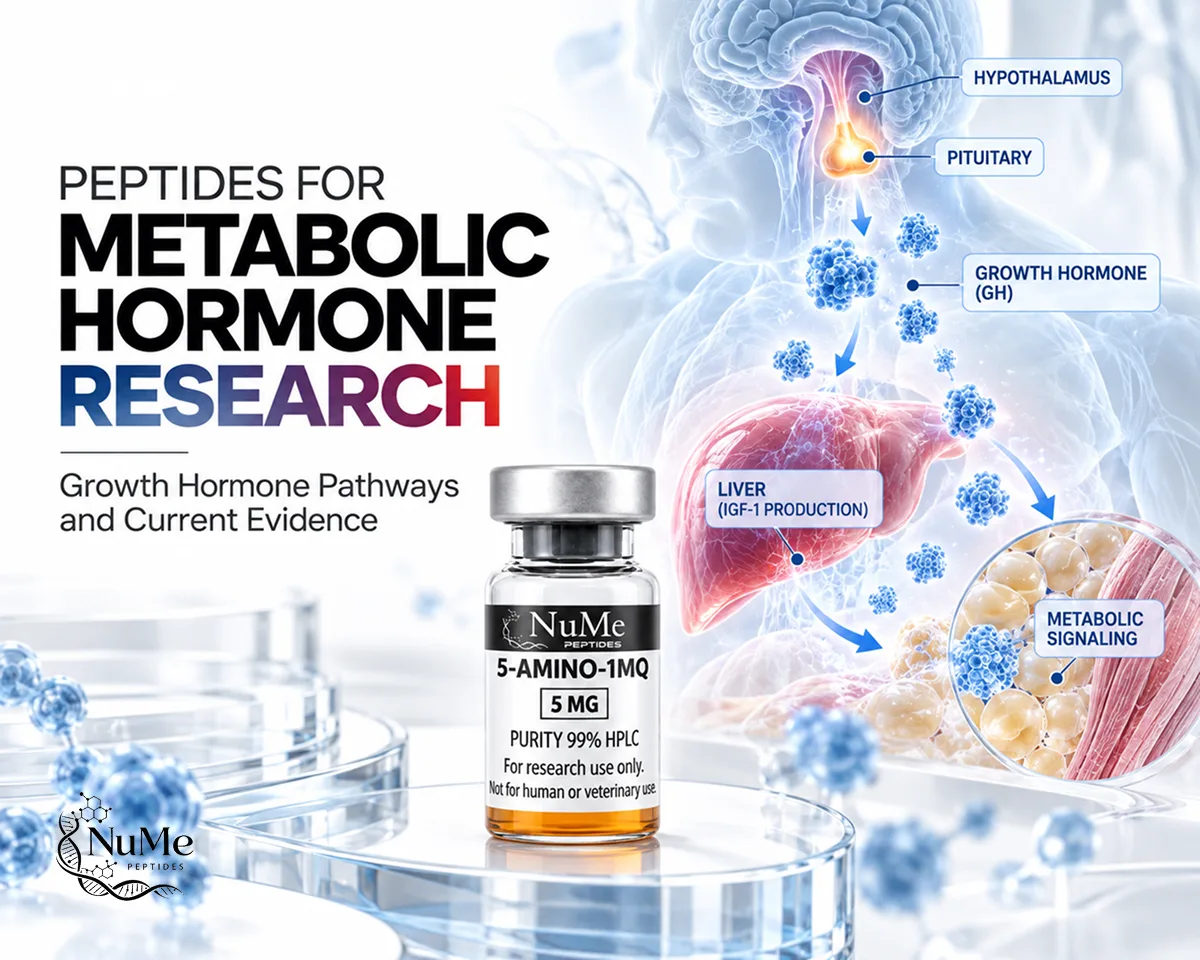
Research into Peptides for Metabolic Hormone Research examines how peptide-mediated changes in growth hormone (GH) secretion may influence metabolic pathways involving lipid mobilization, glucose regulation, insulin signalling, body composition, and the downstream GH–IGF-1 axis.
Growth hormone has a complex metabolic role. In adipose tissue, GH can stimulate lipolysis and increase circulating free fatty acids. At the same time, sustained GH exposure can reduce insulin sensitivity in some tissues. These effects vary with nutritional status, hormone exposure, tissue type, and the duration of signalling. (Møller & Jørgensen, 2009)
Tesamorelin, CJC-1295-related compounds, Ipamorelin, and Sermorelin are relevant research tools because they influence endogenous GH pathways rather than directly replacing GH. However, their mechanisms and metabolic evidence differ substantially.
For researchers looking for peptide materials for laboratory investigation, visit the Nume Peptides to explore the available research peptide collection.
How Are Growth Hormone and Metabolic Signaling Connected?
Growth hormone is secreted from the anterior pituitary and influences multiple metabolic tissues after entering circulation. Its effects depend partly on direct GH receptor signalling and partly on downstream mediators such as IGF-1.
One of the most established metabolic effects of GH is increased lipid mobilization. Human studies have shown that GH can increase circulating free fatty acids within hours, reflecting enhanced lipolysis in adipose tissue. This response is particularly relevant during fasting, when mobilized fatty acids can be used as an alternative energy source. (Møller et al., 2003)
GH also interacts closely with insulin. Chronic or excessive GH signalling can oppose some insulin-mediated metabolic effects, particularly in adipose tissue, liver, and skeletal muscle. Research therefore evaluates GH as both an anabolic endocrine signal and a regulator of substrate availability. (Sharma et al., 2020)
Several metabolic processes are commonly investigated:
- adipose-tissue lipolysis;
- circulating free fatty acids;
- glucose availability;
- insulin sensitivity;
- hepatic IGF-1 production;
- protein metabolism;
- visceral and subcutaneous fat distribution.
| GH-related process | Metabolic research relevance |
|---|---|
| Lipolysis | Mobilizes stored triglycerides |
| Free fatty acid release | Provides alternative metabolic fuel |
| Insulin interaction | Influences glucose and lipid metabolism |
| IGF-1 production | Provides downstream endocrine signalling |
| Protein metabolism | Contributes to anabolic and tissue responses |
| Body composition | Reflects integrated long-term metabolic effects |
This complexity is why higher GH should not automatically be interpreted as metabolically beneficial. Both insufficient and excessive GH signalling can alter metabolic homeostasis.
Explore research compounds studied for GH secretion, GHRH signaling, and secretagogue pathways in the Growth Hormone collection.
Which Biological Pathways Link Growth Hormone to Metabolic Research?
Growth hormone influences metabolism through several interconnected signalling systems.
GH receptor and JAK2–STAT5 signalling
After GH binds the growth hormone receptor, intracellular JAK2–STAT5 signalling is activated. STAT5-mediated transcription contributes to several GH-regulated responses, including hepatic production of IGF-1.
The GH–IGF-1 axis is therefore one major bridge between pituitary hormone secretion and peripheral metabolic effects.
Lipolysis and free fatty acids
GH strongly influences adipose tissue. Human research indicates that increased lipolysis is among its most prominent acute metabolic effects. Increased free fatty acid availability can alter how tissues use glucose and lipid substrates. (Nielsen et al., 2009)
This becomes particularly relevant during fasting, when GH helps shift fuel utilization toward fatty acids.
GH and insulin signalling
GH and insulin can produce overlapping or opposing effects depending on physiological conditions. Insulin generally suppresses adipose lipolysis, while sustained GH exposure can reduce this anti-lipolytic effect and increase free fatty acid flux.
Research into Peptides for Metabolic Hormone Research therefore often examines both GH-related endpoints and glucose/insulin markers rather than considering either system independently.
Relevant metabolic markers can include:
- fasting glucose;
- fasting insulin;
- HbA1c;
- circulating free fatty acids;
- triglycerides;
- IGF-1;
- visceral adipose tissue.
How Are Peptides Studied in Metabolic Hormone Research?
Peptide studies can focus on several levels of the GH–metabolic pathway, ranging from acute pituitary responses to longer-term changes in body composition.
Endocrine response studies
Short-term experiments commonly measure how strongly a peptide stimulates GH secretion.
Typical endpoints include:
- peak GH;
- time to peak GH;
- GH area under the curve;
- duration of GH elevation;
- circulating IGF-1.
Ipamorelin, for example, has been examined in healthy volunteers using pharmacokinetic-pharmacodynamic models. The research confirmed an episodic GH response following peptide exposure. (Gobburu et al., 1999)
Metabolic and body-composition studies
Longer trials can investigate whether sustained changes in the GH axis influence adipose tissue or metabolic markers.
Researchers may measure:
- visceral adipose tissue;
- subcutaneous adipose tissue;
- liver fat;
- lean body mass;
- triglycerides;
- glucose;
- insulin;
- IGF-1.
Tesamorelin research provides one of the clearest examples. In a randomized trial involving people with HIV and abdominal fat accumulation, Tesamorelin reduced visceral adipose tissue while increasing IGF-1. Glucose measures did not differ significantly from placebo over the main study period. (Falutz et al., 2010)
A separate randomized study also reported reductions in visceral and liver fat during six months of Tesamorelin exposure. (Stanley et al., 2014)
These findings show why metabolic peptide studies should include several endpoints rather than assuming that changes in GH alone predict changes in body composition.
Explore research compounds studied for GH secretion, GHRH signaling, and secretagogue pathways in the Growth Hormone collection.
Which Growth Hormone Peptides Are Investigated in Metabolic Research?
The compounds discussed here influence GH through different upstream pathways.
Tesamorelin
Tesamorelin is a stabilized GHRH analogue that activates the GHRH receptor and increases endogenous GH secretion.
Among the peptides discussed here, Tesamorelin has the strongest direct human metabolic evidence. Randomized studies have investigated visceral adipose tissue, liver fat, lipids, glucose, body composition, and IGF-1.
One trial involving abdominally obese participants with reduced GH secretion found that Tesamorelin decreased visceral adipose tissue and triglycerides while increasing IGF-1. Fasting glucose, two-hour glucose, and HbA1c were not significantly changed. (Makimura et al., 2012)
A 2026 meta-analysis of randomized trials also reported significant reductions in visceral adipose tissue and hepatic fat together with increased lean body mass and IGF-1 in the HIV-associated lipodystrophy populations studied. (Tesamorelin Meta-Analysis, 2026)
CJC-1295 (No DAC)
CJC-1295 (No DAC) terminology requires careful interpretation.
Published human research predominantly involves long-acting CJC-1295 containing a Drug Affinity Complex, or DAC. In healthy adults, this form produced sustained increases in GH and IGF-1 for several days. (Teichman et al., 2006)
Commercially described CJC-1295 (No DAC) generally refers to a shorter-acting modified GHRH-type peptide. The long half-life and sustained IGF-1 responses reported for DAC-linked CJC-1295 should therefore not automatically be attributed to No-DAC material.
Researchers should verify:
- exact peptide sequence;
- molecular mass;
- presence or absence of DAC;
- analytical purity;
- identity testing;
- batch documentation.
Ipamorelin
Ipamorelin is a synthetic growth hormone secretagogue associated primarily with GHS-R1a-related signalling.
Human research demonstrates that Ipamorelin can stimulate acute GH release. (Gobburu et al., 1999) However, its direct evidence for long-term metabolic outcomes such as visceral adipose reduction, lipid changes, or insulin sensitivity is considerably more limited than the evidence available for Tesamorelin.
It is therefore most accurately positioned as a research compound for studying the secretagogue component of the GH axis rather than as a compound with established metabolic outcomes.
Sermorelin
Sermorelin corresponds to GHRH(1-29)-NH2 and activates the pituitary GHRH receptor pathway.
Early human research demonstrated substantial GH release following administration of GHRH(1-29). (Barron et al., 1985)
Longer research involving GHRH(1-29) has also demonstrated that repeated stimulation can increase both GH and IGF-1 under some experimental conditions. In older men, short-term repeated GHRH(1-29) exposure increased GH secretion and IGF-1 at the higher experimental dose. (Corpas et al., 1992)
| Peptide | Main pathway | Metabolic evidence profile |
|---|---|---|
| Tesamorelin | GHRH receptor | Strong human body-composition evidence |
| CJC-1295 (No DAC) | Modified GHRH pathway | Direct No-DAC metabolic evidence limited |
| Ipamorelin | GHS-R1a-related | Stronger evidence for acute GH secretion |
| Sermorelin | GHRH receptor | GH/IGF-1 research; limited direct metabolic outcomes |
What Does Current Evidence Show About Growth Hormone Peptides and Metabolic Signaling?
Current research demonstrates that stimulation of endogenous GH can alter metabolic signalling, but the resulting effects depend heavily on the compound, duration of exposure, physiological state, and population studied.
GH has both lipolytic and insulin-antagonistic effects
The metabolic effect most consistently associated with GH is increased lipolysis. However, prolonged elevations in GH can also reduce insulin sensitivity by altering free fatty acid availability and insulin signalling. (Sharma et al., 2020)
This means that a metabolic research outcome cannot be judged simply by determining whether GH increased.
Tesamorelin provides direct body-composition evidence
Tesamorelin studies provide much stronger evidence for metabolic endpoints than studies involving most research secretagogues. Randomized human research has repeatedly demonstrated reductions in visceral adipose tissue in specific study populations.
For example, a large trial reported a 15.2% reduction in visceral adipose tissue in the Tesamorelin group compared with an increase in the placebo group over 26 weeks. (Falutz et al., 2007)
These results are population-specific and should not automatically be generalized to other groups or other GHRH peptides.
GH and IGF-1 should be measured separately
CJC-1295 research also demonstrates that GH and IGF-1 responses do not always move in a simple one-to-one relationship. Long-acting DAC-linked CJC-1295 increased trough and mean GH concentrations while preserving GH pulsatility, yet changes in IGF-1 did not correlate directly with individual GH secretion parameters. (Ionescu & Frohman, 2006)
A useful research framework is therefore:
Peptide stimulation → GH secretion → GH receptor signalling → IGF-1 and metabolic responses
Each stage should be measured independently whenever possible.
Canadian research context
Health Canada currently identifies unauthorized synthetic peptide products containing compounds such as CJC-1295 and Ipamorelin as products encountered in the Canadian market. Health Canada emphasizes that products marketed as “research use only” are not automatically exempt from Canadian regulatory requirements when promoted or supplied for human use. (Health Canada, 2026)
This regulatory context is separate from legitimate laboratory investigation of peptide-mediated metabolic signalling.
Explore research compounds studied for GH secretion, GHRH signaling, and secretagogue pathways in the Growth Hormone collection.

FAQs About Peptides for Metabolic Hormone Research
What Are Peptides for Metabolic Hormone Research?
They are peptide compounds investigated for their effects on endocrine pathways involved in GH secretion, IGF-1 signalling, lipid metabolism, glucose regulation, and body composition.
How Does Growth Hormone Influence Fat Metabolism?
GH can stimulate adipose-tissue lipolysis, increasing the release of free fatty acids that can be used as metabolic fuel.
Does Higher GH Always Improve Metabolic Health?
No. Persistent GH elevation can reduce insulin sensitivity under some conditions. Metabolic effects depend on exposure pattern, physiological state, and tissue response.
Which Peptide Has the Strongest Metabolic Evidence?
Among the compounds discussed here, Tesamorelin has the strongest controlled human evidence involving visceral adipose tissue and other metabolic endpoints.
Does Ipamorelin Have the Same Metabolic Evidence as Tesamorelin?
No. Ipamorelin has human evidence demonstrating GH secretagogue activity, but its direct long-term metabolic evidence is considerably more limited.
Can CJC-1295 With DAC Research Be Applied to CJC-1295 No DAC?
Not automatically. DAC-linked CJC-1295 (No DAC) has a much longer pharmacokinetic profile. Researchers should confirm the exact molecular identity before applying published findings.
Conclusion
Research into Peptides for Metabolic Hormone Research shows that GH-related peptides can influence an endocrine network connecting pituitary secretion, GH receptor signalling, IGF-1, lipid mobilization, glucose regulation, and body composition.
Tesamorelin has the strongest direct human metabolic evidence among the compounds discussed, particularly for visceral adipose tissue in defined study populations. CJC-1295 (No DAC)-related research demonstrates how peptide duration can alter GH and IGF-1 exposure, while Ipamorelin is better supported as a model of acute secretagogue activity. Sermorelin provides an established GHRH(1-29)-based model for investigating pituitary GH stimulation.
The most accurate research approach therefore considers GH, IGF-1, lipid metabolism, glucose regulation, and body composition as related but separate endpoints.
For researchers looking for peptide materials for laboratory investigation, visit the Nume Peptides to explore the available research peptide collection.
Disclaimer: This content is provided for educational and scientific research purposes only. Research peptides are intended for laboratory research only and are not intended for human consumption or medical use.