

Growth Hormone Signaling Research: Pathways and Current Evidence


Research into growth hormone signaling research examines two connected stages of endocrine biology: how growth hormone (GH) is secreted from the pituitary gland and how circulating GH activates receptors in target tissues. This distinction is important because peptides such as Ipamorelin, GHRP-6, CJC-1295, Sermorelin, and Tesamorelin primarily influence upstream GH secretion rather than directly activating the growth hormone receptor.
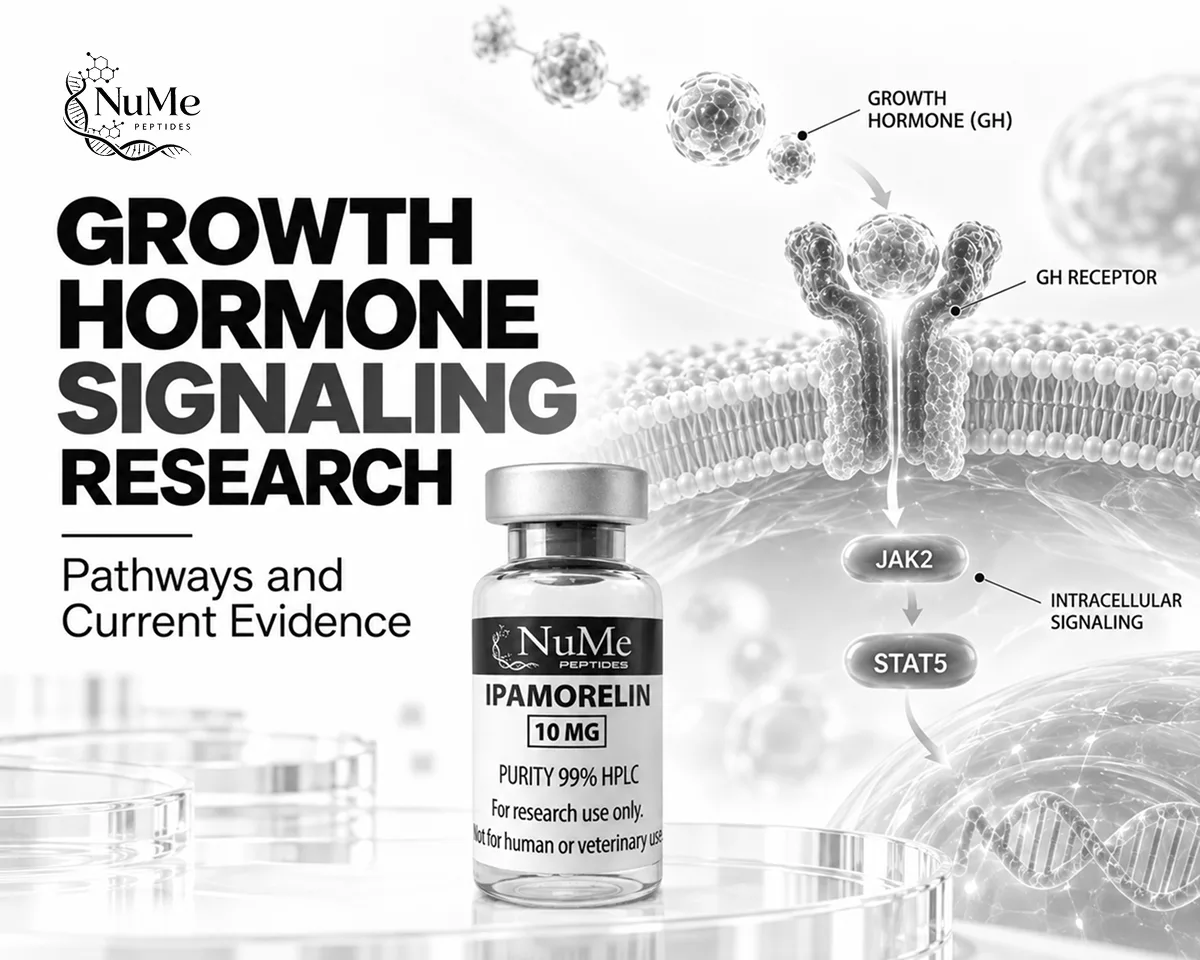
Once released, GH binds the growth hormone receptor (GHR) and activates intracellular pathways including JAK2–STAT5, MAPK/ERK, and PI3K–AKT–mTOR. These pathways connect GH exposure with gene transcription, metabolism, protein synthesis, cellular growth, and IGF-1 production. Current research therefore treats the GH–IGF-1 axis as a coordinated signalling network rather than a simple relationship between higher GH and stronger biological effects. (Tite Haro et al., 2026)
For researchers looking for peptide materials for laboratory investigation, visit the Nume Peptides to explore the available research peptide collection.
How Does Growth Hormone Signaling Work in Biological Research?
Growth hormone is secreted by somatotroph cells in the anterior pituitary. After entering circulation, GH binds GHRs expressed in tissues such as the liver, muscle, bone, and adipose tissue. Receptor activation then initiates several intracellular signalling pathways.
The best-characterized pathway is JAK2–STAT5. GH receptor activation stimulates JAK2, which phosphorylates STAT proteins, particularly STAT5. Activated STAT5 enters the nucleus and regulates GH-responsive genes, including pathways associated with hepatic IGF-1 production. (Tite Haro et al., 2026)
Other important pathways include:
- MAPK/ERK signalling, associated with cell growth and differentiation;
- PI3K–AKT signalling, involved in metabolism and cell-survival responses;
- mTOR-associated signalling, which links nutrient availability with protein synthesis;
- downstream IGF-1 production, an important endocrine component of the GH axis.
| Signalling component | Main research relevance |
|---|---|
| GHR | Initiates tissue responses to circulating GH |
| JAK2–STAT5 | Regulates GH-responsive gene transcription |
| MAPK/ERK | Supports growth and differentiation signalling |
| PI3K–AKT | Influences metabolic and survival pathways |
| IGF-1 | Provides a major downstream endocrine signal |
A higher serum GH concentration therefore does not automatically mean stronger downstream signalling. Receptor sensitivity, tissue type, nutritional state, and endocrine feedback can all influence the final biological response.
Explore research compounds studied for GH secretion, GHRH signaling, and secretagogue pathways in the Growth Hormone collection.
What Role Do the Pituitary Gland and Hormonal Pathways Play in Growth Hormone Secretion?
GH secretion is pulsatile rather than constant. Its pulse frequency and amplitude vary with sleep, age, sex, nutritional status, and metabolic state, which is why research often evaluates integrated GH exposure rather than relying on a single measurement.
Three major signals regulate this system. GHRH stimulates pituitary GH release, somatostatin suppresses it, and ghrelin activates the growth hormone secretagogue receptor GHS-R1a. These pathways interact with negative feedback from GH and IGF-1.
A simplified regulatory sequence includes:
- GHRH activates GHRH receptors on pituitary somatotrophs.
- Somatostatin suppresses GH secretion.
- Ghrelin and synthetic secretagogues activate GHS-R1a-related pathways.
- Circulating GH and IGF-1 contribute to feedback regulation.
- Physiological conditions modify the final secretory response.
The interaction between these pathways is clearly demonstrated in GHRP-6 research. In healthy men, blocking endogenous GHRH markedly reduced the GH response to GHRP-6, indicating that GHS-R-related activity depends partly on the existing hypothalamic environment. (Pandya et al., 1998)
This means that pituitary GH secretion cannot be explained by receptor activation alone. Somatostatin tone, endogenous GHRH, baseline GH secretion, and endocrine feedback all contribute to the measured response.
How Are Peptides Studied in Growth Hormone Signaling and Secretion Research?
Researchers use several experimental approaches depending on whether they are examining receptor activity, pituitary secretion, pharmacokinetics, pulsatility, or downstream signalling.
Endocrine challenge studies
In endocrine challenge studies, researchers expose participants or experimental systems to a defined peptide and measure GH responses over time.
Typical endpoints include:
- baseline and peak GH;
- time to peak GH;
- GH area under the curve;
- pulse frequency and amplitude;
- circulating IGF-1;
- additional pituitary hormones when relevant.
Ipamorelin has been studied using this model. A randomized study in healthy male volunteers characterized its pharmacokinetics and GH responses across several infusion rates, providing direct human evidence of growth hormone-releasing activity. (Gobburu et al., 1999)
Pharmacokinetic and pulsatility studies
Pharmacokinetic research evaluates how a peptide behaves over time, while pharmacodynamic research measures the biological response it produces. This is particularly important when comparing short-acting secretagogues with long-acting GHRH analogues.
In healthy men, DAC-linked CJC-1295 increased mean and trough GH concentrations while preserving pulsatile secretion. This demonstrates that a peptide can alter overall hormone exposure without completely eliminating the natural pulse pattern. (Ionescu & Frohman, 2006)
Downstream signalling studies
For broader growth hormone signaling research, researchers may extend measurements beyond serum GH to examine:
- GHR activation;
- STAT5 phosphorylation;
- IGF-1 production;
- GH-responsive gene expression;
- tissue-specific metabolic effects.
The overall pathway can therefore be viewed as:
Peptide receptor activation → Pituitary GH secretion → Circulating GH → GHR activation → Intracellular signalling → IGF-1 and tissue responses
Which Peptides Are Investigated in Growth Hormone Pathway Research?
The main peptides discussed in this field fall into two broad mechanistic groups. Ipamorelin and GHRP-6 are primarily associated with GHS-R1a-related signalling, while Sermorelin, Tesamorelin, and CJC-1295-related compounds act mainly through the GHRH receptor pathway.
| Peptide | Primary pathway | Main research focus |
|---|---|---|
| Ipamorelin | GHS-R1a-related | Selective GH secretagogue signalling |
| GHRP-6 | GHS-R1a-related | GH release and GHRH interaction |
| CJC-1295 | GHRH receptor | Modified or prolonged GHRH signalling |
| Sermorelin | GHRH receptor | GHRH(1-29)-based pituitary stimulation |
| Tesamorelin | GHRH receptor | GH pulsatility and downstream IGF-1 |
Ipamorelin and GHRP-6
Ipamorelin is a synthetic pentapeptide developed as a relatively selective GH secretagogue. Human pharmacokinetic-pharmacodynamic research demonstrated a measurable GH response following exposure, making it useful for studying how GHS-R-related signalling translates into pituitary secretion. (Gobburu et al., 1999)
GHRP-6 is an earlier synthetic secretagogue with an extensive endocrine research history. Its importance lies partly in demonstrating that ghrelin-receptor-related signalling interacts with endogenous GHRH. Blocking endogenous GHRH substantially reduced GHRP-6-induced GH secretion in human research. (Pandya et al., 1998)
Together, these peptides provide useful models for studying the GHS-R side of GH regulation, while also showing that compounds within the same class can have different endocrine profiles.
CJC-1295
CJC-1295 is a modified GHRH analogue, but its exact molecular form is important. Published human studies primarily examined a long-acting version containing a Drug Affinity Complex, or DAC.
In healthy adults, DAC-linked CJC-1295 produced sustained, dose-dependent increases in mean GH and IGF-1 concentrations. The peptide also had a substantially prolonged half-life compared with short-acting GHRH fragments. (Teichman et al., 2006)
These findings should not automatically be transferred to CJC-1295 materials without DAC. Researchers should verify:
- amino-acid sequence;
- molecular mass;
- presence or absence of DAC;
- HPLC purity;
- identity testing;
- batch-specific documentation.
Sermorelin
Sermorelin corresponds to GHRH(1-29)-NH2, the biologically active N-terminal region of endogenous GHRH. Human experiments demonstrated that this shorter fragment retains substantial GH-releasing activity. (Barron et al., 1985)
Sermorelin is therefore useful for examining direct GHRH receptor stimulation and comparing that pathway with GHS-R-mediated secretagogue responses.
Tesamorelin
Tesamorelin is a stabilized GHRH analogue with a comparatively strong human research base. In healthy men, Tesamorelin increased basal and pulsatile GH secretion while also increasing circulating IGF-1. (Stanley et al., 2011)
Because it has been studied more extensively in humans than many experimental secretagogues, Tesamorelin provides useful comparative evidence for understanding how GHRH receptor stimulation affects the broader GH–IGF-1 axis.
What Does Current Research Show About Growth Hormone Signaling and Secretion?
Current evidence supports a layered model of GH biology. Peptide receptor activation occurs upstream, pituitary GH secretion follows, and circulating GH subsequently activates receptors in peripheral tissues. These receptors then trigger intracellular pathways such as JAK2–STAT5, MAPK/ERK, and PI3K–AKT.
Several principles are important when interpreting the evidence:
- GH secretion and GH receptor signalling are separate endpoints.
- GHRH receptor agonists and GHS-R secretagogues use different upstream receptor systems.
- GH pulse structure may remain important even when total exposure increases.
- IGF-1 responses depend on more than the height of a single GH peak.
- peptide structure and pharmacokinetics can substantially alter endocrine exposure.
- evidence from one molecular form should not automatically be applied to another.
CJC-1295 illustrates the importance of exposure duration. The DAC-linked form produced sustained GH and IGF-1 elevation, while separate research showed that pulsatile GH secretion remained detectable during prolonged stimulation. (Teichman et al., 2006) (Ionescu & Frohman, 2006)
For this reason, researchers often obtain a clearer picture by measuring several variables together rather than relying on a single GH concentration.
Canadian research context
Health Canada reports that unauthorized synthetic peptide products promoted for human use have been identified in Canada. Its peptide information includes CJC-1295 and Ipamorelin among compounds found in unauthorized products promoted for purposes such as bodybuilding, anti-aging, wellness, or athletic performance. (Health Canada, 2026)
This regulatory context is separate from legitimate laboratory research. Experimental evidence showing changes in receptor activity, GH secretion, or IGF-1 does not establish therapeutic authorization or clinical effectiveness.
Explore research compounds studied for GH secretion, GHRH signaling, and secretagogue pathways in the Growth Hormone collection.
FAQs About Growth Hormone Signaling and Secretion Research
What Is Growth Hormone Signaling?
Growth hormone signalling begins when circulating GH binds to GHRs on target cells, activating intracellular pathways such as JAK2–STAT5, MAPK/ERK, and PI3K–AKT.
Is GH Secretion the Same as GH Receptor Signaling?
No. GH secretion refers to release of the hormone from the pituitary, while GH receptor signalling occurs after circulating GH reaches target tissues.
Which Peptides Act Through GHS-R1a-Related Pathways?
Ipamorelin and GHRP-6 are commonly investigated as synthetic growth hormone secretagogues associated with GHS-R1a-related signalling.
Which Peptides Act Through the GHRH Receptor?
Sermorelin, Tesamorelin, and CJC-1295-related peptides primarily belong to the GHRH analogue side of the GH regulatory system.
Why Is CJC-1295 Molecular Identity Important?
Published human evidence largely involves DAC-linked CJC-1295. A No-DAC material should not automatically be assumed to have the same half-life, GH exposure, or IGF-1 response.
Does a Higher GH Peak Guarantee Higher IGF-1?
No. IGF-1 production also depends on integrated GH exposure, GHR sensitivity, hepatic responsiveness, nutritional state, and feedback regulation.
Conclusion
Growth hormone signaling research is best understood as a sequence linking hypothalamic regulation, pituitary secretion, circulating GH, growth hormone receptor activation, intracellular signalling, and downstream IGF-1 production.
Ipamorelin and GHRP-6 are primarily investigated through GHS-R-related secretagogue mechanisms, while Sermorelin, Tesamorelin, and CJC-1295-related compounds provide models of GHRH receptor stimulation. Their receptor targets, pharmacokinetics, effects on GH pulsatility, and downstream evidence differ enough that they should not be treated as interchangeable compounds.
For researchers looking for peptide materials for laboratory investigation, visit the Nume Peptides to explore the available research peptide collection.
Disclaimer: This content is provided for educational and scientific research purposes only. Research peptides are intended for laboratory research only and are not intended for human consumption or medical use.