
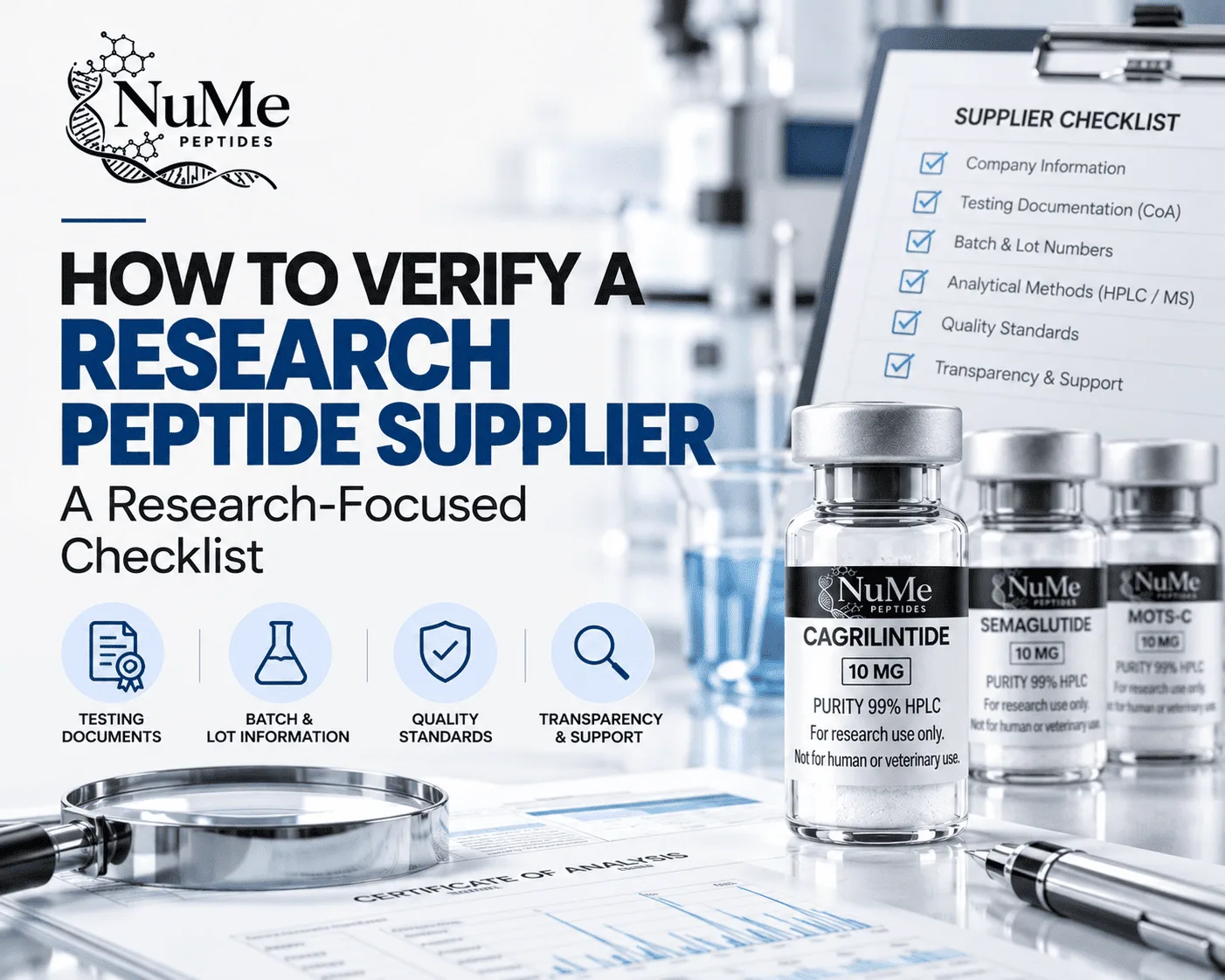
How to Verify a Research Peptide Supplier: A Research-Focused Checklist


Knowing how to verify a research peptide supplier requires more than checking a purity claim or reading product-page language. For laboratory research, supplier evaluation should focus on whether the material can be traced to a specific batch, whether analytical claims are supported by appropriate testing, and whether the documentation is detailed enough for researchers to review.
This matters because synthetic peptides from different suppliers can vary in identity, purity, impurity profile, and documentation quality. Research comparing commercially sourced peptide materials has demonstrated meaningful differences between labelled specifications and independent analytical findings. (De Spiegeleer et al., 2008)
In Canada, Health Canada’s GMP framework for regulated active pharmaceutical ingredients provides a useful quality benchmark. It emphasizes supplier qualification, batch traceability, appropriate analytical methods, Certificates of Analysis, and documented testing. These requirements apply to regulated APIs rather than ordinary research peptides, but the underlying principles are useful when researchers evaluate laboratory materials. (Health Canada, 2022)
For researchers looking for peptide materials for laboratory investigation, visit NuMe Peptides to explore the available research peptide collection.
For researchers looking for peptide materials for laboratory investigation, visit the Nume Peptides to explore the available research peptide collection.
What Information Should Researchers Verify Before Evaluating a Supplier?
Supplier verification should begin before reviewing a single purity percentage.
Researchers first need to determine whether the supplier provides enough information to identify the business, the material, and the quality-control process behind it.
A practical first review includes:
- identifiable supplier or business information;
- clear research-use positioning;
- detailed product specifications;
- batch or lot identification;
- Certificate of Analysis availability;
- analytical testing information;
- storage guidance;
- quality-control contact information;
- shipping and handling information.
The objective is not simply to find a professional-looking website. Instead, researchers should be able to follow a quality claim from the product description to a specific batch and then to supporting analytical documentation.
Health Canada’s regulated API framework treats supplier qualification as a documented quality process. It includes supplier evaluation, testing, traceability, and periodic verification rather than assuming that previous performance guarantees future quality. (Health Canada, 2022)
For researchers looking for peptide materials for laboratory investigation, browse the Nume Peptides Shop to explore the available research collection.
Separate claims from evidence
Statements such as “high purity,” “premium quality,” or “lab tested” provide limited analytical information on their own.
Stronger documentation answers questions such as:
- Which batch was tested?
- Which analytical method was used?
- What numerical result was obtained?
- When was testing performed?
- Who performed the analysis?
- Does the report match the supplied material?
This distinction is central to understanding how to verify a research peptide supplier systematically.
For researchers looking for peptide materials for laboratory investigation, browse the NuMe Peptides Shop to explore the available research collection.
How Can Researchers Review a Supplier’s Testing Documentation?
Testing documentation should explain what was measured, how it was measured, and which batch the result represents.
Review the Certificate of Analysis
A useful COA may include:
- peptide or compound name;
- lot or batch number;
- analytical test date;
- HPLC purity result;
- mass-spectrometry identity result;
- numerical findings;
- testing laboratory information;
- specifications or acceptance criteria where applicable.
Within Health Canada’s regulated API framework, Certificates of Analysis are expected to identify the relevant batch and report appropriate tests and results. Research peptides do not automatically fall under those pharmaceutical API requirements, but the same principles provide a useful model for transparent documentation. (Health Canada, 2022)
Check whether different tests answer different questions
A supplier may provide both HPLC and mass-spectrometry results because these methods measure different characteristics.
HPLC primarily provides information about chromatographic separation and relative peak areas. Mass spectrometry provides molecular-mass information that can support peptide identity.
Consensus recommendations for peptide reference materials also emphasize characterization, purity assessment, peptide content, storage, and handling rather than relying on one test alone. (Hoofnagle et al., 2016)
| Documentation item | What researchers can evaluate |
|---|---|
| Batch-specific COA | Whether testing applies to the supplied lot |
| HPLC result | Relative chromatographic purity |
| Mass spectrum | Molecular-mass evidence |
| Test date | When analysis occurred |
| Laboratory identity | Who performed the testing |
| Specifications | Criteria used to evaluate results |
A certificate becomes more useful when these pieces of information can be connected rather than appearing as isolated claims.
How Can Batch and Lot Information Help With Verification?
Batch traceability is one of the most important parts of supplier verification.
A laboratory result is directly relevant only when researchers can connect it to the material they actually received.
Match the product to the COA
Researchers should compare:
- peptide name;
- product presentation;
- lot number on the product;
- batch number on the COA;
- testing date.
If the lot identifier on the product does not match the certificate, the report may describe another production batch.
That matters because different batches can vary in impurity patterns, manufacturing history, or storage conditions even when they contain the same nominal peptide sequence.
Research comparing synthetic peptides from multiple manufacturers found differences in identity and impurity profiles that could affect experimental interpretation. (De Spiegeleer et al., 2008)
Why lot-specific records matter
Batch documentation can also help researchers investigate unexpected experimental findings.
If an unusual result appears, researchers can:
- identify the exact batch used;
- review its COA;
- compare HPLC and MS data;
- compare another production lot;
- examine storage history;
- determine whether analytical retesting is appropriate.
A useful traceability chain therefore looks like:
Product → Lot number → Matching COA → Analytical results → Test date → Laboratory
For researchers looking for peptide materials for laboratory investigation, browse the Nume Peptides Shop to explore the available research collection.
What Should Researchers Look for When Reviewing Laboratory Test Results?
Understanding how to verify a research peptide supplier also requires knowing what individual laboratory results can and cannot establish.
HPLC results
When HPLC documentation is available, researchers may review:
- reported purity percentage;
- principal chromatographic peak;
- secondary peaks;
- chromatogram;
- retention information;
- analytical method details.
A result such as 99% HPLC purity generally refers to the relative chromatographic area associated with the main detected peak under the selected method.
It should not automatically be interpreted as 99% target peptide by total vial weight.
Chemical purity and net peptide content are separate analytical concepts. (Hoofnagle et al., 2016)
Mass-spectrometry results
MS documentation may include:
- theoretical molecular mass;
- observed molecular mass;
- ion pattern;
- mass spectrum;
- additional molecular species.
Agreement between theoretical and observed molecular mass can support peptide identity.
However, mass spectrometry does not automatically establish chromatographic purity.
Reviews of synthetic peptide characterization describe LC-MS as particularly useful because it combines chromatographic separation with molecular-mass information and can assist with characterization of peptide-related impurities. (Lian et al., 2021)
Look for consistency across results
A stronger documentation set may show:
- HPLC indicating one dominant chromatographic component.
- MS showing a molecular mass consistent with the intended peptide.
- Matching lot numbers on the product and COA.
- A clear analytical testing date.
- An identifiable testing laboratory.
The purpose is not to require every possible analytical method. Instead, the available evidence should support the specific quality claim being made.
For researchers looking for peptide materials for laboratory investigation, browse the Nume Peptides Shop to explore the available research collection.
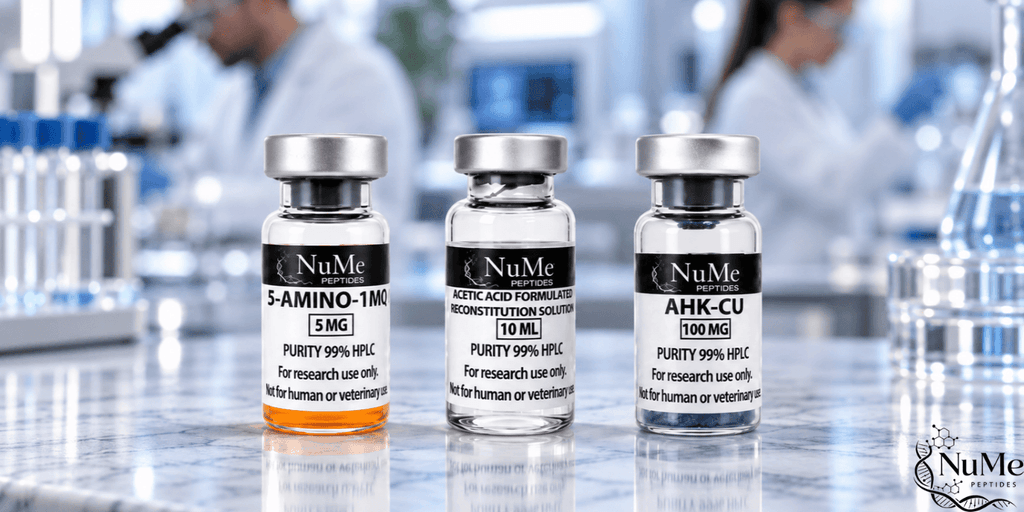
What Warning Signs Can Indicate Incomplete or Unclear Supplier Documentation?
A strong verification process also requires recognizing missing or ambiguous information.
Potential warning signs include:
- no batch-specific COA;
- COA batch number that does not match the product;
- purity claims without a stated analytical method;
- identity claims without supporting analytical evidence;
- missing test dates;
- unidentified testing laboratory;
- identical certificates reused across different lots;
- only a headline purity percentage with no analytical context;
- inconsistent information between product pages and documentation;
- claims that exceed what the reported test can demonstrate.
Treat “third-party tested” as a claim that still requires evidence
Independent testing can add useful separation between the supplier and analytical laboratory. However, the phrase “third-party tested” does not independently establish quality.
Researchers should determine:
- Is the laboratory identified?
- Does the report correspond to the correct lot?
- Are numerical results shown?
- Are the analytical methods identified?
- Is the test date relevant?
- Can the document be connected to the product?
Use a structured verification checklist
| Verification question | Stronger evidence |
|---|---|
| Is the supplier identifiable? | Clear business and contact information |
| Is the material traceable? | Matching batch and lot numbers |
| Was purity evaluated? | HPLC result and supporting data |
| Was identity evaluated? | MS or equivalent identity analysis |
| Is the laboratory identifiable? | Laboratory name and report details |
| Are results relevant? | Appropriate analytical test date |
| Can claims be reviewed? | Numerical results and supporting records |
Supplier documentation should therefore be treated as evidence to evaluate rather than automatic proof of quality.
Learn how identity, purity, analytical testing, and documentation work together when evaluating peptide materials in our guide: Research Peptide Quality: How to Evaluate Testing, Documentation and Verification.
Learn how identity, purity, analytical testing, and documentation work together when evaluating peptide materials in our guide: Research Peptide Quality: How to Evaluate Testing, Documentation and Verification
FAQs About Research Peptide Supplier Verification
How Do I Verify a Research Peptide Supplier?
Start by checking supplier transparency, batch-specific documentation, analytical methods, laboratory information, and whether the COA corresponds to the material supplied.
Avoid relying exclusively on purity percentages or marketing terminology.
Is a COA Enough to Verify a Supplier?
No.
A COA becomes more useful when it clearly identifies the batch, analytical methods, numerical results, test date, and testing laboratory.
Should the COA Batch Number Match the Product?
Yes.
A certificate associated with another production lot does not directly characterize the material currently being studied.
Is Third-Party Testing Always Better?
Not automatically.
Independent testing can improve transparency, but researchers should still review the testing method, laboratory identity, batch relationship, and analytical results.
Which Tests Are Commonly Used for Research Peptides?
The appropriate method depends on the analytical question. Common approaches include:
- HPLC for chromatographic purity;
- MS for molecular-mass and identity evidence;
- LC-MS for combining separation with molecular information;
- peptide-content analysis when quantitative accuracy is relevant;
- stability testing when changes over time need to be evaluated.
Can Customer Reviews Verify Research Peptide Quality?
No.
Reviews may provide information about ordering, communication, or shipping, but they do not replace analytical verification.
For laboratory research, lot-specific analytical documentation provides more direct evidence about the material itself.
Conclusion
Knowing how to verify a research peptide supplier requires a structured review of evidence rather than reliance on one purity claim or quality label.
Researchers should consider:
- supplier transparency;
- batch and lot traceability;
- Certificate of Analysis quality;
- HPLC documentation;
- mass-spectrometry identity testing;
- laboratory identification;
- analytical test dates;
- consistency between product claims and analytical results.
The strongest documentation creates a traceable connection between the physical product, its production batch, and the analytical results associated with that batch.
Health Canada’s regulated API framework provides a useful Canadian quality reference because it emphasizes supplier qualification, traceability, appropriate analytical procedures, documented testing, and reliable Certificates of Analysis. (Health Canada, 2022)
For researchers looking for peptide materials for laboratory investigation, visit the Nume Peptides to explore the available research peptide collection.
Disclaimer: This content is provided for educational and scientific research purposes only. Research peptides are intended for laboratory research only and are not intended for human consumption or medical use.


Verifying a research peptide supplier is an important step that shouldn’t be overlooked. Checking certificates of analysis, testing methods, and batch-specific documentation can help researchers make more informed decisions when evaluating product quality.
I like the emphasis on transparency and documentation. A professional supplier should be able to provide clear product information and relevant testing records, rather than relying on marketing claims alone.
This is a useful checklist for anyone assessing suppliers in the research peptide field. I would also compare the stated purity results with the actual testing documentation and look for independent verification where available.