
HPLC vs Mass Spectrometry Peptides: What’s the Difference?


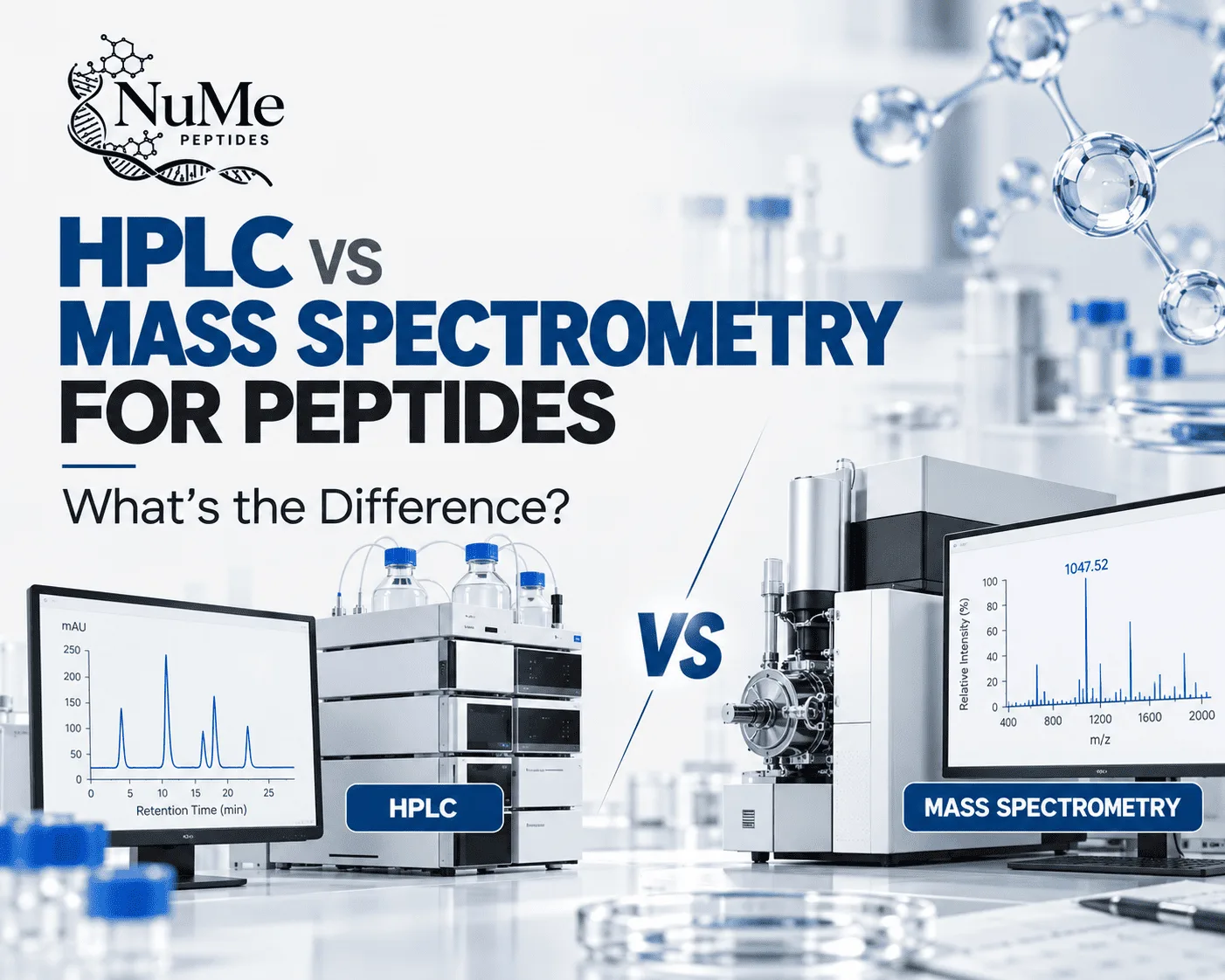
When comparing HPLC vs mass spectrometry peptides analysis, the key difference is that the two methods answer different analytical questions. High-performance liquid chromatography focuses on separating compounds according to chromatographic behaviour, while mass spectrometry measures ion mass-to-charge ratios and provides information about molecular mass and identity.
This distinction is important in peptide research. A strong HPLC result may show that one chromatographic component dominates a sample, but it does not independently prove that the peak belongs to the intended peptide. Likewise, detecting the expected molecular mass by mass spectrometry does not automatically establish chromatographic purity.
For this reason, researchers often interpret HPLC and MS results together rather than treating them as competing tests. Health Canada’s analytical-quality framework similarly emphasizes that analytical procedures should be appropriate for the specific characteristic being evaluated. (Health Canada, 2022)
For researchers looking for peptide materials for laboratory investigation, visit the Nume Peptides to explore the available research peptide collection.
How Do HPLC and Mass Spectrometry Analyze Peptides Differently?
HPLC and mass spectrometry examine different physical or chemical characteristics of a peptide sample.
HPLC separates components as they move through an analytical column. Different compounds interact with the stationary and mobile phases differently, causing them to elute at different retention times.
Mass spectrometry works differently. Molecules are ionized, separated according to mass-to-charge ratio, and detected as a mass spectrum.
The distinction can be summarized as follows:
| Analytical feature | HPLC | Mass spectrometry |
|---|---|---|
| Primary measurement | Chromatographic separation | Mass-to-charge ratio |
| Main output | Chromatogram | Mass spectrum |
| Common use | Relative purity and separation | Molecular mass and identity |
| Main comparison | Peak areas and retention times | Theoretical vs observed mass |
| Impurity information | Shows resolved secondary peaks | Can characterize mass-related variants |
| Identity confirmation | Limited alone | Strong supporting evidence |
Peptide-analysis literature describes chromatography and mass spectrometry as complementary because synthetic peptide characterization frequently requires information about both separation and molecular composition. (Patel et al., 2022)
Therefore, the better question is not “Which method is superior?” but “Which analytical property needs to be measured?”
For researchers looking for peptide materials for laboratory investigation, browse the Nume Peptides Shop to explore the available research collection.
What Information Can HPLC Provide About a Peptide Sample?
HPLC is particularly useful for evaluating chromatographic composition.
Relative chromatographic purity
One of the most common outputs is a relative peak-area percentage.
If the principal chromatographic peak represents approximately 99% of the integrated detector signal, the report may state approximately 99% HPLC purity.
However, this does not automatically mean that 99% of the total material by weight is target peptide.
The sample may also contain:
- water;
- counterions;
- salts;
- residual solvents;
- substances with weak detector response;
- non-peptide material.
Consensus recommendations for synthetic peptide standards distinguish chemical purity from net peptide content because the two measurements answer different quantitative questions. (Hoofnagle et al., 2016)
Chromatographic impurity patterns
HPLC can reveal additional resolved peaks associated with other detectable species.
Potential peptide-related impurities may include:
- truncated sequences;
- deletion peptides;
- oxidation products;
- deamidated variants;
- incomplete synthesis products;
- storage-related degradation products.
The presence of a secondary peak can indicate that another chromatographically distinct species exists. However, the chromatogram alone may not reveal its molecular identity.
Batch comparison
When the same analytical method is used, HPLC can help researchers compare:
- principal peak retention time;
- number of secondary peaks;
- relative peak areas;
- overall chromatographic profile;
- changes after storage.
Changes in analytical columns, solvent gradients, flow rates, temperatures, or detector settings can also influence results. Therefore, direct comparisons require consistent methodology.
What Information Can Mass Spectrometry Provide About Peptide Identity?
Mass spectrometry is most useful when the research question focuses on molecular mass and identity.
Theoretical vs observed molecular mass
A peptide’s amino-acid composition allows researchers to calculate an expected theoretical molecular mass.
Mass spectrometry measures peptide ions and can estimate the corresponding experimental molecular mass.
When the measured value closely matches the expected value, the result supports the presence of the intended molecular species.
Modern mass spectrometry is widely used in synthetic peptide quality control because it can provide highly specific information about peptide authenticity, integrity, and molecular variants. (Højrup, 2024)
Detection of mass changes
Unexpected molecular masses may suggest:
- oxidation;
- certain deamidation-related changes;
- amino-acid loss;
- sequence truncation;
- adduct formation;
- selected modifications;
- degradation-related variants.
For example, an oxidized peptide may show a predictable mass increase, while a truncated peptide may produce a smaller molecular species.
Tandem mass spectrometry
MS/MS can provide more detailed structural information.
The instrument selects an ion, fragments it, and analyzes the resulting fragment ions. Researchers can then use fragmentation patterns to obtain additional sequence-related information.
However, intact molecular mass does not establish every structural characteristic. Positional isomers, some stereoisomers, and other closely related structures can have identical or nearly identical masses.
For researchers looking for peptide materials for laboratory investigation, browse the Nume Peptides Shop to explore the available research collection.
Why Can HPLC and Mass Spectrometry Complement Each Other?
HPLC and mass spectrometry complement each other because one method provides separation information while the other provides molecular information.
Consider a peptide sample with one dominant HPLC peak and three smaller peaks.
HPLC may reveal:
- one principal chromatographic component;
- three secondary components;
- relative peak areas;
- retention times.
However, it may not reveal what those minor peaks actually are.
Mass spectrometry can then provide molecular-mass information that may help characterize those species.
How LC-MS combines both approaches
LC-MS connects chromatography directly to mass spectrometry.
First, liquid chromatography separates sample components. As each component leaves the column, it enters the mass spectrometer for molecular analysis.
This workflow can help researchers:
- associate a chromatographic peak with a molecular mass;
- investigate oxidation-related variants;
- characterize truncated peptides;
- analyze degradation products;
- distinguish certain synthesis-related impurities.
Synthetic peptide impurity research identifies LC-MS as an important method for investigating structurally related impurities formed during manufacturing and storage. (Lian et al., 2021)
A simplified comparison is:
| Result | What it mainly tells researchers |
|---|---|
| HPLC main peak | Dominant chromatographic component |
| HPLC secondary peaks | Other resolved species may be present |
| MS expected mass | Supports molecular identity |
| Additional MS masses | May indicate molecular variants |
| LC-MS | Links chromatographic species with mass information |
This is why a 99% HPLC result and a matching MS result provide stronger combined evidence than either measurement interpreted alone.
For researchers looking for peptide materials for laboratory investigation, browse the Nume Peptides Shop to explore the available research collection.
Which Analytical Method Is Appropriate for Different Research Questions?
Method selection should start with the research question.
When HPLC is more informative
HPLC may be particularly useful when researchers need to investigate:
- relative chromatographic purity;
- secondary chromatographic peaks;
- separation efficiency;
- batch-to-batch patterns;
- changes during stability studies;
- purification performance.
When mass spectrometry is more informative
MS may be more appropriate when the main objective involves:
- expected molecular mass;
- peptide identity;
- mass-related modifications;
- degradation products;
- characterization of selected impurities.
When LC-MS is useful
LC-MS can be valuable when researchers need both chromatographic separation and molecular information.
For example, a researcher may detect a small secondary HPLC peak but not know whether it represents oxidation, truncation, or another peptide-related species.
LC-MS may help associate that chromatographic peak with a particular molecular mass.
| Research question | HPLC | MS | LC-MS |
|---|---|---|---|
| Relative chromatographic purity | Strong | Limited | Strong |
| Molecular mass | Limited | Strong | Strong |
| Identity support | Limited | Strong | Strong |
| Detect resolved secondary peaks | Strong | Limited | Strong |
| Characterize impurity mass | Limited | Strong | Strong |
| Link peak to molecular species | Limited | Limited | Strong |
| Compare chromatographic batches | Strong | Moderate | Strong |
Health Canada’s analytical principles similarly emphasize that a method should be suitable for its intended analytical purpose rather than expected to answer every quality question. (Health Canada, ICH Q2(R2))
Learn how identity, purity, analytical testing, and documentation work together when evaluating peptide materials in our guide: Research Peptide Quality: How to Evaluate Testing, Documentation and Verification
FAQs About HPLC vs Mass Spectrometry Peptides
Is HPLC or Mass Spectrometry Better for Peptide Testing?
Neither method is universally better. HPLC is particularly useful for chromatographic separation and relative purity analysis, while mass spectrometry provides molecular-mass information that supports identity assessment.
Can HPLC Confirm the Molecular Mass of a Peptide?
No. HPLC measures chromatographic behaviour rather than molecular mass. Mass spectrometry is more appropriate when researchers need to compare theoretical and observed molecular mass.
Can Mass Spectrometry Replace HPLC Purity Testing?
Not directly. Mass spectrometry can detect the expected molecular species, but it does not measure chromatographic purity in the same way as HPLC peak-area analysis.
Why Are HPLC and MS Often Used Together?
They answer different questions. HPLC separates components, while MS provides molecular information. Combining the techniques can offer a more complete analytical picture. (Lian et al., 2021)
What Does LC-MS Add to Peptide Analysis?
LC-MS allows researchers to connect a chromatographic peak with mass information.
This can help investigate peptide-related impurities, degradation products, and molecular variants.
Does a 99% HPLC Result and Matching MS Mass Prove Complete Peptide Quality?
No. A broader evaluation may also consider:
- peptide content;
- impurity profile;
- batch-specific COA;
- analytical method quality;
- stability;
- storage conditions;
- lot traceability.
Conclusion
The comparison of HPLC vs mass spectrometry peptides analysis is best understood as a comparison between two complementary analytical approaches.
HPLC is primarily useful for chromatographic separation, relative purity assessment, and detecting resolved secondary components. Mass spectrometry provides molecular-mass information that can support peptide identity and characterize certain molecular variants.
When researchers need both separation and molecular information, LC-MS can connect these two forms of evidence.
A systematic analytical evaluation may therefore consider:
- chromatographic purity;
- retention behaviour;
- peak separation;
- theoretical molecular mass;
- observed molecular mass;
- additional molecular species;
- impurity characterization;
- batch-specific analytical documentation.
Neither technique should be expected to answer every quality question alone. Instead, researchers should choose methods according to the analytical property they need to measure.
For researchers looking for peptide materials for laboratory investigation, visit the Nume Peptides to explore the available research peptide collection.
Disclaimer: This content is provided for educational and scientific research purposes only. Research peptides are intended for laboratory research only and are not intended for human consumption or medical use.


This comparison makes the differences between HPLC and mass spectrometry much easier to understand. I found the distinction between assessing peptide purity and verifying molecular identity particularly useful when learning about analytical testing methods.
I appreciate the side-by-side explanation of these two analytical techniques. Understanding what each method measures, along with its limitations, helps explain why HPLC and mass spectrometry can complement each other when characterizing peptide samples.
A useful resource for anyone exploring peptide quality control. The comparison highlights an important point: chromatographic purity results and mass confirmation provide different types of information, so interpreting them together can offer a more complete assessment of a sample.