
What Is Mass Spectrometry Peptide Testing? A Guide to Peptide Identity Analysis


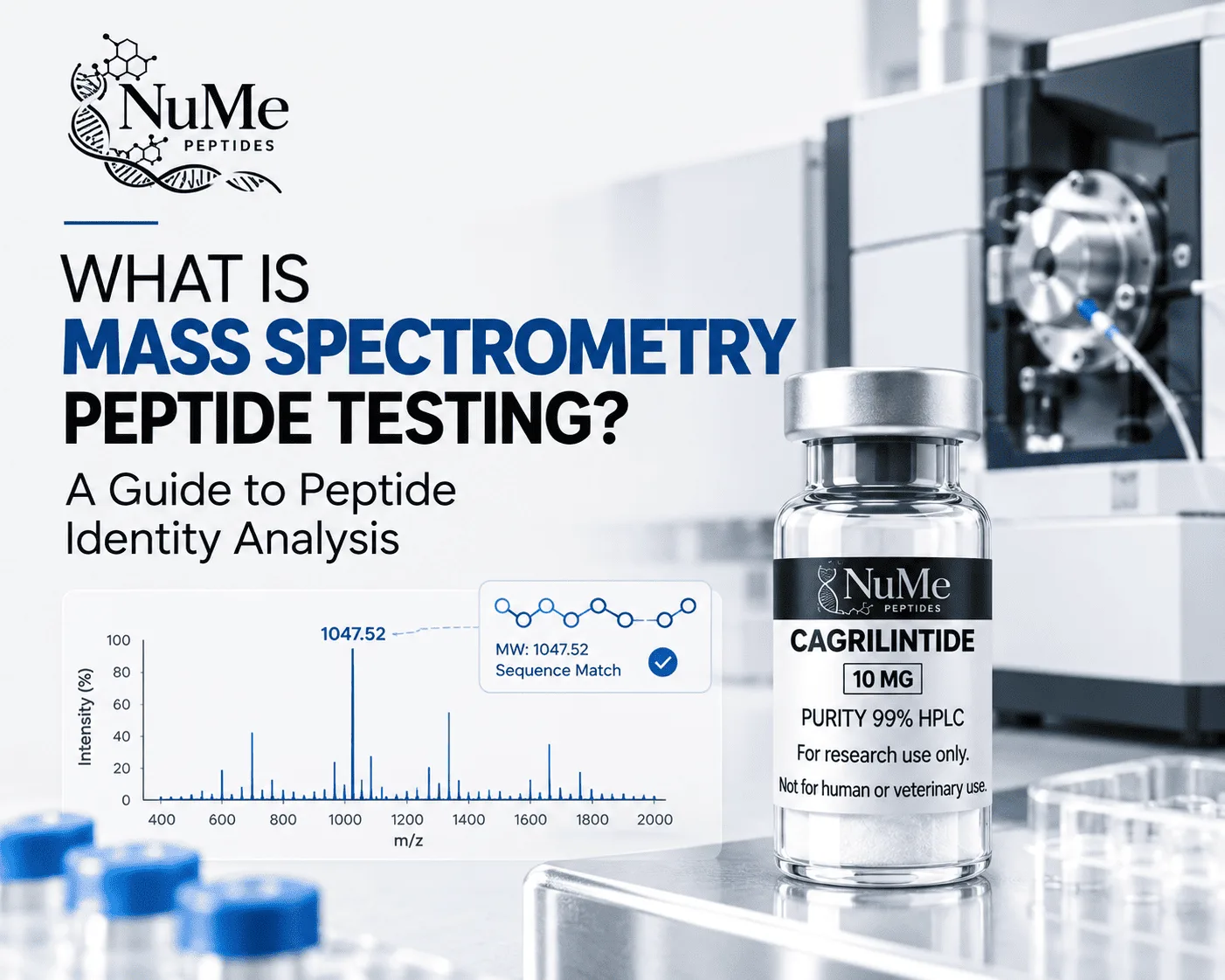
Mass spectrometry peptide testing is an important analytical approach for examining the molecular identity of synthetic research peptides. Instead of relying only on chromatographic behaviour, mass spectrometry measures the mass-to-charge ratios of ionized molecules and can help researchers determine whether a detected peptide is consistent with its expected molecular mass.
For peptide research, this distinction matters. A sample may show high HPLC purity while still requiring independent identity confirmation. Likewise, an expected molecular mass does not automatically demonstrate high purity. Researchers therefore often interpret mass-spectrometry data alongside chromatographic results, batch documentation, and other analytical evidence.
In Canada, Health Canada’s quality framework for regulated active pharmaceutical ingredients emphasizes scientifically appropriate analytical procedures, documented specifications, and reliable testing. These requirements apply to regulated APIs rather than ordinary research-use peptides, but they demonstrate an important analytical principle: the test method must be suitable for the question being evaluated. (Health Canada, 2022)
For researchers looking for peptide materials for laboratory investigation, visit the Nume Peptides to explore the available research peptide collection.
What Is Mass Spectrometry in Peptide Research?
Mass spectrometry, commonly abbreviated as MS, is an analytical technique that measures ions according to their mass-to-charge ratio, or m/z.
During peptide analysis, molecules are converted into gas-phase ions. These ions are then separated and detected according to their m/z values. The resulting mass spectrum provides information researchers can use to investigate molecular mass and identity.
Modern peptide analysis commonly uses soft-ionization techniques that allow large biomolecules to enter the mass spectrometer with relatively limited fragmentation during initial ionization.
Two widely used approaches include:
- electrospray ionization, or ESI;
- matrix-assisted laser desorption/ionization, or MALDI.
ESI can produce multiple charge states for the same peptide. Software can then deconvolute these signals to estimate the peptide’s neutral molecular mass.
Mass spectrometry has become central to peptide characterization because it can provide highly specific molecular information and support the detection of peptide variants, modifications, and impurities. (Højrup, 2024)
However, MS should not be interpreted as a universal measure of every quality attribute. It answers different questions from HPLC, peptide-content analysis, or stability testing.
For researchers looking for peptide materials for laboratory investigation, browse the Nume Peptides Shop to explore the available research collection.
How Does Mass Spectrometry Analyze Peptide Samples?
Mass spectrometry peptide testing generally involves several analytical stages.
Ionization
First, peptide molecules must become charged ions.
In electrospray ionization, a peptide-containing solution passes through a charged capillary and forms a fine spray. As solvent evaporates, charged peptide ions enter the mass spectrometer.
Larger peptides often carry several charges. Therefore, the spectrum may show a series of m/z peaks that represent different charge states of the same molecular species.
Mass analysis
The instrument then separates ions according to their mass-to-charge ratios.
Different mass analyzers can be used, including:
- quadrupoles;
- time-of-flight analyzers;
- ion traps;
- Orbitrap systems;
- combinations such as quadrupole-TOF.
Each platform has different characteristics for resolution, mass accuracy, scan speed, and fragmentation analysis.
Detection and spectrum generation
The separated ions are detected and converted into an electronic signal.
Software then produces a mass spectrum showing detected ion intensity against m/z.
Researchers can use this spectrum to compare experimental measurements with the theoretical mass calculated from the intended peptide sequence.
LC-MS analysis
Mass spectrometry is frequently combined with liquid chromatography.
In LC-MS, chromatography separates components before they enter the mass spectrometer. This can make complex samples easier to interpret because individual peptide-related species may enter the detector at different retention times.
LC-MS has become particularly useful for analyzing synthetic peptide impurities generated during synthesis, purification, processing, or storage. (Lian et al., 2021)
| Analytical stage | Primary purpose |
|---|---|
| Sample introduction | Deliver peptide material to the system |
| Ionization | Convert molecules into detectable ions |
| Mass analysis | Separate ions by m/z |
| Detection | Measure ion signals |
| Deconvolution | Estimate molecular mass from charge states |
| LC-MS separation | Distinguish peptide-related species before MS analysis |
What Can Molecular Mass Reveal About Peptide Identity?
One of the main uses of mass spectrometry peptide testing is comparing measured molecular mass with the theoretical mass expected from a peptide sequence.
Suppose a peptide has a calculated molecular mass based on its amino-acid composition. If mass spectrometry detects a molecular species with a closely matching experimental mass, the result supports the conclusion that the intended peptide may be present.
However, researchers should use careful language: matching mass supports identity rather than proving every structural characteristic.
Molecular mass can reveal unexpected changes
A difference between theoretical and observed mass may indicate several possibilities, including:
- oxidation;
- deamidation;
- loss or addition of amino acids;
- incomplete synthesis;
- adduct formation;
- certain post-synthetic modifications;
- degradation-related changes.
For example, oxidation of some amino-acid side chains can produce a predictable increase in molecular mass. Similarly, sequence truncation may produce a smaller species.
This ability to detect mass shifts makes MS valuable for investigating peptide-related impurities.
Reviews of synthetic peptide analysis describe high-resolution LC-MS as particularly useful for identifying and characterizing impurities that differ from the target peptide in molecular composition. (Lian et al., 2021)
Matching mass is not the same as complete structural proof
Two molecules can occasionally have the same nominal mass while differing structurally.
Examples may include:
- positional isomers;
- some sequence variants;
- stereoisomers;
- certain modifications with no net mass change.
Therefore, molecular mass should be interpreted as one part of a broader identity assessment.
Tandem mass spectrometry, or MS/MS, can provide additional structural information by fragmenting selected peptide ions and examining the resulting fragments.
For researchers looking for peptide materials for laboratory investigation, browse the Nume Peptides Shop to explore the available research collection.
How Are Mass Spectrometry Results Interpreted in Peptide Research?
A mass spectrum can initially appear more complex than an HPLC chromatogram because a single peptide may produce several ion peaks.
Understanding m/z
The x-axis of a typical spectrum represents mass-to-charge ratio.
For example, a peptide carrying multiple positive charges appears at a lower m/z than its neutral molecular mass.
Therefore, researchers should not assume that each major m/z value directly equals the peptide’s intact mass.
Software commonly deconvolutes multiple charge states to calculate an estimated neutral molecular mass.
Comparing theoretical and observed mass
A typical identity assessment may compare:
| Result | Purpose |
|---|---|
| Theoretical molecular mass | Expected value calculated from peptide composition |
| Observed molecular mass | Experimental result from MS |
| Mass difference | Difference between expected and observed values |
| Ion pattern | Supports interpretation of charge states |
| Additional masses | May indicate related molecular species |
The acceptable difference between theoretical and observed values depends on instrument performance, calibration, molecular size, and the analytical method.
Interpreting additional peaks
Additional MS signals do not automatically mean contamination.
They may represent:
- alternative charge states;
- isotope distributions;
- sodium or potassium adducts;
- oxidized peptide;
- fragments;
- peptide-related impurities.
Therefore, researchers must understand the analytical context before assigning an identity to each signal.
MS and HPLC answer different questions
This distinction is particularly important when reviewing a Certificate of Analysis.
HPLC generally provides information about chromatographic separation and relative peak areas. Mass spectrometry provides molecular-mass information.
A useful analytical workflow may therefore involve:
- HPLC to examine chromatographic composition.
- MS to investigate molecular identity.
- LC-MS to connect chromatographic peaks with molecular-mass information.
- Batch documentation to connect those findings to the research material.
Consensus recommendations for peptide standards also emphasize combining complementary analytical methods rather than relying on a single test. (Hoofnagle et al., 2016)
For researchers looking for peptide materials for laboratory investigation, browse the Nume Peptides Shop to explore the available research collection.
What Are the Limitations of Mass Spectrometry Peptide Testing?
Mass spectrometry peptide testing provides powerful identity information, but it has important limitations.
MS does not automatically measure chromatographic purity
Detecting the expected molecular mass does not establish that the entire sample consists of that peptide.
The intended peptide may be present alongside:
- truncated sequences;
- degradation products;
- synthesis-related impurities;
- residual non-peptide material.
Chromatographic techniques such as HPLC can therefore provide complementary purity information.
Isomers may be difficult to distinguish
Some molecules can have identical elemental compositions and molecular masses while differing structurally.
Consequently, intact-mass analysis may not distinguish every positional or stereochemical variation.
Additional separation methods or fragmentation analysis may be required.
Ionization efficiency varies
Different molecules do not necessarily ionize with equal efficiency.
One peptide-related impurity may generate a strong signal while another generates a weak signal even if their actual quantities are similar.
For this reason, peak intensity in a mass spectrum should not automatically be interpreted as exact concentration.
Adducts can complicate spectra
Peptide ions may associate with sodium, potassium, solvents, or other species.
These adducts can generate additional peaks and make interpretation more complex.
Sample preparation matters
Several factors can influence MS performance:
- solvent composition;
- salt concentration;
- peptide concentration;
- contaminants;
- ionization method;
- instrument calibration.
Therefore, a clean spectrum depends on both sample quality and analytical procedure.
Mass spectrometry cannot answer every quality question
MS alone does not fully establish:
- total peptide content;
- chromatographic purity;
- long-term stability;
- complete impurity profile;
- batch traceability;
- storage history.
Health Canada’s analytical-quality principles similarly emphasize that analytical procedures should be suitable for their intended purpose. A single method should not be expected to answer questions outside its analytical scope. (Health Canada, 2022)
Learn how identity, purity, analytical testing, and documentation work together when evaluating peptide materials in our guide: Research Peptide Quality: How to Evaluate Testing, Documentation and Verification
FAQs About Mass Spectrometry Peptide Testing
What Does Mass Spectrometry Peptide Testing Measure?
Mass spectrometry peptide testing measures ion mass-to-charge ratios. Researchers can use these measurements to estimate molecular mass and determine whether detected peptide species are consistent with the expected molecule.
Can Mass Spectrometry Confirm Peptide Identity?
It can provide strong supporting evidence.
When observed molecular mass closely matches the expected value, the result supports identity. However, additional structural or chromatographic analysis may be necessary when closely related molecules could share similar masses.
Does Mass Spectrometry Measure Peptide Purity?
Not in the same way as HPLC.
MS is highly useful for molecular identity and impurity characterization, while HPLC is commonly used to evaluate relative chromatographic purity.
Why Are HPLC and MS Often Used Together?
They provide complementary information.
HPLC separates components, whereas MS provides molecular-mass information. LC-MS combines both approaches and can help researchers investigate individual peptide-related peaks. (Lian et al., 2021)
What Does a Difference Between Theoretical and Observed Mass Mean?
The difference may result from modifications, degradation, adducts, sequence differences, analytical error, or other factors.
Researchers should evaluate the magnitude and pattern of the difference rather than assuming one explanation.
Is One Matching MS Peak Enough to Establish Peptide Quality?
No.
A broader evaluation may also consider:
- HPLC purity;
- impurity profile;
- batch-specific COA;
- peptide content where relevant;
- testing date;
- storage conditions;
- laboratory traceability.
Conclusion
Mass spectrometry peptide testing provides researchers with detailed molecular information that can support peptide identity assessment and the investigation of peptide-related variants.
Its key strength is the ability to compare experimental molecular mass with the value expected from a peptide’s composition. When coupled with chromatography, MS can also help researchers investigate impurities, degradation products, and other molecular species within a sample.
However, researchers should remember that molecular identity is only one component of peptide quality.
A systematic evaluation may consider:
- theoretical and observed molecular mass;
- mass accuracy;
- charge-state patterns;
- additional detected species;
- chromatographic purity;
- impurity characterization;
- batch-specific documentation;
- complementary analytical techniques.
Mass spectrometry should therefore be interpreted alongside HPLC and other quality information rather than as a replacement for them.
For researchers looking for peptide materials for laboratory investigation, visit the Nume Peptides to explore the available research peptide collection.
Disclaimer: This content is provided for educational and scientific research purposes only. Research peptides are intended for laboratory research only and are not intended for human consumption or medical use.


This is a useful introduction to mass spectrometry in peptide analysis. I found the explanation of how molecular mass data can help verify peptide identity particularly helpful, especially when distinguishing identity testing from purity analysis.
I appreciate how the article explains the role of mass spectrometry in peptide quality assessment. Understanding the relationship between measured mass, expected molecular weight, and analytical results provides useful context for interpreting laboratory reports.
A helpful resource for anyone learning about peptide characterization techniques. The discussion of mass spectrometry highlights why analytical methods are often used together, since confirming molecular identity alone does not necessarily establish sample purity.
For an illustration exercise, I am drawing the same fictional character with three hair colors while leaving the clothing and face unchanged. The character wears a blue shirt against a muted background, and I want each version to remain readable at a small size. My first options are dark brown, light copper, and silver, chosen because they create noticeably different relationships with the existing colors. I came across this reference while searching for terminology related to a personal color test as a starting point for further reading. I would like the terminology to help with critique, while leaving room for the intentional color exaggeration that illustration often uses. The issue is deciding whether the hair supports the face or distracts from it, especially when the picture is reduced in size. Should I compare the three color versions together and then inspect values, or begin with the value check before discussing hue? I would appreciate a few specific critique questions that keep the discussion focused on this drawing instead of general preferences about hair.
A small exhibition needs a repeating background track, and I am working out the preparation steps. I need to think about the transition between the final section and the opening passage. My plan is to separate the loop transition from questions about texture inside the music. I bookmarked remove suno artifacts while gathering possible references for the second question. Before choosing any processing, I would mark candidate loop points and listen through several repetitions. A separate check on the intended player should establish how it handles the end of the file. Once the transition is understood, I would consider whether any texture needs further attention. I would keep the original beside each trial version to compare the overall musical character. The final check would use the actual speakers and the expected exhibition playback level. Which order of checks would you recommend for a reliable exhibition loop?
I have a transition question while preparing a community radio practice segment. One generated song has a busy ending, and the spoken introduction follows immediately. I want to check the programme layout before making changes to the song itself. A short pause might be enough, although it changes the pace of the segment. I could also give the ending more time before introducing the next voice. For context, I have been reading discussions of suno shimmer in this context. That does not replace listening to this passage at a stable playback level. Would you try a brief gap or a restrained fade when speech follows a dense ending? We can record two versions of the transition and listen away from the editing screen, using the same playback level so that the louder option does not automatically seem clearer. I want the presenter to remain intelligible while the musical ending keeps its character.
Before asking for curtain bangs, I want to understand how their outline would work with the glasses I normally wear. The reference photos I saved mostly show people without frames, so they leave out an important part of my everyday appearance. I bookmarked a page during a search for blonde hair with curtain bangs and want to use references to start a discussion. My first comparison would be the length of the shortest pieces and how they sit beside the corners of the glasses. A slight cowlick changes my parting on some days, and I want to mention that before discussing a balanced curtain shape. I would take my regular glasses to the appointment and bring references that show a range of possible fringe lengths. The fallback matters too: I would want to know how easily the shorter pieces can be moved away from my face. A cautious first length seems sensible to me, especially if I can decide later whether I want a more noticeable fringe. For people who wear glasses daily, which fringe details proved most useful to discuss at the consultation before having it cut?
For an introductory music session, I want students to compare a few generated excerpts. Students should describe what they hear before discussing the source or processing method. My starting point is a set of lettered excerpts played at comparable levels. I would use one musical passage across versions so the arrangement stays familiar. I would ask for timestamps and descriptions before accepting an explanation of the sound. The group includes people with different listening experience, so technical vocabulary should be optional. I would collect individual notes before discussing them together, and let students replay the excerpt when they need to check whether their first impression holds up. I found a resource on ai audio artifact removal that might inform an optional later comparison. I have not evaluated it and would avoid presenting it as a demonstrated solution. The exercise needs room for the original version to be preferred. What listening prompts would help students describe differences without suggesting a winner?
I am looking for a first levada walk in Madeira, but route length alone does not tell me whether it will be comfortable. A moderate half-day walk sounds appealing, yet narrow paths beside steep drops are a different matter for me. I keep seeing references to tunnels, and I am not sure how much light or headroom to expect. I have looked through best levada walks in madeira but I would rather choose by conditions than by a ranking. If it rains overnight, I assume a route can feel quite different from its photos. Where would you check whether a path is open and decide whether to postpone instead of pressing on? The return journey is also part of the decision, because I will not have a car and would prefer not to rely on an uncertain pickup. I would be grateful for a less exposed starting route, plus any warning signs that would make you choose a different day or trail. I would be willing to change plans if conditions look poor.
We are sorting a box of family jewelry, and the color question has become more interesting than expected. There are both gold and silver tones in the box, alongside several designs that deliberately mix the two. We hope to share the jewelry according to personal interest without losing the family memories associated with it. I find it easy to notice whether I like a design, but harder to describe the effect of its metal tone. The pieces vary in size and finish, so a polished pendant and a delicate chain create very different impressions. Could similarly sized plain samples make the first comparison clearer before we try the more elaborate designs? I came across this while exploring color analysis but I would rather treat any result as an observation than let it overrule a sentimental attachment. What would make this a fair comparison, especially when a favorite piece is one someone already loves wearing?
Our library is hosting a small clothing swap, and I am preparing an optional discussion about choosing colors from the available donations. The activity should stay accessible to visitors with no previous interest in fashion. Participants will bring very different styles, and many simply need something comfortable that fits. My aim is to make unfamiliar colors easier to consider while browsing the tables. We considered arranging garments by seasonal labels, but agreeing on those labels could be tricky. One subject on my preparation list is [url=https://hairdye.top]personal color analysis[/url] and would like to introduce the vocabulary without presenting it as a set of rules. We have a few mirrors available, though personal assessments are beyond what volunteers can offer. An open question about two contrasting garments might work better than a formal sorting system. Do you have suggestions for a friendly prompt that keeps personal choice at the center?
I am preparing a generated backing guide for a bassist who records remotely. The arrangement is clear enough, although the rough texture could distract from the actual musical instructions. My handoff will include a tempo map, the key, chord changes, and the places where bass should enter. Is it useful to provide both the untouched guide and a revised version? The wording I found was suno fix during my search for a clearer description; I have not tried the linked resource myself. I want the musician to follow the arrangement without treating accidental noise as a performance instruction. The bassist will work in a different recording application, so I would also welcome advice on export format, a shared starting point, and whether a count-in helps prevent alignment mistakes. What information would make this handoff easier for the person recording the part?
I would like to build a small workshop exercise around audio repair. The aim is to help participants describe what they hear before they decide which version they prefer, rather than treating every change as an improvement. The source would be a generated music excerpt. We would use the same passage in every comparison. A page discussing ai music artifact removal gave me a starting point for the topic, but it does not settle how to structure the exercise. I would match playback levels before presenting the versions. Participants could write down observations before seeing labels. The original excerpt needs to remain available throughout. The worksheet could distinguish distracting texture from lost musical detail. We could repeat the excerpts in a different order and discuss disagreements, since a single preference vote would reveal little about the reasons behind it. What listening criteria would you add to this exercise?
We’re comparing apartments for a short family trip to Tenerife and keep coming back to Playa de las Americas. The area looks convenient, but listings that appear similar can be very different once I look at their exact location. I started with are there any holiday rentals available in playa de las americas, canary islands, spain? and found plenty of results, so availability alone doesn’t help us choose. Our main priorities are an easy walk for meals, a practical route to the beach, and a place where evenings aren’t dominated by noise. A listing doesn’t always explain the route from the building to the promenade or whether the bedroom faces a busy street. I’m already looking at recent guest comments, the exact map pin, and whether the stated sleeping arrangements really work for our group. Would you ask the host about street-facing rooms and late-evening noise before paying, or is there another detail visitors often miss? We won’t have a car every day so a manageable uphill return matters more to us than a slightly better view. I’m also curious about which nearby streets feel calmer while still being convenient for a family arriving after a flight. If you know the area well, what checks helped you avoid a poor fit, and which listing details turned out to matter most in practice?
Our dance class needs a practice recording that combines spoken counts with a generated instrumental backing. A buzzing texture appears during the opening bars, close to the first movement cue. The recording is intended for learning a sequence, with clear timing as the main requirement. I encountered remove suno artifacts while researching the buzz, and I want to evaluate any processing against that practical requirement. I have not tried a repaired version and cannot assume that a quieter buzz would make the track easier to follow. Would you compare the count-in and the first full phrase at the playback level used in class? I can keep the spoken layer identical so the backing track is the only part that changes. I would listen for softened attacks or a less obvious downbeat as well as any reduction in the buzz. How would you judge whether reduced buzzing was worth a change in the movement cues?
I’m planning a ten-day trip to Tenerife in late July, and I’m trying to make an itinerary that leaves room for the weather rather than treating every day the same. The beach forecast looks reliably warm, but I keep reading that a drive into the mountains can feel very different, especially if we stay out after sunset. We would like a few beach days, alongside a walk near Teide and a couple of shorter trips to towns away from the resort area. I have been reading tenerife weather in july and august while deciding what clothes and timings make sense, but I would appreciate advice from people who have actually made a similar trip. Would you commit to a set date for the upland outing, or keep that day flexible until the forecast is clearer? We are happy to leave before breakfast, although we do not want to spend the entire holiday racing from place to place. I would also like to know whether light layers are enough for an evening at higher altitude or if a proper jacket is useful. If you have done this in summer, how did you balance heat, driving time, and rest days? Specific examples would help us avoid overplanning.
Our library is planning a clothing swap next month. We have enough donations to arrange several rails by color. The organizers suggested seasonal labels, but I worry that a sign could sound like a rule about who should wear each item. I want the signs to help people browse comfortably. Warm reds and cooler reds could be easier labels to understand. We will have only one afternoon to sort everything, so the method needs to be understandable without a consultation. There will also be a mirror available for visitors who want to try their own comparisons. I have been reading about color analysis to understand the vocabulary before printing anything. I am unsure where helpful guidance becomes an unnecessary restriction. Someone might want a shade that deliberately contrasts with their usual choices. Would plain descriptions be more useful than season names? A consistent approach would help everyone setting up the room.
Estoy organizando una manana de bicicleta por Playa de Palma, con tiempo suficiente para regresar sin prisas. Mi principal duda es como comparar los alquileres cuando cada anuncio destaca condiciones diferentes y omite otros detalles. Quisiera confirmar la fianza, el candado y que ocurre si aparece un problema mecanico durante el paseo. Tambien necesito conocer la hora exacta de devolucion, porque despues debo recoger el equipaje en el alojamiento. Me gustaria pedalear sin exigencias y parar cuando apetezca, en lugar de seguir un itinerario demasiado ambicioso. Si hace demasiado calor, preferiria acortar el paseo; por eso tambien preguntaria si permiten devolver la bicicleta antes del horario previsto. He guardado esta referencia mientras comparaba alternativas: alquiler de bicicletas en Playa de Palma ?Que preguntas os han resultado utiles al contratar y que detalles revisariais en la bicicleta antes de salir? Me vendrian bien consejos con algo de contexto sobre fechas y reserva, para valorar si encajan con mi plan.