

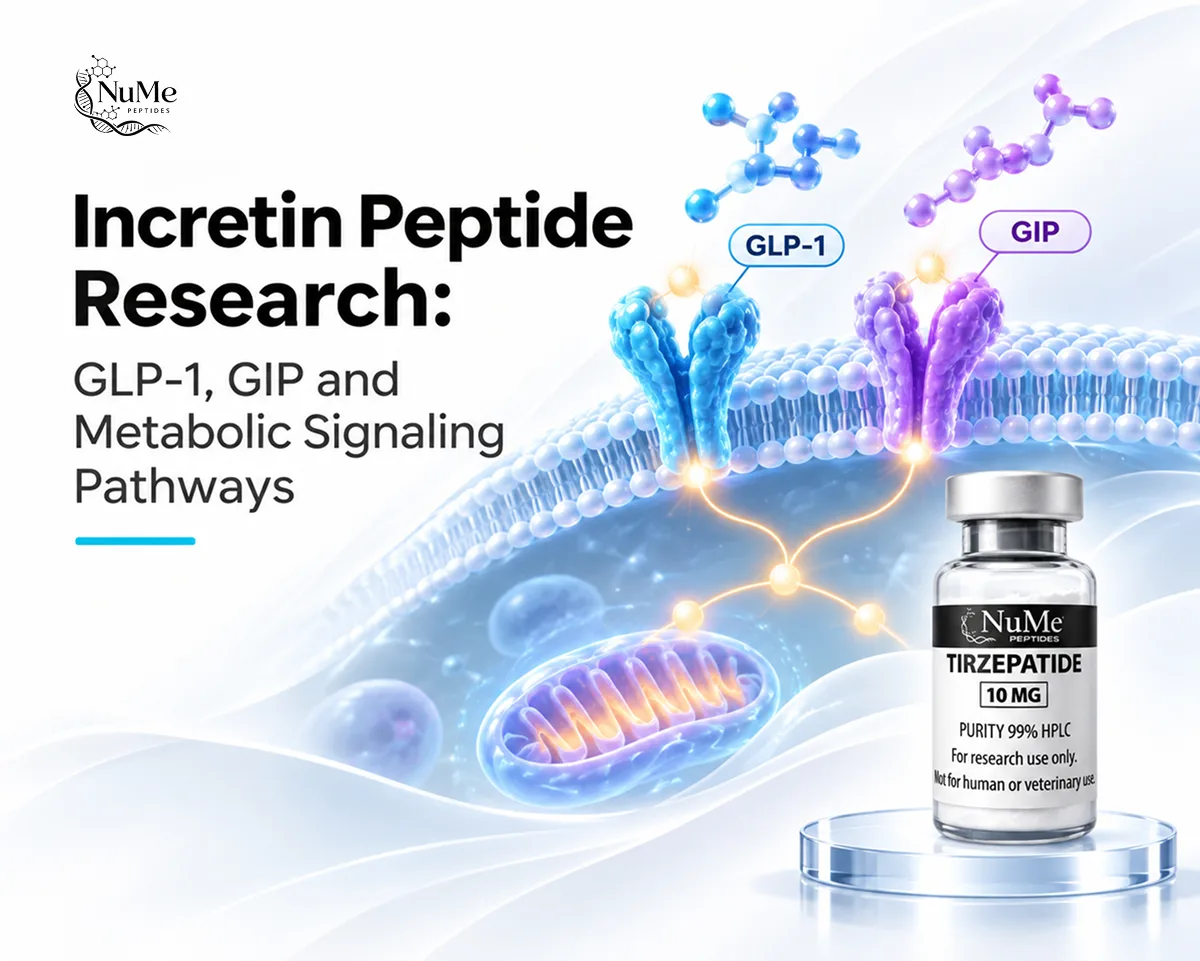
Incretin Peptide Research: GLP-1, GIP and Metabolic Signaling Pathways


Incretin Peptide Research examines how gastrointestinal peptide hormones connect nutrient intake with pancreatic, metabolic, gastrointestinal, and central nervous system signalling. The two physiological incretin hormones are glucagon-like peptide-1 (GLP-1) and glucose-dependent insulinotropic polypeptide (GIP), both of which increase nutrient-dependent insulin secretion but operate within broader and partly distinct biological networks.
Modern research compounds have expanded this field beyond a single receptor. Semaglutide primarily targets the GLP-1 receptor, Tirzepatide combines GLP-1 and GIP receptor activity, while Retatrutide adds glucagon receptor activation to create a triple-receptor research model. These differences allow researchers to investigate how receptor balance, signalling bias, and pathway integration affect metabolic outcomes.
For researchers looking for peptide materials for laboratory investigation, visit the Nume Peptides to explore the available research peptide collection.
What Are Incretin Hormones?
Incretins are gastrointestinal hormones released in response to nutrient intake that enhance insulin secretion when circulating glucose is elevated. The classic “incretin effect” describes the observation that oral glucose produces a greater insulin response than an equivalent intravenous glucose exposure producing similar blood-glucose concentrations. GLP-1 and GIP account for most of this physiological effect. (Nauck & Meier, 2016)
GLP-1 is generated through tissue-specific processing of proglucagon and is secreted primarily from intestinal L cells after nutrient intake. GIP is a 42-amino-acid peptide released mainly from enteroendocrine K cells in the upper intestine in response to carbohydrates and dietary fat. (Nauck & Meier, 2018) (Holst et al., 2025)
Their effects extend beyond pancreatic insulin release. Researchers investigate incretin pathways in relation to:
- glucose-dependent insulin secretion;
- pancreatic glucagon regulation;
- gastric emptying;
- nutrient handling;
- adipose-tissue metabolism;
- appetite and central signalling;
- postprandial glucose control.
| Hormone | Main physiological source | Primary receptor | Major research focus |
|---|---|---|---|
| GLP-1 | Intestinal L cells | GLP-1R | Insulin, glucagon, gastric and central signalling |
| GIP | Intestinal K cells | GIPR | Insulin, glucagon and nutrient partitioning |
| Glucagon | Pancreatic alpha cells | GCGR | Hepatic glucose output and energy metabolism |
Although GLP-1 and GIP are both incretins, their receptor biology and metabolic effects are not identical.
Explore laboratory research into GLP-1 receptor signaling, incretin pathways, and metabolic regulation with Semaglutide (10 mg).

How Does GLP-1 Signaling Work?
The GLP-1 receptor is a class B G-protein-coupled receptor. In pancreatic beta cells, receptor activation is strongly associated with Gs signalling, increased adenylyl cyclase activity, and elevated intracellular cyclic AMP.
Rather than triggering insulin release independently of glucose, GLP-1 signalling amplifies glucose-dependent insulin secretion. This explains why glucose concentration is an important experimental variable when researchers measure GLP-1 receptor activity.
A simplified pathway is:
- GLP-1 or a GLP-1R agonist activates GLP-1R.
- Gs signalling increases intracellular cAMP.
- cAMP-dependent pathways enhance beta-cell responsiveness.
- Calcium-dependent exocytosis of insulin is facilitated when glucose is elevated.
- Downstream metabolic responses alter postprandial glucose handling.
GLP-1 also influences glucagon secretion, gastric motility, and neural circuits involved in nutrient intake. Reviews of GLP-1-based therapies show that delayed gastric emptying can significantly alter the rate at which nutrients reach the small intestine and therefore influence postprandial glucose appearance. (Jalleh et al., 2024)
The signalling system is also more complex than a single Gs–cAMP pathway. Recent mechanistic research with Semaglutide has demonstrated both Gs- and Gq-related signalling in specific GLP-1 receptor-expressing hindbrain neurons, illustrating that receptor responses can vary by cell type and signalling environment. (Gao et al., 2026)
How Do GLP-1, GIP and Glucagon Pathways Differ?
The three receptors relevant to Semaglutide, Tirzepatide, and Retatrutide all contribute to metabolic regulation, but they should not be treated as interchangeable targets.
GLP-1 receptor pathway
GLP-1R activation is particularly associated with glucose-dependent insulin secretion, glucagon modulation, gastrointestinal motility, and neural regulation of nutrient intake.
Semaglutide provides the clearest single-receptor model among the compounds discussed here because its primary pharmacological target is GLP-1R.
GIP receptor pathway
GIPR signalling is also strongly insulinotropic when glucose is elevated, but GIP has a more context-dependent relationship with glucagon.
Human studies indicate that at hyperglycemia, GIP strongly supports insulin secretion, while at lower glucose concentrations it can enhance glucagon release. This has led researchers to describe GIP as a glucose-dependent regulator that may help stabilize glucose in different metabolic states. (Christensen et al., 2016)
GIP receptor biology is also relevant to adipose tissue. Experimental research with long-acting GIPR activation has shown effects on insulin signalling, glucose uptake, lipid handling, and nutrient partitioning in adipocytes. (Regmi et al., 2024)
Glucagon receptor pathway
Glucagon signalling differs because activation of the glucagon receptor can stimulate hepatic glucose production. This might appear contradictory when glucagon receptor activity is included in a compound intended to improve metabolic control.
However, triple-receptor research examines the net effect of simultaneously activating incretin and glucagon pathways. GLP-1 and GIP receptor activity can provide glycemic counterbalance while glucagon receptor signalling may influence hepatic metabolism, substrate turnover, and energy expenditure.
| Pathway | Key receptor | Major experimental role |
|---|---|---|
| GLP-1 | GLP-1R | Insulin, glucagon, gastric and neural signalling |
| GIP | GIPR | Insulin secretion and nutrient partitioning |
| Glucagon | GCGR | Hepatic glucose production and energy metabolism |
The number of receptor targets therefore does not simply indicate “stronger GLP-1 activity.” Multi-receptor compounds represent different signalling architectures.
How Are Incretin-Based Compounds Studied in Metabolic Research?
Incretin research ranges from receptor assays to controlled human trials. Because receptor activation can affect several organs simultaneously, researchers typically evaluate multiple endpoints rather than relying on one measurement.
Receptor pharmacology
Cell-based receptor studies can evaluate:
- receptor binding;
- cAMP generation;
- β-arrestin recruitment;
- receptor internalization;
- signalling duration;
- relative potency at different receptors.
This is particularly important for Tirzepatide. Molecular pharmacology studies show that Tirzepatide does not simply activate GIPR and GLP-1R equally. It shows greater engagement of GIPR and a biased GLP-1 receptor signalling profile that favours cAMP production relative to β-arrestin recruitment and receptor internalization. (Willard et al., 2020)
Metabolic challenge studies
Researchers can use meal tolerance tests, glucose challenges, or clamp methods to examine insulin, glucagon, glucose disposal, and insulin sensitivity.
Typical measurements include:
- fasting glucose;
- postprandial glucose;
- insulin;
- glucagon;
- HbA1c;
- gastric emptying;
- insulin sensitivity;
- body composition and nutrient handling.
Clinical trials
Longer studies allow researchers to determine whether molecular and short-term endocrine effects translate into sustained metabolic changes.
This distinction matters because receptor activation demonstrates mechanism, while clinical endpoints measure integrated effects across multiple tissues.
Explore laboratory research into dual GLP-1/GIP receptor signaling, incretin pathways, and metabolic regulation with Tirzepatide (10 mg).

Which Compounds Are Investigated Across Incretin Signaling Pathways?
Semaglutide, Tirzepatide, and Retatrutide provide a useful progression from single- to multi-receptor signalling.
| Compound | Receptor profile | Research model |
|---|---|---|
| Semaglutide | GLP-1R | Single incretin-receptor agonism |
| Tirzepatide | GIPR + GLP-1R | Dual incretin-receptor agonism |
| Retatrutide | GIPR + GLP-1R + GCGR | Triple metabolic-receptor agonism |
Semaglutide
Semaglutide is a long-acting GLP-1 analogue and provides a relatively focused model for studying prolonged GLP-1 receptor activation.
Human clinical research has established effects on glycemic control. In the multinational SUSTAIN 1 trial, which included Canadian study sites, Semaglutide significantly reduced HbA1c compared with placebo over 30 weeks in treatment-naive participants with type 2 diabetes. (Sorli et al., 2017)
For mechanistic research, Semaglutide is particularly useful as a comparator when evaluating whether adding GIP or glucagon receptor activity produces effects beyond selective GLP-1R activation.
Tirzepatide
Tirzepatide is a unimolecular dual GIP/GLP-1 receptor agonist. Its value in Incretin Peptide Research comes from its ability to test how coordinated stimulation of two incretin receptors differs from selective GLP-1 receptor activation.
Importantly, Tirzepatide is not simply “Semaglutide plus GIP.” Experimental pharmacology indicates an imbalanced and signalling-biased receptor profile, including strong GIP receptor engagement and distinct behaviour at GLP-1R. (Willard et al., 2020)
Reviews of the pathway also emphasize that the precise contribution of GIP receptor activation to Tirzepatide’s integrated human metabolic effects remains an active research question. (Holst et al., 2023)
Retatrutide
Retatrutide extends multi-receptor research by combining GIPR, GLP-1R, and glucagon receptor agonism within one peptide.
A phase 2 randomized trial in people with type 2 diabetes demonstrated dose-dependent improvements in HbA1c and body weight, providing evidence that adding glucagon receptor activity does not necessarily prevent glycemic improvement when balanced with incretin signalling. (Rosenstock et al., 2023)
The evidence base has continued to develop. By November 2026, peer-reviewed phase 3 data have also been published for Retatrutide in adults with obesity without diabetes, further expanding research into triple-receptor agonism. (Jastreboff et al., 2026)
Retatrutide remains especially useful for investigating how glucagon receptor activity can be integrated with incretin signalling rather than studied in isolation.
Current Evidence and Canadian Research Context
Current incretin research increasingly focuses on receptor balance rather than simply receptor activation. Semaglutide demonstrates what prolonged GLP-1 receptor stimulation can achieve, Tirzepatide illustrates how GIP and GLP-1 pathways can be integrated within a single molecule, and Retatrutide adds a glucagon component that creates a substantially different metabolic signalling profile.
The evidence supports three important conclusions:
- GLP-1 and GIP are both incretins, but their biology is not identical.
- Dual and triple agonists have distinct receptor pharmacology rather than functioning as stronger versions of GLP-1 alone.
- Receptor-level findings, glucose effects, body-composition effects, and longer-term clinical outcomes should be evaluated separately.
Canadian regulatory context also requires careful distinction between authorized medicines and research products. Health Canada lists authorized Semaglutide- and Tirzepatide-containing drug products while separately warning about unauthorized or counterfeit versions sold online. Retatrutide is also identified among unauthorized synthetic peptide ingredients marketed for human use in Canada. (Health Canada, 2026)
Health Canada further states that a “Research Use Only” or “Investigational Use Only” label does not automatically authorize a peptide for human use or exempt it from Canadian regulatory requirements. (Health Canada, 2026)
Explore research compounds for metabolic signaling, energy regulation, and longevity pathways in the Metabolic & Longevity collection.

FAQs About Incretin Peptide Research
What Is the Incretin Effect?
The incretin effect describes the greater insulin response produced by oral glucose compared with intravenous glucose producing similar glycemia. GLP-1 and GIP are the major physiological incretin hormones.
Is Semaglutide a GIP Agonist?
No. Semaglutide primarily targets the GLP-1 receptor and is useful as a selective GLP-1R research model.
How Is Tirzepatide Different From Semaglutide?
Tirzepatide activates both GIP and GLP-1 receptors and also displays distinct receptor-signalling characteristics. Semaglutide primarily activates GLP-1R.
Why Is Glucagon Included in Retatrutide Research?
Glucagon receptor signalling can influence hepatic metabolism and energy expenditure. Retatrutide research examines how this pathway behaves when combined with GLP-1 and GIP receptor activation.
Does More Receptor Activity Mean a Compound Is Stronger?
Not necessarily. Receptor balance, potency, signalling bias, pharmacokinetics, tissue distribution, and experimental endpoints all influence the final response.
Are Semaglutide, Tirzepatide, and Retatrutide Interchangeable?
No. They have different receptor profiles and evidence bases, so findings from one compound should not automatically be transferred to another.
Conclusion
Incretin Peptide Research has progressed from studying individual gastrointestinal hormones to investigating increasingly complex multi-receptor signalling systems. GLP-1 and GIP form the physiological foundation of the incretin effect, while glucagon introduces a distinct hepatic and energy-metabolism pathway.
Semaglutide provides a selective GLP-1 receptor model, Tirzepatide combines GIP and GLP-1 receptor signalling with a distinctive pharmacological profile, and Retatrutide adds glucagon receptor activity to create a triple-receptor research system.
The most informative approach is therefore to compare receptor targets, signalling behaviour, endocrine responses, and downstream metabolic outcomes separately rather than ranking compounds simply by the number of pathways they activate.
For researchers looking for peptide materials for laboratory investigation, visit the Nume Peptides to explore the available research peptide collection.
Disclaimer: This content is provided for educational and scientific research purposes only. Research peptides are intended for laboratory research only and are not intended for human consumption or medical use.