
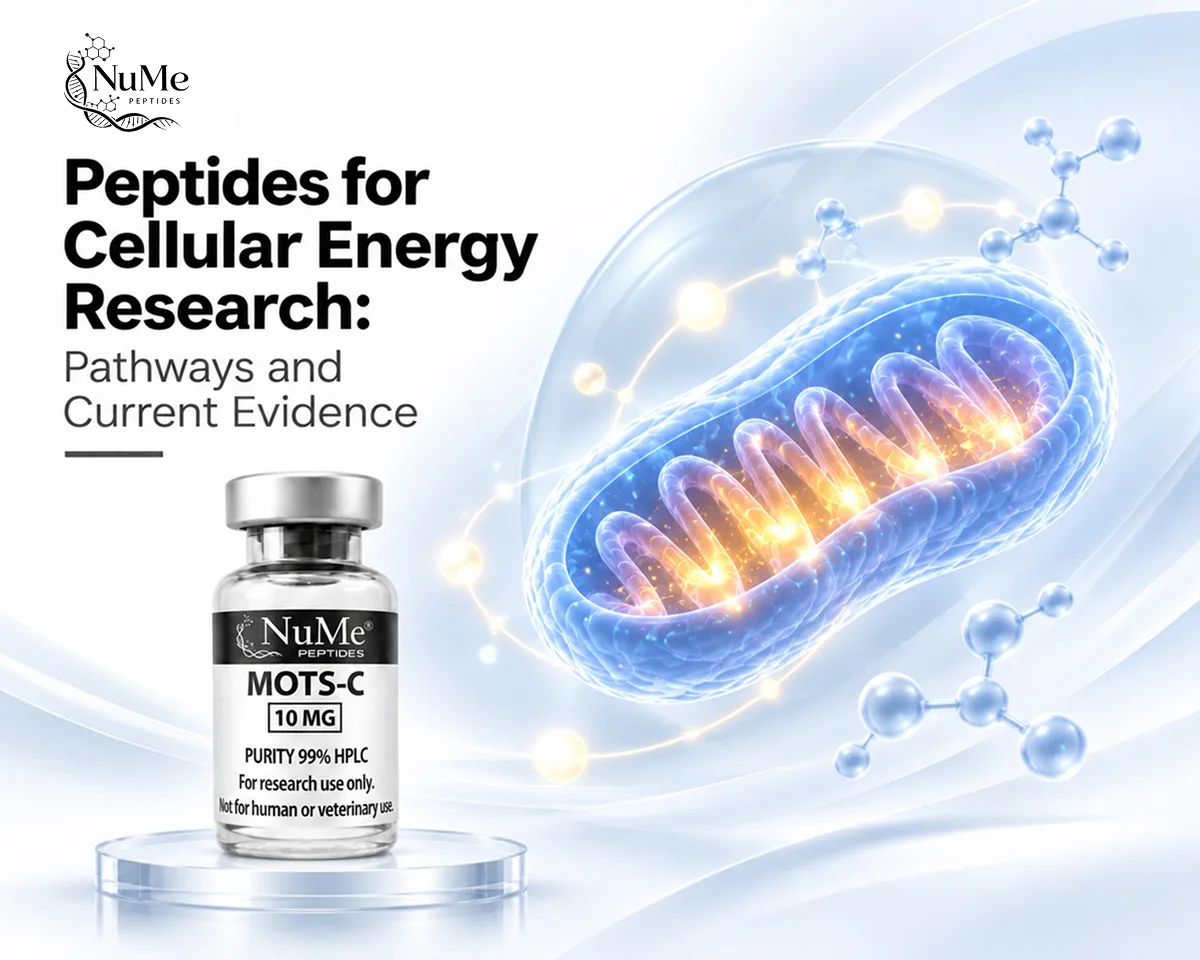
Peptides for Cellular Energy Research: Pathways and Current Evidence


Peptides for Cellular Energy Research are investigated to understand how cells sense energy availability, generate ATP, switch between metabolic fuels, and maintain mitochondrial function when nutrient supply or energy demand changes. Rather than focusing on one substrate such as glucose, this field examines the coordination of glycolysis, fatty-acid oxidation, mitochondrial respiration, redox balance, and energy-sensitive signalling.
MOTS-C and SS-31 provide two peptide-based models for this research. MOTS-C is a mitochondria-derived signalling peptide associated with metabolic stress and AMPK, while SS-31 is a mitochondria-targeting tetrapeptide that interacts with cardiolipin and mitochondrial bioenergetics. NAD+ contributes to cellular energy as a metabolic coenzyme, while 5-Amino-1MQ and SLU-PP-332 are experimental small molecules targeting NNMT and estrogen-related receptors, respectively.
These compounds therefore represent different entry points into the same broader question: how do cells coordinate energy production with metabolic demand? For researchers looking for peptide materials for laboratory investigation, visit the Nume Peptides to explore the available research peptide collection.
What Is Cellular Energy Metabolism in Research?
Cellular energy metabolism describes the biochemical processes that convert nutrients into usable energy while maintaining the metabolic intermediates required for cell function. ATP is the principal immediately available energy currency, but cellular energy status also depends on the balance among ATP, ADP, AMP, reducing equivalents, and available metabolic substrates.
Glucose can enter glycolysis and generate pyruvate, which may be oxidized through mitochondrial pathways. Fatty acids can undergo beta-oxidation, producing acetyl-CoA and reducing equivalents that enter the same mitochondrial energy system. Amino acids can also contribute to central metabolism under specific conditions.
Researchers therefore examine several interconnected processes:
- glycolysis and glucose oxidation;
- fatty-acid beta-oxidation;
- TCA-cycle activity;
- mitochondrial oxidative phosphorylation;
- ATP production and turnover;
- NAD+/NADH redox balance;
- metabolic substrate selection;
- cellular energy-sensing pathways.
One important concept is metabolic flexibility—the ability of a cell or tissue to shift between available fuels depending on nutritional conditions and energy requirements. A system that can oxidize both glucose and fatty acids appropriately may respond differently to metabolic stress than one locked into a restricted substrate pattern.
| Energy parameter | What it tells researchers |
|---|---|
| ATP/ADP balance | Immediate cellular energy state |
| Oxygen consumption | Mitochondrial respiratory activity |
| NAD+/NADH | Redox and substrate-oxidation state |
| Fatty-acid oxidation | Lipid utilization |
| Glycolytic rate | Cytosolic glucose processing |
| Respiratory exchange | Relative substrate utilization |
| AMPK activity | Cellular energetic stress response |
Cellular energy research therefore involves more than measuring ATP concentration. Researchers also need to determine where energy is coming from, how efficiently it is generated, and how signalling pathways respond when supply and demand become mismatched.
Explore laboratory research into cellular energy metabolism, redox balance, and aging-related pathways with NAD+ (500 mg).

How Do Mitochondria Regulate Cellular Energy Production?
Mitochondria integrate multiple metabolic pathways by converting reducing equivalents from nutrient oxidation into ATP. NADH and FADH2 donate electrons to the electron transport chain, and the resulting proton gradient drives ATP synthase.
The efficiency of this process depends on several factors, including mitochondrial membrane organization, electron transport, substrate supply, and redox state.
Mitochondrial coupling and ATP production
Efficient oxidative phosphorylation requires electron transport to remain coupled to proton-gradient formation and ATP synthesis. Disruption of membrane structure or electron flow can reduce ATP-generating efficiency even when nutrients remain available.
SS-31 research is relevant here because the peptide interacts with cardiolipin, a phospholipid enriched in the inner mitochondrial membrane. Experimental research showed that SS-31 can support cytochrome c electron-carrier activity and improve mitochondrial respiration and ATP-synthesis efficiency in mitochondrial models. (Birk et al., 2014)
Mitochondria as signalling organelles
Mitochondria also communicate cellular energy status rather than simply producing ATP. MOTS-C illustrates this principle. MOTS-C is encoded within mitochondrial DNA and has been linked with metabolic regulation through pathways involving AMPK. Original experiments showed effects on folate and purine metabolism, insulin sensitivity, and metabolic homeostasis in cellular and mouse models. (Lee et al., 2015)
During metabolic stress, MOTS-C can also translocate toward the nucleus and alter stress-responsive gene expression through an AMPK-dependent mechanism. (Kim et al., 2018)
This provides a model of mitonuclear communication in which mitochondrial signals contribute to broader cellular adaptation.
How Are Peptides Studied in Cellular Energy and Metabolic Research?
Researchers use different methods depending on whether they are studying ATP production, fuel selection, mitochondrial performance, or signalling.
Cell-based metabolic platforms can measure oxygen consumption and extracellular acidification, helping distinguish mitochondrial respiration from glycolytic activity. More specialized approaches can examine mitochondrial membrane potential, ATP generation, substrate oxidation, or intracellular NAD-related metabolites.
Common experimental endpoints include:
- oxygen consumption rate;
- ATP production;
- maximal respiratory capacity;
- glycolytic activity;
- fatty-acid oxidation;
- AMPK phosphorylation;
- NAD+/NADH ratios;
- mitochondrial gene expression;
- insulin sensitivity;
- whole-body energy expenditure in animal models.
Indirect calorimetry can also assess metabolic fuel selection at the organism level. Changes in respiratory exchange ratio may indicate altered reliance on carbohydrate versus lipid oxidation.
These measurements are important because “more energy” is not a precise scientific endpoint. A compound might increase mitochondrial respiration, shift fuel preference toward fatty acids, improve ATP-production efficiency, or alter metabolic signalling without producing the same effect across every endpoint.
Explore laboratory research into mitochondrial function, cardiolipin binding, and electron transport chain efficiency with SS-31 (10 mg).

Which Peptides and Compounds Are Investigated in Energy and Metabolic Pathways?
MOTS-C, NAD+, SS-31, 5-Amino-1MQ, and SLU-PP-332 act at different levels of cellular metabolism.
| Compound | Molecular class | Primary research pathway | Evidence profile |
|---|---|---|---|
| MOTS-C | Mitochondria-derived peptide | AMPK and metabolic stress | Mainly preclinical |
| SS-31 | Synthetic tetrapeptide | Cardiolipin and bioenergetics | Preclinical + human research |
| NAD+ | Metabolic coenzyme | Redox and energy metabolism | Extensive biological evidence |
| 5-Amino-1MQ | Small molecule | NNMT inhibition | Preclinical |
| SLU-PP-332 | Small molecule | ERRα/β/γ activation | Preclinical |
MOTS-C
MOTS-C is a 16-amino-acid mitochondria-derived peptide studied for its ability to connect mitochondrial status with cellular metabolic responses. Its best-characterized experimental mechanisms involve AMPK activation, altered purine-related metabolism, and mitonuclear signalling.
Mouse research has associated MOTS-C with changes in insulin sensitivity and metabolic homeostasis. However, most intervention evidence remains preclinical, so these findings should not be interpreted as established metabolic effects in humans. (Lee et al., 2015)
NAD+
NAD+ is not a peptide. It is a coenzyme essential for redox reactions that connect nutrient oxidation to cellular energy production. NAD+ and NADH are distributed across cellular compartments, including the cytosol and mitochondria. Their ratios differ among compartments and help shape glycolysis, mitochondrial oxidation, DNA repair, and metabolic signalling. Recent research emphasizes that NAD+ homeostasis should therefore be considered compartment-specific rather than as a single cellular pool. (Nobile et al., 2026)
Although NAD+ biology is well established, evidence for supplementation strategies is more variable. Oral NAD+ precursors can raise NAD-related metabolites in humans, while functional metabolic outcomes remain context-dependent. (Pandolfi et al., 2026)
SS-31
SS-31 targets mitochondrial bioenergetics from a structural perspective. It binds cardiolipin in the inner mitochondrial membrane, where cardiolipin helps organize proteins involved in respiration. Experimental evidence suggests that SS-31 can preserve cytochrome c electron-transfer function and improve mitochondrial respiratory efficiency under certain stress conditions. (Birk et al., 2014)
Unlike MOTS-C, which primarily represents a signalling model, SS-31 provides a research model for investigating how inner-membrane organization affects energy production.
5-Amino-1MQ
5-Amino-1MQ, or 5A1MQ, is a small-molecule inhibitor of nicotinamide N-methyltransferase (NNMT), not a peptide. NNMT metabolizes nicotinamide and participates in a network involving nicotinamide availability and methyl metabolism. Pharmacological NNMT inhibition has therefore been investigated as a way to modify metabolic phenotypes.
In diet-induced obese mice, 5A1MQ reduced fat-mass gain and was associated with improved glucose tolerance, insulin sensitivity, and liver-related metabolic markers. (Babula et al., 2024)
These findings remain preclinical and do not establish equivalent effects in humans.
SLU-PP-332
SLU-PP-332 is another non-peptide experimental compound. It activates estrogen-related receptors ERRα, ERRβ, and ERRγ, with particularly important activity involving ERRα.
ERRs regulate transcriptional programs associated with mitochondrial respiration and oxidative metabolism. In skeletal-muscle cells, SLU-PP-332 increased mitochondrial function and respiration. Mouse research also showed increased oxidative muscle characteristics and exercise capacity. (Billon et al., 2023)
Later mouse studies reported increased energy expenditure and fatty-acid oxidation in obesity models. (Billon et al., 2024)
These effects remain experimental, and human clinical validation is still lacking.
What Does Current Research Show About Peptides and Cellular Energy Regulation?
Current evidence suggests that cellular energy can be modified at several different levels rather than through one universal pathway.
Energy sensing can modify metabolic adaptation
MOTS-C studies support the idea that AMPK-related signalling can translate energetic stress into changes in cellular metabolism and gene expression. This mechanism is different from directly increasing ATP production.
Membrane organization affects bioenergetic efficiency
SS-31 research highlights the importance of mitochondrial structure. Cardiolipin organization influences electron transfer and oxidative phosphorylation, meaning bioenergetic function depends partly on maintaining the physical environment of respiratory proteins.
NAD+ connects metabolism with cellular regulation
NAD+ provides a direct biochemical connection between substrate oxidation and cellular signalling. Newer research emphasizes that mitochondrial NAD+ regulation is itself dynamic; a 2026 study identified a mitochondrial NAD+-hydrolysis mechanism linked to fatty-acid oxidation and protection against sustained metabolic overactivation. (Jia et al., 2026)
NNMT and ERR pathways influence metabolic phenotype
5-Amino-1MQ and SLU-PP-332 demonstrate that cellular energy research also extends beyond peptides. NNMT inhibition modifies nicotinamide-related metabolism, while ERR activation alters transcriptional programs governing oxidative capacity and substrate utilization.
These mechanisms should therefore be interpreted separately rather than grouped under a vague claim that each compound “increases cellular energy.”
A useful framework is:
Energy substrate → Metabolic pathway → Mitochondrial oxidation → ATP/redox state → Energy sensing → Cellular adaptation
Different compounds may influence different steps in this sequence.
Canadian research context
Health Canada currently identifies MOTS-C and SS-31 among unauthorized synthetic peptide ingredients found in products promoted for human use in Canada. Health Canada also states that products labelled “Research Use Only” or “Investigational Use Only” are not automatically authorized for human use and remain subject to Canadian regulatory requirements. (Health Canada, 2026)
This regulatory distinction should remain separate from legitimate laboratory investigation of cellular energy and metabolic pathways.
Explore research compounds for metabolic signaling, energy regulation, and longevity pathways in the Metabolic & Longevity collection.

FAQs About Peptides for Cellular Energy Research
What Are Peptides for Cellular Energy Research?
They are peptide compounds investigated for their effects on mitochondrial signalling, ATP-related metabolism, energy sensing, and cellular adaptation. The broader research category can also include non-peptide metabolic compounds.
How Does MOTS-C Relate to Cellular Energy?
MOTS-C is linked experimentally with AMPK, metabolic stress signalling, and communication between mitochondria and the nucleus.
Is NAD+ a Peptide?
No. NAD+ is an endogenous metabolic coenzyme involved in redox reactions, mitochondrial energy metabolism, and multiple cellular signalling pathways.
How Does SS-31 Differ From MOTS-C?
SS-31 primarily targets mitochondrial membrane and cardiolipin-related bioenergetics, while MOTS-C is studied mainly as a mitochondria-derived signalling peptide.
Are 5-Amino-1MQ and SLU-PP-332 Peptides?
No. Both are small-molecule research compounds. 5-Amino-1MQ inhibits NNMT, while SLU-PP-332 activates estrogen-related receptors.
Do These Compounds Have Proven Human Energy-Enhancing Effects?
No. Evidence levels vary considerably. Some compounds have extensive mechanistic biology, but MOTS-C, 5-Amino-1MQ, and SLU-PP-332 remain predominantly preclinical for the research outcomes discussed here.
Conclusion
Peptides for Cellular Energy Research provide different experimental models for studying how cells generate energy and adapt to metabolic demand. MOTS-C focuses on mitochondrial stress signalling and AMPK, SS-31 on cardiolipin and mitochondrial bioenergetics, and NAD+ on redox-dependent energy metabolism. 5-Amino-1MQ and SLU-PP-332 extend this framework into NNMT-mediated metabolism and ERR-driven oxidative transcription.
Their mechanisms, molecular classes, and evidence levels differ substantially. The most accurate research approach therefore separates ATP production, substrate utilization, redox state, mitochondrial efficiency, and cellular signalling rather than treating them as a single “energy” endpoint.
For researchers looking for peptide materials for laboratory investigation, visit the Nume Peptides to explore the available research peptide collection.
Disclaimer: This content is provided for educational and scientific research purposes only. Research peptides are intended for laboratory research only and are not intended for human consumption or medical use.