
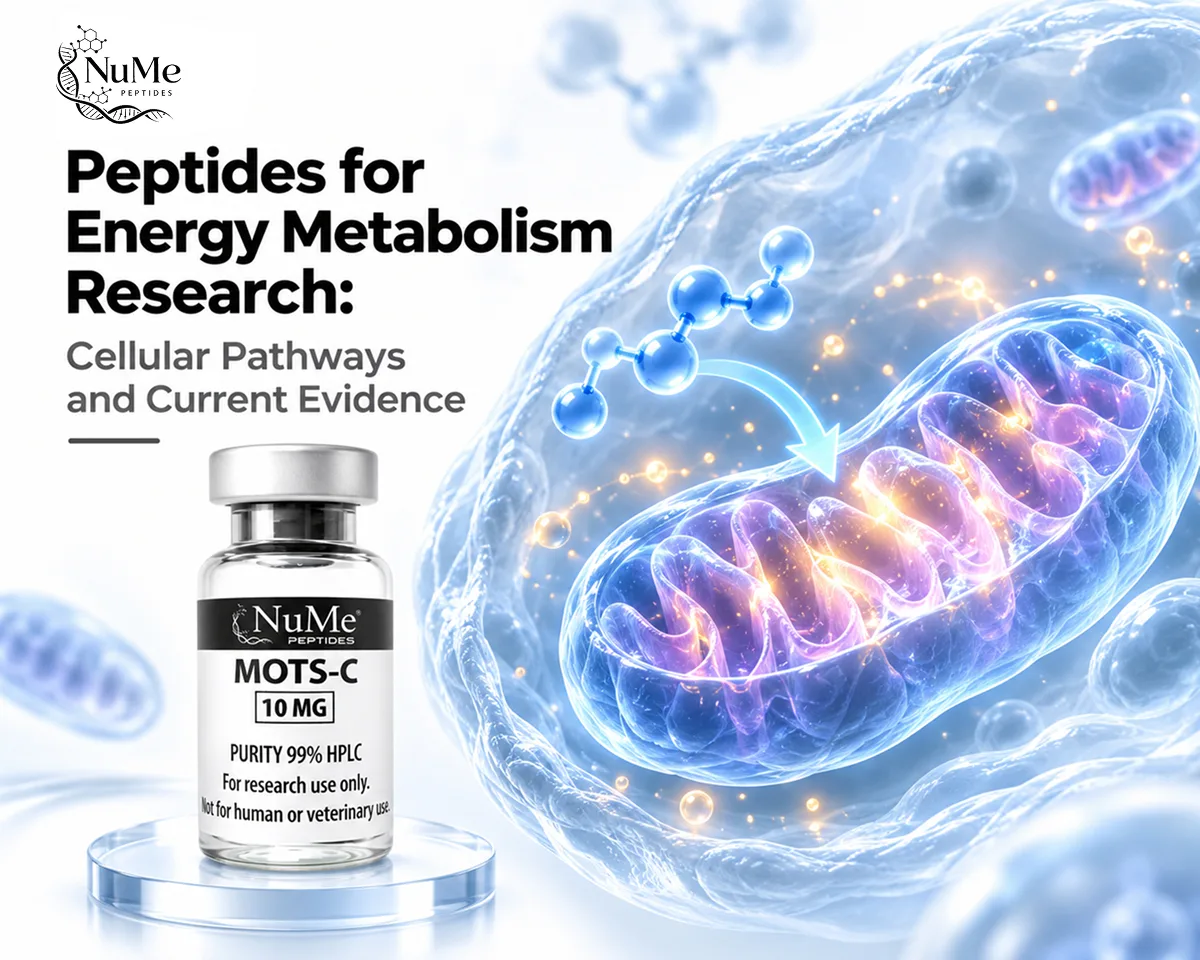
Peptides for Energy Metabolism Research: Cellular Pathways and Current Evidence


Peptides for Energy Metabolism Research help researchers investigate how cells produce ATP, respond to energetic stress, select between glucose and fatty acids, and coordinate mitochondrial function with broader metabolic demands. Unlike glucose-focused research, cellular energy research examines a larger system that includes mitochondrial respiration, redox balance, substrate oxidation, energy sensing, and transcriptional adaptation.
MOTS-C is particularly relevant because it is a mitochondria-derived peptide connected with metabolic stress signalling. Other compounds discussed in this field operate through different mechanisms: SLU-PP-332 targets estrogen-related receptors (ERRs), 5-Amino-1MQ inhibits nicotinamide N-methyltransferase (NNMT), and NAD+ acts as an essential metabolic coenzyme.
For researchers looking for peptide materials for laboratory investigation, visit the Nume Peptides to explore the available research peptide collection.
How Do Cells Regulate Energy Metabolism?
Cells continuously adjust energy production to match changing biological demand. ATP acts as the primary immediately usable energy source for processes such as membrane transport, protein synthesis, maintenance of ion gradients, intracellular signalling, and muscle contraction.
Glucose and fatty acids are two major energy substrates. Glucose enters glycolysis and can ultimately supply acetyl-CoA to the tricarboxylic acid (TCA) cycle, while fatty acids undergo beta-oxidation before contributing to the same mitochondrial network. The TCA cycle produces reducing equivalents such as NADH, which transfer electrons to the mitochondrial electron transport chain and support oxidative phosphorylation.
Key processes involved in cellular energy regulation include:
- glycolysis and glucose oxidation;
- fatty-acid beta-oxidation;
- TCA-cycle activity;
- mitochondrial electron transport;
- oxidative phosphorylation;
- ATP production and consumption;
- NAD+/NADH redox cycling;
- nutrient and energetic stress sensing.
Mitochondria also function as signalling organelles. MOTS-C provides an important example: research shows that this mitochondria-encoded peptide can move to the nucleus during metabolic stress and alter stress-responsive gene expression through mechanisms involving AMPK. This supports the broader concept that mitochondrial signals can influence nuclear programs rather than mitochondria simply producing energy in isolation. (Kim et al., 2018)
| Cellular process | Main role in energy research |
|---|---|
| Glycolysis | Processes glucose and generates metabolic intermediates |
| Beta-oxidation | Converts fatty acids into mitochondrial substrates |
| TCA cycle | Generates reducing equivalents for respiration |
| Oxidative phosphorylation | Produces most mitochondrial ATP |
| AMPK signalling | Detects cellular energetic stress |
| NAD+/NADH cycling | Transfers electrons during metabolism |
| Mitonuclear signalling | Coordinates mitochondrial and nuclear responses |
Researchers also examine which substrates are being used, how efficiently mitochondria respond to demand, and how cells adapt when nutrients or energy become limited.
Explore research compounds for metabolic signaling, energy regulation, and longevity pathways in the Metabolic & Longevity collection.

Which Pathways Influence Cellular Energy Balance?
Several signalling systems regulate the transition between energy storage, substrate oxidation, and metabolic adaptation. MOTS-C, SLU-PP-332, 5-Amino-1MQ, and NAD+ are useful because each intersects with a different part of this network.
AMPK and cellular energy sensing
AMP-activated protein kinase, or AMPK, is one of the major sensors of cellular energy status. When cellular energy availability falls, AMPK shifts metabolism toward pathways that support ATP generation while reducing some energy-intensive anabolic processes.
MOTS-C has been linked closely with this pathway. The peptide was identified as a 16-amino-acid product encoded within mitochondrial DNA, and early experiments showed effects on folate and purine metabolism that were associated with AMPK activation. In mouse models, MOTS-C also influenced insulin sensitivity and metabolic homeostasis. (Lee et al., 2015)
ERR signalling and oxidative capacity
Estrogen-related receptors ERRα, ERRβ, and ERRγ are nuclear receptors involved in transcriptional regulation of mitochondrial and oxidative metabolism. Despite their name, they are distinct from classical estrogen receptors and are particularly relevant in tissues with high energetic requirements, including skeletal muscle.
Activation of ERR-related transcription can influence genes associated with mitochondrial respiration, fatty-acid metabolism, and oxidative muscle characteristics. SLU-PP-332 was developed as a research agonist for this pathway, with its highest potency reported for ERRα. (Billon et al., 2023)
NNMT and nicotinamide metabolism
NNMT converts nicotinamide to N-methylnicotinamide using S-adenosylmethionine as a methyl donor. Because nicotinamide is linked to NAD+ metabolism, changes in NNMT activity can affect a broader metabolic network involving nicotinamide availability and methyl-donor balance.
NNMT inhibition has consequently become an experimental approach for studying adipose and metabolic regulation. Small-molecule NNMT inhibitors have altered metabolic phenotypes in experimental models, providing the rationale for compounds such as 5-Amino-1MQ. (Kannt et al., 2018)
NAD+ and redox regulation
NAD+ is essential for numerous oxidation-reduction reactions. It accepts electrons during processes including glycolysis and the TCA cycle, producing NADH that can then support mitochondrial electron transport.
Beyond energy transfer, NAD+ also serves as a substrate for enzymes such as sirtuins and PARPs. It therefore links cellular energy metabolism with stress responses, DNA maintenance, mitophagy, and other regulatory pathways. (Lautrup et al., 2024)
How Are Peptides and Research Compounds Studied in Energy Metabolism?
Energy metabolism studies often combine biochemical measurements with cellular respiration and whole-organism experiments. Because different compounds target different mechanisms, researchers select endpoints based on whether they are studying substrate utilization, mitochondrial performance, transcriptional regulation, or metabolic stress.
Common laboratory endpoints include:
- oxygen consumption rate;
- ATP production;
- mitochondrial membrane potential;
- glycolytic activity;
- fatty-acid oxidation;
- AMPK phosphorylation;
- mitochondrial gene expression;
- NAD+/NADH ratio;
- respiratory exchange measurements;
- metabolomic changes.
Cellular respiration platforms are particularly useful for evaluating mitochondrial function. For example, research on SLU-PP-332 demonstrated increased mitochondrial function and respiration in skeletal-muscle cells. Follow-up mouse experiments showed changes in oxidative muscle characteristics and endurance associated with ERRα-dependent transcriptional activity. (Billon et al., 2023)
Whole-organism studies provide another layer by examining how cellular changes relate to energy expenditure, substrate oxidation, insulin sensitivity, body composition, or physical capacity. However, animal data remain mechanistic evidence. A metabolic response observed in mice should not automatically be interpreted as an established human outcome.
Explore laboratory research into ERR signaling, energy expenditure, and metabolic regulation with SLU-PP-332 (5 mg).

Which Compounds Are Investigated in Energy Metabolism Research?
The compounds below represent different experimental entry points into cellular energy regulation.
| Compound | Molecular class | Primary research focus | Evidence level |
|---|---|---|---|
| MOTS-C | Mitochondria-derived peptide | AMPK and stress adaptation | Mainly preclinical |
| SLU-PP-332 | Small molecule | ERR-driven oxidative metabolism | Preclinical |
| 5-Amino-1MQ | Small molecule | NNMT inhibition | Preclinical |
| NAD+ | Endogenous coenzyme | Redox and mitochondrial metabolism | Extensive biological evidence |
MOTS-C
MOTS-C is encoded by a short open reading frame within mitochondrial DNA and provides a distinctive model for studying communication between mitochondrial metabolism and nuclear gene regulation. Early research showed that the peptide altered folate and purine pathways, activated AMPK, and influenced metabolic homeostasis in cellular and mouse models. (Lee et al., 2015)
MOTS-C influenced skeletal-muscle metabolism and stress-responsive gene programs in mice, while endogenous MOTS-C levels were also observed to change following exercise in a small human experiment. Importantly, most intervention findings still come from animal models rather than controlled human administration studies. (Reynolds et al., 2021)
SLU-PP-332
SLU-PP-332 is a synthetic small molecule rather than a peptide. It activates ERRα, ERRβ, and ERRγ, with research focusing particularly on ERRα-dependent regulation of mitochondrial and oxidative metabolism.
Cellular experiments demonstrated increased mitochondrial respiration, while mouse studies reported increased oxidative skeletal-muscle characteristics and exercise endurance. A subsequent metabolic-syndrome study found increased energy expenditure and fatty-acid oxidation together with reduced fat accumulation and improved insulin sensitivity in mouse models. (Billon et al., 2023) (Billon et al., 2024)
These results make SLU-PP-332 relevant to transcriptional energy-metabolism research, but the evidence remains preclinical. Describing it as an established human “exercise mimetic” would therefore go beyond the available evidence.
5-Amino-1MQ
5-Amino-1MQ is a small-molecule NNMT inhibitor used to investigate how altered nicotinamide metabolism affects broader metabolic pathways. Rather than directly stimulating mitochondrial respiration, its research rationale centers on changing an enzymatic pathway connected to nicotinamide and methyl metabolism.
A 2024 study in diet-induced obese mice reported that NNMT inhibition with 5-Amino-1MQ improved glucose tolerance and insulin sensitivity and reduced body and liver fat accumulation under the experimental conditions studied. These findings help establish a mechanistic research model, but controlled human metabolic evidence remains lacking. (Babula et al., 2024)
NAD+
NAD+ differs fundamentally from the other compounds because it is an endogenous coenzyme required for normal cellular metabolism. NAD+/NADH cycling supports electron transfer during glycolysis, the TCA cycle, beta-oxidation, and mitochondrial respiration.
Research involving nicotinamide riboside or nicotinamide mononucleotide shows that NAD-related metabolites can be increased in humans, while downstream clinical effects remain inconsistent across studies. Direct intravenous NAD+ is considerably less characterized. (Pandolfi et al., 2026)
What Does Current Evidence Show About Peptides and Cellular Energy Regulation?
Current research does not support a single universal pathway that simply “boosts energy.” Instead, the evidence shows several distinct mechanisms that influence how cells sense demand, select substrates, regulate gene expression, and maintain mitochondrial function.
The main evidence can be summarized as follows:
- MOTS-C links mitochondrial stress with cellular adaptation. Its interactions with AMPK and nuclear stress-response pathways support a role in mitonuclear communication, although most intervention evidence remains preclinical.
- SLU-PP-332 alters transcriptional programs related to oxidative metabolism. ERR activation can increase mitochondrial and fatty-acid metabolism in experimental models, but human evidence is currently insufficient.
- NNMT inhibition affects a broader metabolic network. 5-Amino-1MQ findings support further research into nicotinamide metabolism, but the mechanism should not be simplified to a direct increase in cellular energy.
- NAD+ is essential for metabolism, but supplementation is a separate research question. Strong evidence for the biological importance of NAD+ does not automatically establish clinical benefits from a specific external NAD+ strategy.
Canadian research context
Health Canada distinguishes laboratory research products from drugs intended for human clinical investigation. Products labelled “Research Use Only” are not automatically authorized for human use or exempt from Canadian regulatory requirements. Investigational products intended for human clinical trials require the appropriate authorization under Canada’s clinical-trial framework. (Health Canada, 2026)
Explore laboratory research into cellular energy metabolism, redox balance, and aging-related pathways with NAD+ (500 mg).

FAQs About Peptides for Energy Metabolism Research
What Are Peptides for Energy Metabolism Research?
They are peptides studied for their roles in mitochondrial signalling, energy sensing, substrate metabolism, and adaptation to metabolic stress. Broader energy-metabolism research may also include non-peptide compounds targeting related pathways.
How Is MOTS-C Related to Mitochondrial Metabolism?
MOTS-C is encoded within mitochondrial DNA and has been linked experimentally to AMPK activation, metabolic stress responses, and communication between mitochondria and the nucleus.
Is SLU-PP-332 a Peptide?
No. SLU-PP-332 is a synthetic small-molecule agonist of estrogen-related receptors involved in transcriptional control of oxidative and mitochondrial metabolism.
What Does 5-Amino-1MQ Target?
5-Amino-1MQ inhibits NNMT, an enzyme involved in nicotinamide metabolism. Current evidence for metabolic effects comes primarily from cellular and animal studies.
Why Is NAD+ Important in Cellular Energy Research?
NAD+ participates directly in electron-transfer reactions required for cellular metabolism and mitochondrial ATP production while also serving as a substrate for several regulatory enzymes.
Do These Compounds Have the Same Level of Evidence?
No. NAD+ has extensive established biological evidence, while intervention outcomes remain context dependent. MOTS-C has growing preclinical and limited human research, whereas SLU-PP-332 and 5-Amino-1MQ remain predominantly preclinical.
Conclusion
Peptides for Energy Metabolism Research provide multiple ways to investigate how cells respond to energetic demand. MOTS-C focuses attention on mitochondrial stress signalling and AMPK, SLU-PP-332 examines ERR-driven transcription of oxidative pathways, 5-Amino-1MQ targets NNMT and nicotinamide metabolism, and NAD+ sits directly within the redox reactions required for cellular energy production.
Their molecular classes, mechanisms, evidence levels, and experimental endpoints differ substantially, making accurate classification essential when interpreting research findings.
For researchers looking for peptide materials for laboratory investigation, visit the Nume Peptides to explore the available research peptide collection.
Disclaimer: This content is provided for educational and scientific research purposes only. Research peptides are intended for laboratory research only and are not intended for human consumption or medical use.