
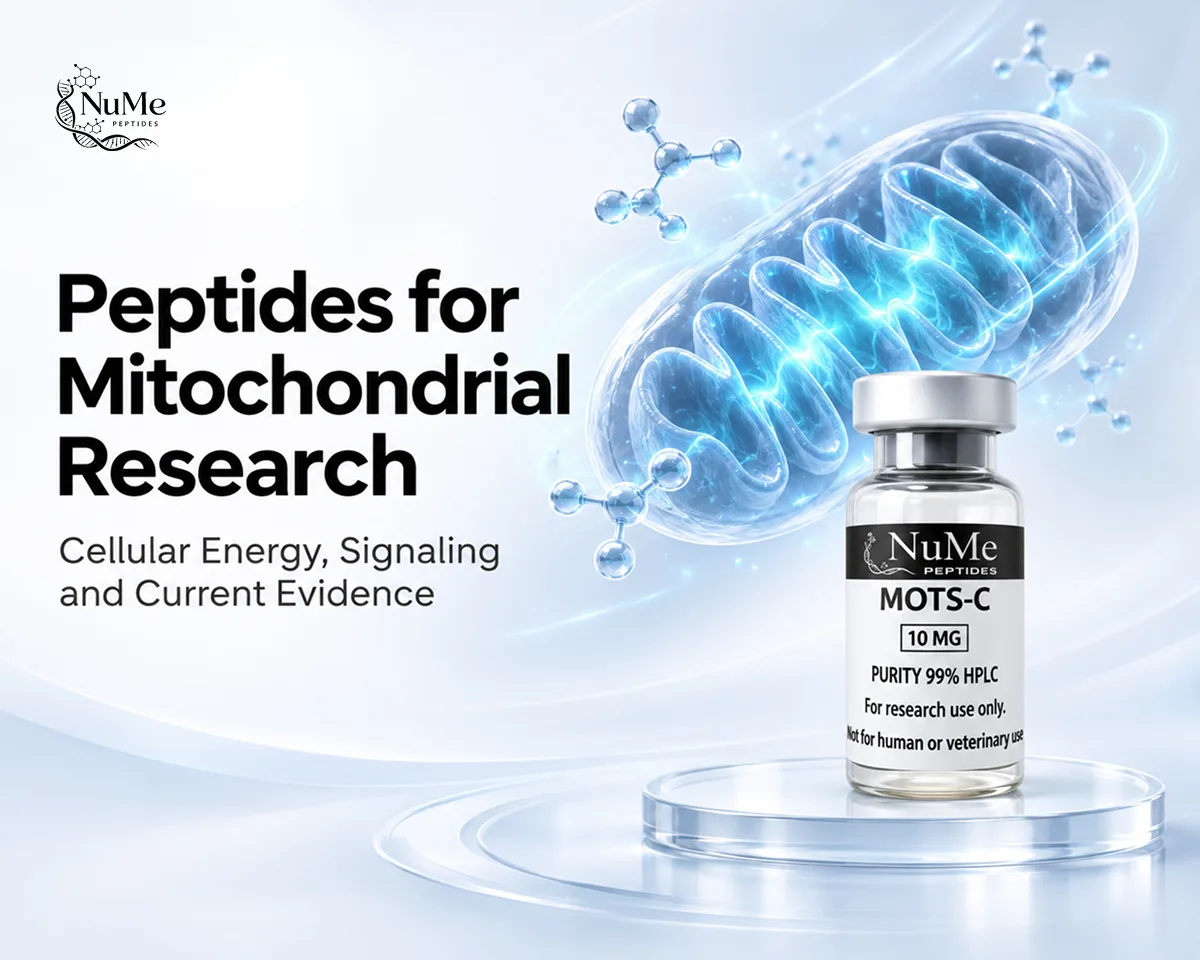
Peptides for Mitochondrial Research: Cellular Energy, Signaling and Current Evidence


Peptides for Mitochondrial Research are investigated to understand how mitochondrial structure, energy production, redox balance, and stress signalling can be modified in experimental systems. Mitochondria are best known for generating ATP through oxidative phosphorylation, but they also regulate reactive oxygen species, metabolic adaptation, calcium handling, apoptosis, and communication with the nucleus.
MOTS-C and SS-31 represent two very different peptide-based approaches to mitochondrial research. MOTS-C is a mitochondria-derived signalling peptide associated with metabolic stress and mitonuclear communication, whereas SS-31, also known as elamipretide, is a synthetic mitochondria-targeting tetrapeptide that interacts with the inner mitochondrial membrane and cardiolipin. NAD+ is not a peptide; it is an essential metabolic coenzyme with a central role in mitochondrial redox reactions and cellular signalling.
For researchers looking for peptide materials for laboratory investigation, visit the Nume Peptides to explore the available research peptide collection.
What Role Do Mitochondria Play in Cellular Metabolism?
Mitochondria convert energy stored in nutrients into ATP that can be used by cells. Carbon derived from glucose, fatty acids, and amino acids can enter the tricarboxylic acid cycle, generating NADH and FADH2. These reducing equivalents transfer electrons to the electron transport chain within the inner mitochondrial membrane.
Electron transfer through respiratory complexes creates a proton gradient across the inner membrane. ATP synthase then uses this gradient to produce ATP from ADP and inorganic phosphate. However, mitochondrial function extends beyond energy production.
Important mitochondrial functions include:
- oxidative phosphorylation and ATP synthesis;
- fatty-acid oxidation;
- TCA-cycle metabolism;
- redox regulation;
- reactive oxygen species signalling;
- calcium handling;
- apoptosis-related signalling;
- mitochondrial-to-nuclear communication.
The inner mitochondrial membrane is particularly important because it contains the respiratory chain complexes and ATP synthase. Its architecture is organized into folds called cristae, which increase the membrane surface available for oxidative phosphorylation.
Cardiolipin is a specialized phospholipid enriched in the inner mitochondrial membrane. It interacts with respiratory-chain proteins and cytochrome c, helping maintain membrane organization and electron-transfer processes. Disruption of cardiolipin structure or mitochondrial membrane organization can therefore affect respiratory efficiency and cellular bioenergetics.
| Mitochondrial component | Main research relevance |
|---|---|
| Electron transport chain | Transfers electrons and builds the proton gradient |
| ATP synthase | Produces ATP |
| Cardiolipin | Supports inner-membrane organization |
| Cristae | Increase functional membrane surface |
| NAD+/NADH | Transfers reducing equivalents |
| Mitochondrial DNA | Encodes selected mitochondrial proteins and peptides |
| ROS signalling | Participates in stress adaptation and cellular signalling |
Explore laboratory research into cellular energy metabolism, redox balance, and aging-related pathways with NAD+ (500 mg).

Which Pathways Regulate Mitochondrial Function?
Mitochondrial function is controlled by both internal metabolic processes and communication with the rest of the cell. Three areas are especially relevant to MOTS-C, SS-31, and NAD+ research.
Mitonuclear communication
Although mitochondria contain their own DNA, most mitochondrial proteins are encoded by nuclear genes. Communication between mitochondria and the nucleus is therefore essential for maintaining metabolic homeostasis.
MOTS-C provides an unusual example of signalling in the opposite direction. This 16-amino-acid peptide is encoded within the mitochondrial 12S rRNA region. Under metabolic stress, MOTS-C can translocate to the nucleus and participate in regulation of stress-responsive genes through an AMPK-dependent mechanism. (Kim et al., 2018)
Earlier research also linked MOTS-C with folate and purine metabolism, AMPK activation, and metabolic homeostasis in cellular and mouse models. (Lee et al., 2015)
Inner mitochondrial membrane and cardiolipin
SS-31 approaches mitochondrial function from a different direction. Rather than being encoded by mitochondrial DNA, SS-31 is a synthetic tetrapeptide designed to concentrate around mitochondrial membranes.
Experimental studies show that SS-31 interacts with cardiolipin-containing membranes and modifies membrane surface electrostatics and lipid packing. These interactions may influence mitochondrial membrane organization and responses to calcium or oxidative stress. (Mitchell et al., 2020)
Research has also shown that SS-31 can influence the interaction between cardiolipin and cytochrome c, helping preserve electron-carrier activity and mitochondrial respiration in experimental systems. (Birk et al., 2013)
NAD+ and mitochondrial redox balance
NAD+ participates directly in redox reactions that support mitochondrial metabolism. NADH generated during metabolic reactions transfers electrons into the respiratory chain, linking substrate oxidation with oxidative phosphorylation.
NAD+ also interacts with signalling systems involving sirtuins and other NAD-consuming enzymes. Recent research indicates that intracellular NAD+ pools are compartmentalized and interconnected, with mitochondrial NAD+ playing a particularly important role in maintaining cellular metabolic stability. (Yusri et al., 2025)
How Are Peptides Studied in Mitochondrial Research?
Mitochondrial research can measure structure, respiration, biochemical signalling, and cellular stress responses. Different experimental methods are needed because mitochondrial dysfunction may arise from changes in membrane structure, electron transport, substrate availability, or regulatory signalling.
Common research endpoints include:
- oxygen consumption rate;
- ATP production;
- mitochondrial membrane potential;
- respiratory-chain activity;
- reactive oxygen species;
- mitochondrial morphology;
- cardiolipin organization;
- NAD+/NADH balance;
- stress-responsive gene expression;
- mitochondrial protein interactions.
Researchers may use cultured cells to measure respiration or mitochondrial membrane potential, isolated mitochondria to investigate electron transport, and animal models to examine integrated physiological responses.
SS-31 research provides a good example of combining these approaches. Cross-linking mass spectrometry has identified SS-31 interactions with mitochondrial proteins associated with oxidative phosphorylation and metabolic processes, many of which also interact with cardiolipin. (Chavez et al., 2020)
Clinical studies require different endpoints. Instead of measuring only mitochondrial respiration, researchers may examine exercise capacity, fatigue, functional performance, or disease-specific markers. This distinction is important because an improvement in mitochondrial bioenergetics in a laboratory model does not necessarily translate into measurable clinical improvement.
Explore laboratory research into mitochondrial function, cardiolipin binding, and electron transport chain efficiency with SS-31 (10 mg).

Which Peptides and Compounds Are Investigated in Mitochondrial Research?
MOTS-C, SS-31, and NAD+ represent three distinct ways of studying mitochondrial biology.
| Compound | Molecular type | Primary research focus | Evidence profile |
|---|---|---|---|
| MOTS-C | Mitochondria-derived peptide | Mitonuclear signalling and metabolic stress | Mainly preclinical |
| SS-31 / Elamipretide | Synthetic tetrapeptide | Cardiolipin and mitochondrial membrane function | Preclinical + human trials |
| NAD+ | Endogenous coenzyme | Redox metabolism and mitochondrial bioenergetics | Extensive biological evidence |
MOTS-C
MOTS-C is a mitochondria-derived peptide encoded by a short open reading frame in mitochondrial DNA. Its research significance lies in the concept that mitochondria can produce signalling molecules capable of influencing cellular metabolism beyond the organelle itself.
Initial experiments showed that MOTS-C altered metabolic pathways associated with purine synthesis and activated AMPK. Mouse studies also reported changes in insulin sensitivity and metabolic homeostasis. (Lee et al., 2015)
Later research demonstrated stress-induced translocation of MOTS-C to the nucleus, where it interacted with stress-responsive transcriptional pathways. (Kim et al., 2018)
Current reviews describe MOTS-C as a promising model for studying metabolic stress, aging, and mitonuclear communication, but most intervention evidence remains preclinical. (Wan et al., 2023)
SS-31
SS-31, also called elamipretide, is an aromatic-cationic tetrapeptide investigated for its ability to target mitochondrial membranes. Its mechanism differs fundamentally from MOTS-C because SS-31 acts directly at the mitochondrial membrane rather than primarily functioning as a mitochondria-derived signalling messenger.
Research has linked SS-31 with cardiolipin interaction, cristae organization, electron transport, and oxidative phosphorylation. Studies suggest that its interaction with cardiolipin can preserve cytochrome c electron-transfer activity and influence mitochondrial bioenergetics. (Birk et al., 2013)
SS-31 has progressed substantially further into human research than MOTS-C. However, results vary by condition. In the phase 3 MMPOWER-3 trial involving 218 participants with primary mitochondrial myopathy, elamipretide did not significantly improve the six-minute walk test or the primary fatigue endpoint after 24 weeks compared with placebo. (Karaa et al., 2023)
This illustrates why promising mitochondrial mechanisms should not automatically be interpreted as evidence of clinical efficacy across every mitochondrial disorder.
NAD+
NAD+ is not a peptide. It is an endogenous coenzyme required for many cellular oxidation-reduction reactions and has a particularly important role in mitochondrial metabolism.
The NAD+/NADH couple transfers electrons generated during substrate oxidation into pathways supporting mitochondrial respiration. NAD+ is also consumed by enzymes involved in cellular stress responses, DNA repair, and metabolic regulation.
Recent research has emphasized that NAD+ cannot be treated as one uniform cellular pool. Mitochondrial, nuclear, and cytosolic NAD+ availability can differ, and disruption of mitochondrial NAD+ may have distinct metabolic consequences. (Yusri et al., 2025)
Therefore, the established importance of NAD+ in mitochondrial biology should be separated from claims that any particular form of external NAD+ supplementation produces predictable mitochondrial outcomes.
What Does Current Evidence Show About Peptides and Mitochondrial Function?
Current evidence supports the importance of mitochondria-targeted signalling, membrane organization, and redox metabolism, but the strength of evidence differs considerably among compounds.
MOTS-C supports the concept of mitochondrial signalling
MOTS-C research has helped expand the traditional view of mitochondria from energy-producing organelles to active signalling systems. Its ability to influence AMPK and stress-responsive nuclear gene expression provides evidence for direct mitonuclear communication.
The major limitation is that controlled human intervention evidence remains limited.
SS-31 directly targets mitochondrial membrane biology
SS-31 has one of the clearest mitochondrial-targeting mechanisms among the compounds discussed here. Experimental evidence supports interactions with cardiolipin and proteins associated with oxidative phosphorylation.
However, clinical evidence depends strongly on the population studied. The negative primary outcomes in MMPOWER-3 demonstrate that improved mitochondrial mechanisms in experimental systems do not guarantee clinically measurable benefit in primary mitochondrial myopathy. (Karaa et al., 2023)
NAD+ links energy metabolism with cellular regulation
NAD+ has the strongest established fundamental role of the three because it is required for normal cellular metabolism. The research question is therefore not whether NAD+ matters, but how changes in its concentration and subcellular distribution influence mitochondrial function.
Research published in 2024 showed that mitochondrial NAD+ can help buffer broader cellular NAD+ homeostasis, further emphasizing the importance of compartment-specific NAD metabolism. (McReynolds et al., 2024)
Canadian research context
Health Canada identifies both MOTS-C and SS-31 among unauthorized synthetic peptide ingredients found in products promoted for human use in Canada. NAD+ also appears among injectable products identified in Health Canada’s peptide-related enforcement information. Health Canada states that products labelled “Research Use Only” are not automatically authorized for human use or exempt from Canadian regulatory requirements. (Health Canada, 2026)
Laboratory research materials should therefore remain clearly separated from products intended for human therapeutic use.
Explore research compounds for metabolic signaling, energy regulation, and longevity pathways in the Metabolic & Longevity collection.

FAQs About Peptides for Mitochondrial Research
What Are Peptides for Mitochondrial Research?
They are peptide compounds investigated for their effects on mitochondrial signalling, membrane structure, oxidative phosphorylation, stress responses, and cellular bioenergetics.
Is MOTS-C Produced by Mitochondria?
MOTS-C is encoded within mitochondrial DNA and is classified as a mitochondria-derived peptide. It has been studied for its relationship with AMPK and mitonuclear stress signalling.
How Does SS-31 Differ From MOTS-C?
MOTS-C functions primarily as a mitochondria-derived signalling peptide, whereas SS-31 is a synthetic tetrapeptide that targets mitochondrial membranes and interacts with cardiolipin-associated systems.
Why Is Cardiolipin Important in SS-31 Research?
Cardiolipin is concentrated in the inner mitochondrial membrane and interacts with respiratory-chain proteins and cytochrome c. SS-31 research examines whether modifying these interactions can help maintain mitochondrial membrane and electron-transfer function.
Is NAD+ a Mitochondrial Peptide?
No. NAD+ is a metabolic coenzyme rather than a peptide. It participates in redox reactions required for mitochondrial energy metabolism.
Do MOTS-C, SS-31, and NAD+ Have the Same Level of Evidence?
No. MOTS-C remains predominantly preclinical, SS-31 has both preclinical and human clinical-trial data, and NAD+ has extensive established biological evidence, although specific intervention strategies require separate evaluation.
Conclusion
Peptides for Mitochondrial Research provide different experimental approaches to understanding mitochondrial biology. MOTS-C highlights mitochondria-to-nucleus communication and metabolic stress signalling, while SS-31 focuses on the inner mitochondrial membrane, cardiolipin, and oxidative phosphorylation. NAD+ represents a fundamental redox cofactor linking substrate metabolism with mitochondrial respiration and broader cellular regulation.
The evidence also illustrates an important research principle: mechanistic mitochondrial effects, cellular bioenergetic changes, and clinical outcomes are separate levels of evidence and should be interpreted independently.
For researchers looking for peptide materials for laboratory investigation, visit the Nume Peptides to explore the available research peptide collection.
Disclaimer: This content is provided for educational and scientific research purposes only. Research peptides are intended for laboratory research only and are not intended for human consumption or medical use.