
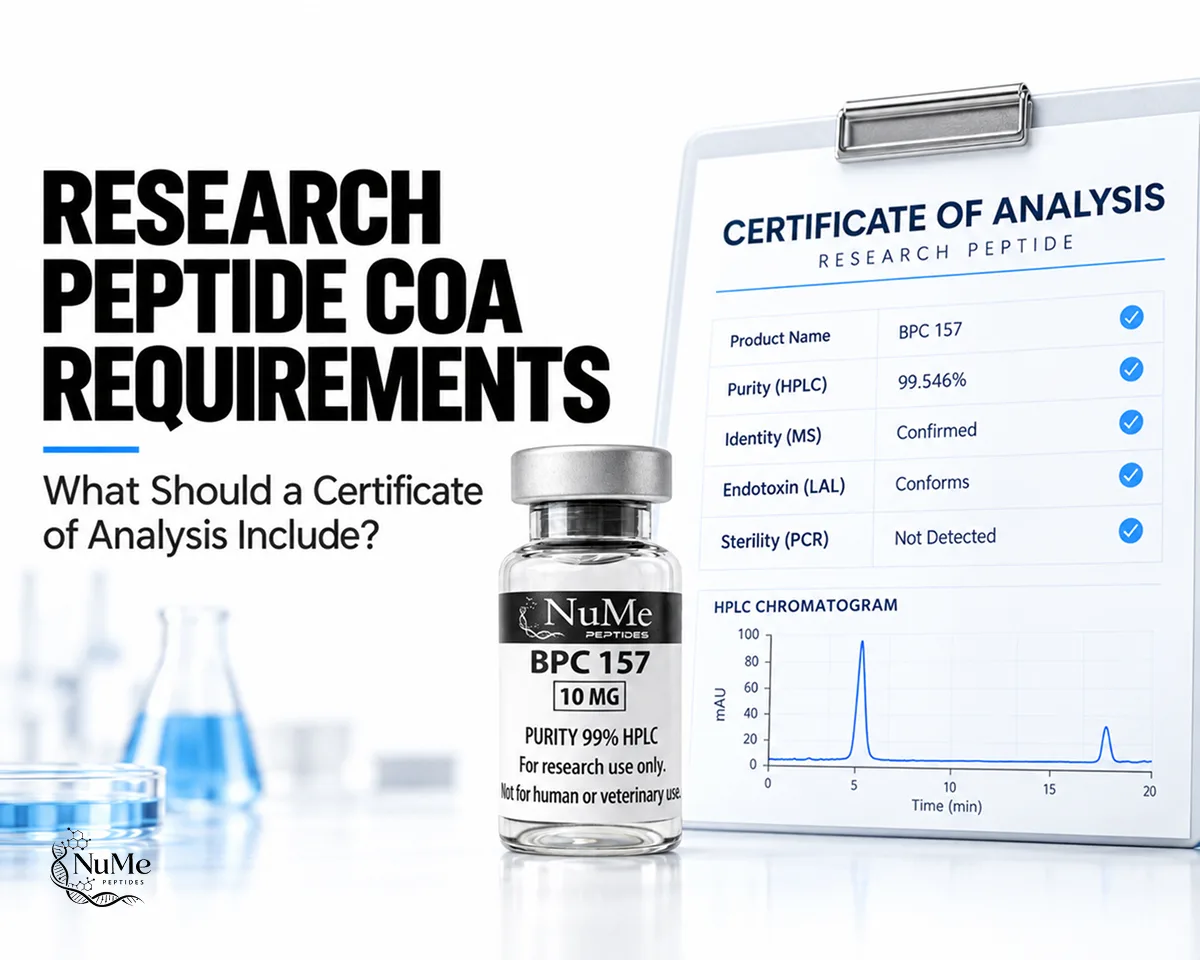
Research Peptide COA Requirements: What Should a Certificate of Analysis Include?


Understanding research peptide COA requirements begins with an important distinction: a Certificate of Analysis is not simply a document showing a purity percentage. A useful COA should connect a specific research material to a specific batch, identify the analytical tests performed, report the resulting data, and provide enough information for researchers to understand what those results actually demonstrate.
For research peptides, this is particularly important because identity, chromatographic purity, peptide content, and stability are separate quality characteristics. A certificate reporting “99% purity,” for example, does not automatically establish molecular identity or the amount of target peptide by total dry weight.
Canadian researchers can use Health Canada’s regulated active pharmaceutical ingredient framework as a useful quality reference. For regulated APIs, Certificates of Analysis are expected to identify the batch, list relevant tests and specifications, and provide numerical results where applicable. Research-use peptides are not automatically subject to these pharmaceutical requirements, but the same principles help researchers evaluate whether documentation is complete and traceable. (Health Canada, 2022)
For researchers looking for peptide materials for laboratory investigation, visit the Nume Peptides to explore the available research peptide collection.
What Identification Information Should Appear on a Peptide COA?
One of the first research peptide COA requirements to evaluate is identification. Researchers should be able to determine exactly which material and production batch the certificate describes.
Useful identification fields may include:
- peptide or compound name;
- amino-acid sequence where appropriate;
- product identifier;
- lot or batch number;
- sample identification number;
- testing laboratory;
- date of analysis;
- report or certificate number.
Peptide identity
The certificate should clearly identify the peptide being analyzed.
A product name alone may not always provide sufficient specificity. Where appropriate, sequence information, molecular formula, or theoretical molecular mass can add useful context.
Batch or lot number
The lot number creates a direct connection between the analytical certificate and the physical research material.
If the batch number printed on the vial does not correspond to the COA, the certificate may describe another production lot.
This principle is also reflected in Health Canada’s GMP guidance for regulated APIs, where Certificates of Analysis and distribution records are expected to maintain traceability to individual batches. (Health Canada, 2022)
Testing laboratory
Researchers should also be able to identify who performed the analysis.
Laboratory information may include:
- laboratory name;
- report number;
- authorized signature or approval;
- testing location where relevant.
A statement such as “third-party tested” provides less information if the laboratory and analytical report cannot be identified.
| Identification field | Why it matters |
|---|---|
| Peptide name | Identifies the intended material |
| Sequence or molecular information | Adds molecular specificity |
| Lot number | Connects testing to the product |
| Report number | Supports document traceability |
| Test date | Shows when analysis occurred |
| Laboratory identity | Identifies who generated the results |
For researchers looking for peptide materials for laboratory investigation, browse the Nume Peptides Shop to explore the available research collection.
What Analytical Testing Information Should Be Included?
A complete COA should identify the analytical methods used rather than reporting results without context.
For research peptides, common analytical information may include:
- HPLC or UPLC purity testing;
- mass-spectrometry identity analysis;
- LC-MS where appropriate;
- peptide-content analysis;
- water or moisture measurements;
- counterion analysis;
- additional physicochemical tests where relevant.
Not every peptide requires every test. Instead, the testing should address the characteristics the supplier claims to have evaluated.
HPLC information
If a supplier reports chromatographic purity, the certificate should indicate that HPLC or another chromatographic method generated the result.
More detailed documentation may also provide:
- purity percentage;
- chromatogram;
- principal peak;
- secondary peaks;
- retention time;
- analytical conditions.
HPLC is widely used for assessing synthetic peptide purity, but chromatographic purity should not be confused with peptide content. Consensus recommendations for peptide standards distinguish chemical purity from the amount of actual peptide present in the total material. (Hoofnagle et al., 2016)
Mass-spectrometry information
A COA may also show:
- theoretical molecular mass;
- observed molecular mass;
- MS spectrum;
- ion or charge-state information.
Mass spectrometry can provide strong evidence that a detected molecular species is consistent with the intended peptide.
However, an expected molecular mass does not by itself establish chromatographic purity.
Reviews of synthetic peptide quality control identify mass spectrometry as an important tool for assessing peptide identity, molecular integrity, and selected related variants. (Højrup, 2024)
For researchers looking for peptide materials for laboratory investigation, browse the NuMe Peptides Shop to explore the available research collection.
For researchers looking for peptide materials for laboratory investigation, browse the Nume Peptides Shop to explore the available research collection.
How Should Purity and Identity Results Be Documented?
Purity and identity should ideally appear as separate analytical results because they answer different questions.
Purity evaluates sample composition
An HPLC purity result typically represents the relative detector response associated with the principal chromatographic peak compared with other integrated peaks.
For example, a reported result of 99.2% generally means the main peak represented approximately 99.2% of the integrated chromatographic response under that particular analytical method.
It does not necessarily mean:
- 99.2% of total vial mass is target peptide;
- molecular identity has been completely established;
- every possible impurity was detected;
- the sample contains no water or counterions.
Identity evaluates what the detected molecule is
Mass spectrometry addresses a different analytical question.
Researchers may compare:
- theoretical molecular mass;
- experimentally observed molecular mass;
- difference between the two;
- additional detected molecular species.
A close agreement supports molecular identity, although more detailed structural characterization may be required for some closely related variants.
Synthetic peptide impurity research demonstrates why chromatographic and mass-spectrometric data can be complementary. LC-MS can help associate separated impurity peaks with molecular-mass information and support characterization of manufacturing- or storage-related species. (Lian et al., 2021)
| Result | What it primarily demonstrates |
|---|---|
| HPLC purity | Relative chromatographic composition |
| MS molecular mass | Support for molecular identity |
| LC-MS | Separation linked with mass information |
| Peptide content | Amount of peptide within total material |
| Water analysis | Residual moisture information |
A well-structured COA should avoid presenting these measurements as interchangeable.
Why Are Batch Numbers and Testing Dates Important?
Research peptide documentation is most valuable when it is batch-specific and time-specific.
Batch numbers establish traceability
A manufacturer may produce the same peptide in multiple production runs. Each lot may experience differences in synthesis, purification, storage, or handling.
Therefore, a COA from one batch should not automatically be used to characterize another.
Researchers should verify that:
- the product lot matches the certificate;
- the analytical report references that lot;
- the peptide name and presentation are consistent;
- the test results correspond to the same material.
Testing dates provide analytical context
A COA represents the condition of a sample when testing occurred.
It does not automatically establish that the material will remain unchanged indefinitely.
Temperature, moisture, oxygen exposure, light, and storage duration may contribute to chemical or physical changes after initial testing.
Therefore, when reviewing research peptide COA requirements, the analytical date provides important context for understanding how current the reported results are.
Health Canada’s regulated API guidance likewise emphasizes controlled records, batch traceability, retest information, and appropriate documentation throughout storage and distribution. (Health Canada, 2022)
For researchers looking for peptide materials for laboratory investigation, browse the Nume Peptides Shop to explore the available research collection.
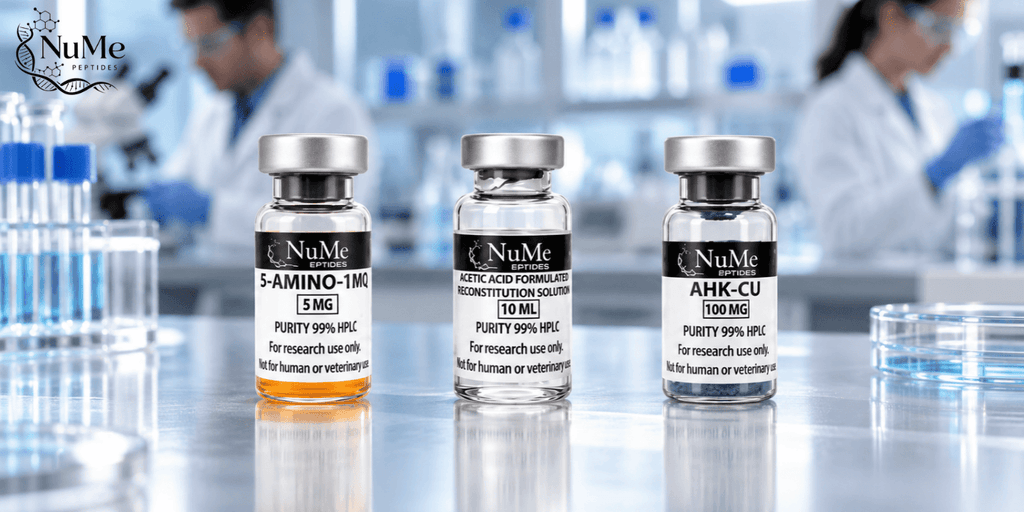
What Information Can Help Researchers Evaluate COA Completeness?
A complete COA does not need to contain every possible analytical measurement. It does, however, need enough information for researchers to understand what was tested and how the results relate to the material.
A practical completeness review can ask:
- Is the peptide clearly identified?
- Does the lot number match the product?
- Is the analytical test date provided?
- Are the testing methods named?
- Are actual numerical results reported?
- Are purity and identity shown separately?
- Is the testing laboratory identifiable?
- Are specifications or acceptance criteria provided where relevant?
Information that deserves closer review
Researchers should be cautious when a certificate contains:
- no batch number;
- no analytical date;
- “passed” without numerical data;
- a purity percentage without a method;
- MS confirmation without observed mass;
- unclear laboratory information;
- identical documentation reused across several production lots.
Evaluate what is missing
Absence of a field does not automatically mean that the material is unsuitable.
Instead, researchers should consider whether the missing information affects the intended experiment.
For example, a qualitative study may not require the same level of peptide-content assignment as a quantitative analytical reference standard.
This reflects a broader analytical principle: quality documentation should be evaluated in relation to intended research use rather than through a single universal checklist. (Hoofnagle et al., 2016)
Learn how testing, documentation, traceability, and identity work together when reviewing laboratory peptide materials in our guide: Research Peptide Quality: How to Evaluate Testing, Documentation and Verification.
Learn how identity, purity, analytical testing, and documentation work together when evaluating peptide materials in our guide: Research Peptide Quality: How to Evaluate Testing, Documentation and Verification
FAQs About Research Peptide COA Requirements
What Are the Most Important Research Peptide COA Requirements?
A useful starting set includes:
- product identification;
- lot or batch number;
- analytical test date;
- HPLC result where purity is claimed;
- MS result where identity is claimed;
- numerical test results;
- identifiable testing laboratory.
Should Every Peptide COA Include HPLC and Mass Spectrometry?
Not necessarily.
The appropriate analytical methods depend on what the supplier claims to have evaluated. However, HPLC and MS are commonly complementary because one addresses chromatographic composition while the other provides molecular-mass information.
Does a 99% HPLC Result Prove 99% Peptide Content?
No.
HPLC area percentage and peptide content are different measurements. Water, counterions, salts, and other material may not be represented by the headline chromatographic purity value. (Hoofnagle et al., 2016)
Should the COA Lot Number Match the Product?
Yes.
Without a matching lot number, researchers cannot confidently connect the certificate to the material being used.
Is “Third-Party Tested” Enough Information?
No.
Researchers should ideally know which laboratory performed the testing, which batch was analyzed, what methods were used, and what numerical results were obtained.
Does a COA Mean the Peptide Meets Pharmaceutical Standards?
No.
A Certificate of Analysis reports analytical information. Research-use peptide documentation should not be assumed to demonstrate pharmaceutical GMP compliance or regulatory approval unless the appropriate regulatory evidence specifically establishes that status.
Conclusion
Research peptide COA requirements are best understood as a framework for analytical transparency and traceability rather than a single mandatory template for every research material.
A useful Certificate of Analysis should help researchers determine:
- what peptide was tested;
- which batch was analyzed;
- when testing occurred;
- which analytical methods were used;
- what purity and identity results were obtained;
- which laboratory generated the data.
Most importantly, purity, identity, peptide content, and stability should remain separate analytical concepts. A strong COA makes those distinctions clear instead of compressing them into one headline quality claim.
For Canadian researchers, Health Canada’s regulated API framework provides a useful reference because it emphasizes batch-specific documentation, scientifically appropriate testing, traceability, and reliable Certificates of Analysis. (Health Canada, 2022)
For researchers looking for peptide materials for laboratory investigation, visit the Nume Peptides to explore the available research peptide collection.
Disclaimer: This content is provided for educational and scientific research purposes only. Research peptides are intended for laboratory research only and are not intended for human consumption or medical use.


A clear explanation of why a Certificate of Analysis matters when evaluating research peptides. Checking batch-specific results, testing methods, and sample identification details can help researchers assess whether the documentation is complete and relevant.
I appreciate the emphasis on reviewing the details rather than relying on a COA title alone. Information about analytical methods, reported purity, and the laboratory responsible for testing is important when assessing the credibility of a research document.
This is a useful checklist for anyone reviewing peptide documentation. I would also look for traceable batch numbers and, where possible, independent verification, since a certificate is only as useful as the data and testing behind it.