
Research Peptides vs Pharmaceutical Peptides: What’s the Difference?


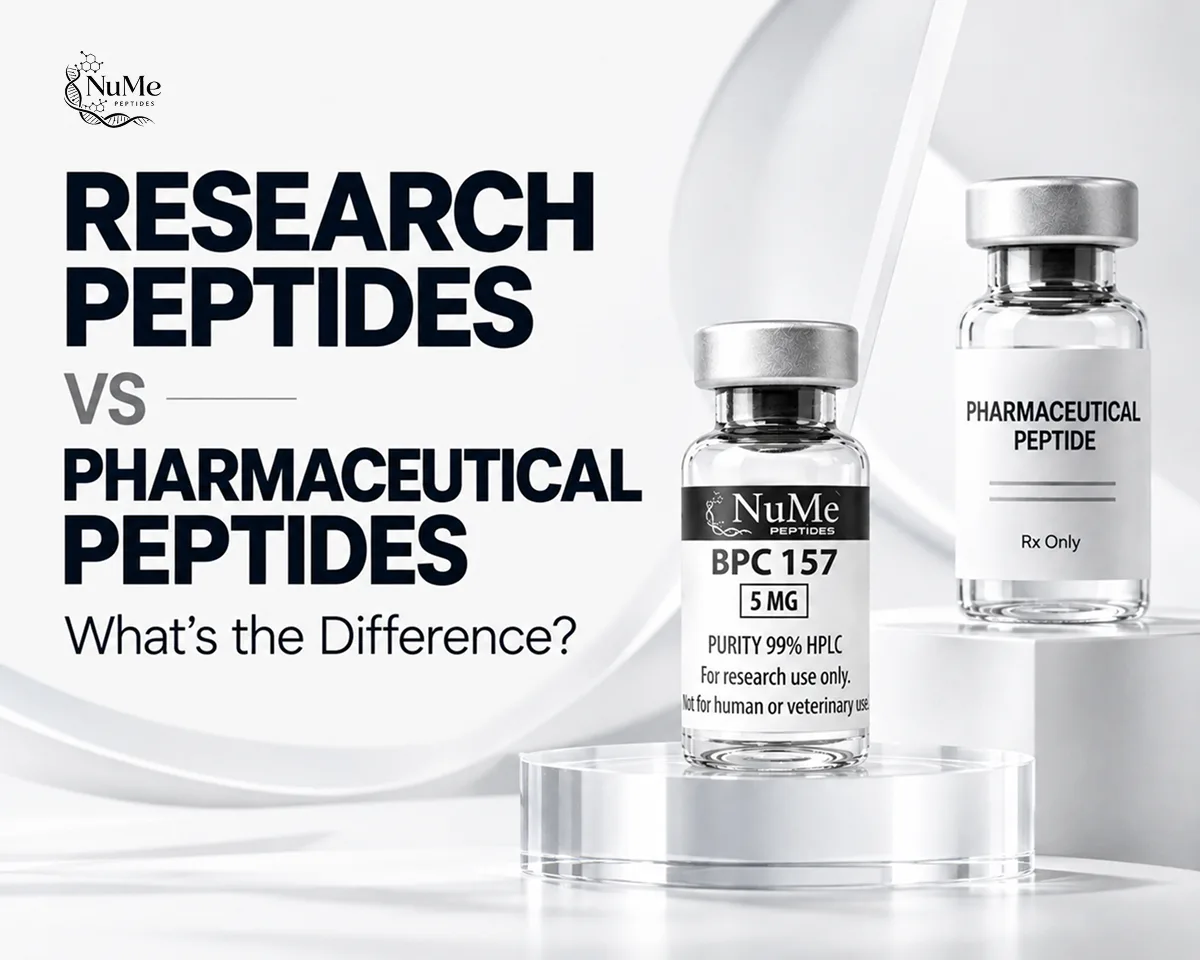
Understanding research peptides vs pharmaceutical peptides is important for anyone working with peptide science, because the two categories can involve similar molecular structures while serving very different purposes. A peptide may be synthesized using similar chemical principles, yet its intended use, manufacturing controls, testing requirements, documentation, and regulatory pathway can differ substantially.
At Nume Peptides, researchers can explore peptide materials intended for laboratory research. Visit the Nume Peptides Shop to browse the available research peptide collection.
The distinction begins with the purpose for which each material is developed and supplied. It also involves the complete context surrounding the material, including its intended use, manufacturing process, analytical characterization, quality system, labeling, and regulatory status. Instead, it involves the complete context surrounding the material, including its intended purpose, manufacturing process, analytical characterization, quality system, labeling, and regulatory status. (FDA, 2023)
This guide examines the differences between the two categories across five important areas: intended use, manufacturing, testing, regulatory requirements, and scientific interpretation.
How Do Research Peptides and Pharmaceutical Peptides Differ in Their Intended Use?
One of the most fundamental differences between these two categories is their intended use.
Research peptides are generally supplied as materials for laboratory investigation. Researchers may use them to study molecular interactions, peptide structure, receptor binding, biochemical pathways, analytical methods, or other scientific questions. Their purpose is to generate experimental information rather than to serve as an approved therapeutic product.
Pharmaceutical peptides, in contrast, are developed as medicinal products intended for regulated use in patients. Their development involves a much broader evidence package covering areas such as quality, pharmacology, toxicology, clinical pharmacology, safety, efficacy, manufacturing, and regulatory review. The FDA’s guidance on peptide drug products specifically addresses clinical pharmacology considerations relevant to development programs for proposed peptide medicines. (FDA, 2023)
| Research Peptides | Pharmaceutical Peptides |
|---|---|
| Intended for laboratory investigation | Developed as medicinal products |
| Used to answer scientific questions | Intended for regulated therapeutic use |
| Research-focused documentation | Extensive pharmaceutical documentation |
| Experimental models may vary | Development follows defined regulatory pathways |
| Not automatically approved medicines | Subject to applicable regulatory review |
This distinction matters because the same or similar peptide sequence can appear in both scientific research and pharmaceutical development. The molecular identity alone does not determine whether a material is a pharmaceutical product. Instead, its intended use and regulatory context are critical.
In fact, the FDA has stated in recent enforcement actions that simply placing “research use only” language on a label does not by itself determine regulatory status when other evidence indicates that products are intended for human use. This illustrates why intended use must be evaluated in context rather than inferred from a label alone. (FDA, 2026)
Therefore, researchers should first ask what the material is intended to do and within what scientific or regulatory framework it is being supplied.
For researchers looking for peptide materials for laboratory investigation, browse the Nume Peptides Shop to explore the available research collection.
How Do Quality and Manufacturing Requirements Differ?
Another important distinction concerns manufacturing controls and quality systems.
Research peptide materials can be manufactured for laboratory investigation with specifications appropriate to the intended research purpose. Depending on the supplier and application, researchers may evaluate characteristics such as peptide identity, sequence, purity, molecular mass, and analytical results.
Pharmaceutical peptide manufacturing operates within a much broader quality framework. Drug substance development involves control of the manufacturing process, starting materials, impurities, process parameters, and other characteristics that can affect product quality. The FDA’s ICH Q11 guidance addresses the development and manufacture of drug substances and specifically discusses process understanding and impurity control. (FDA, 2012)
For pharmaceutical peptides, manufacturing is not simply about producing a peptide with a particular sequence. Developers must demonstrate that the manufacturing process consistently produces material meeting predefined quality characteristics.
This is especially relevant because synthetic peptides can contain different types of impurities or structural variants arising from starting materials, synthesis, purification, storage, and degradation. Analytical characterization of these impurities is therefore an important part of pharmaceutical peptide development.
Research materials can also be characterized using sophisticated analytical methods, but the purpose and depth of characterization depend on the scientific application. A researcher studying peptide binding may prioritize molecular identity and purity, while a pharmaceutical developer must establish a much broader collection of critical quality attributes and manufacturing controls.
The difference therefore involves more than a simple “high purity versus low purity” comparison. Both types can be highly characterized, but pharmaceutical development requires a comprehensive and controlled manufacturing framework appropriate for a medicinal product.
For pharmaceutical products, lifecycle management also becomes important. ICH Q12 describes a framework for managing post-approval chemistry, manufacturing, and controls changes in a predictable regulatory environment. (FDA, 2021)
How Do Testing and Documentation Requirements Compare?
Testing is another area where the requirements can differ substantially.
For research materials, analytical testing may focus on confirming whether the material corresponds to the intended peptide and whether it meets the specifications needed for a particular experiment. Common analytical techniques include high-performance liquid chromatography (HPLC), mass spectrometry, chromatography, and other structural or physicochemical methods. (Chandrudu et al., 2013)
HPLC can provide information about chromatographic purity, while mass spectrometry can help confirm molecular mass and investigate peptide-related impurities. These methods are frequently used together because each provides different information about the material. (Lian et al., 2021)
Pharmaceutical peptide testing is considerably broader. Developers may need to establish identity, purity, impurities, potency or biological activity where applicable, stability, degradation characteristics, higher-order structural properties, and other critical quality attributes.
A review of peptide therapeutic characterization describes how chemical and biophysical analytical techniques contribute to understanding peptide drug products and establishing quality attributes that can ultimately support regulatory specifications.
Documentation also becomes more extensive during pharmaceutical development. Regulatory submissions can require detailed information about manufacturing processes, analytical methods, specifications, stability, controls, and supporting studies.
For example, FDA guidance concerning chemistry, manufacturing, and controls explains that sponsors developing investigational drugs need to provide appropriate CMC information, with the depth of information depending partly on the stage of development and the nature of the investigation.
Consequently, these categories should not be viewed as a simple comparison in which one type is “tested” and the other is not. Research materials can undergo extensive testing, while pharmaceutical products require a more comprehensive, lifecycle-oriented quality and documentation framework.
For researchers, this distinction is useful when reviewing certificates of analysis, analytical reports, or other documentation. A laboratory research certificate should not automatically be interpreted as evidence that a material meets all requirements applicable to an approved pharmaceutical product.
How Do Regulatory Standards Differ Between Research and Pharmaceutical Peptides?
Regulatory status is one of the clearest areas of distinction between laboratory research materials and pharmaceutical products.
Pharmaceutical peptides intended for regulated medical use are developed within applicable drug regulatory frameworks. In the United States, for example, peptide drug products may be submitted through regulatory pathways involving applications such as an NDA, depending on the product and development route. FDA guidance specifically discusses clinical pharmacology considerations for peptide drug products submitted in an NDA framework.
The regulatory process can involve assessment of quality, manufacturing, nonclinical evidence, clinical pharmacology, safety, efficacy, labeling, and other requirements.
Recent FDA activity also illustrates the level of specificity involved in pharmaceutical peptide regulation. In July 2026, the agency published revised draft product-specific guidances for several generic peptide products. The guidances addressed areas including impurity thresholds, higher-order structure assessment, biological activity, and other considerations relevant to generic peptide drug assessment. (FDA, 2026)
Research materials exist in a different context. Their scientific purpose is to support laboratory investigation rather than establish an approved therapeutic use. However, the precise legal and regulatory treatment of research materials can vary according to jurisdiction, product characteristics, claims, labeling, distribution, and actual intended use.
This is why the distinction should not be reduced to the presence of a “research use only” statement. Regulatory authorities can consider the broader evidence surrounding how a product is represented and intended to be used. (FDA, 2026)
Researchers and suppliers should therefore avoid assuming that terminology alone establishes regulatory status. Applicable laws and requirements depend on the jurisdiction and the specific circumstances surrounding the product.
Why Does the Distinction Matter in Scientific Research?
Understanding this distinction matters because researchers need to interpret peptide materials according to their intended purpose, analytical evidence, and scientific context.
A peptide used as a laboratory research material may be perfectly appropriate for investigating a molecular hypothesis without being equivalent to a pharmaceutical product. Conversely, a pharmaceutical peptide has to satisfy a much broader set of requirements because it is being developed within a regulated medicinal-product framework.
This distinction can help researchers interpret scientific literature more carefully. A study describing a peptide’s molecular interaction does not necessarily establish the safety, efficacy, manufacturing consistency, or regulatory status required for a pharmaceutical product.
The distinction is also important when comparing analytical documentation. A certificate of analysis can provide valuable information about a particular research material or batch, but its contents should be interpreted according to what was actually tested and the specifications used.
For example, mass spectrometry can help characterize peptide identity and impurities, but analytical results must be interpreted using appropriate methods, reference standards, and acceptance criteria. Pharmaceutical characterization therefore involves a broader analytical strategy rather than relying on one test alone. (Lian et al., 2021)
Ultimately, research peptides and pharmaceutical peptides represent two different contexts within the broader field of peptide science. Both can involve sophisticated chemistry and analytical science, but their objectives and quality frameworks are not interchangeable.
For researchers, recognizing this difference can make it easier to evaluate research materials, understand published studies, assess analytical documentation, and avoid drawing conclusions that extend beyond the evidence available.
If you’re new to peptide research, start with our beginner-friendly guide What Are Research Peptides? A Beginner’s Guide to Peptide Research to learn more about peptide structure, molecular mechanisms, scientific applications, and key considerations before exploring the differences between research and pharmaceutical peptides.
FAQs About Research Peptides vs Pharmaceutical Peptides
What is the main difference between research peptides and pharmaceutical peptides?
The primary difference is their intended context. Research peptides are used as materials for scientific investigation, while pharmaceutical peptides are developed as regulated medicinal products. Their manufacturing, testing, documentation, and regulatory requirements therefore differ. (Muttenthaler et al., 2021)
Are research peptides the same as pharmaceutical-grade peptides?
No. A research peptide may have a defined sequence and high analytical purity, but that does not automatically mean it meets the complete quality, manufacturing, regulatory, and clinical requirements applicable to a pharmaceutical product.
Are pharmaceutical peptides always more thoroughly tested?
Pharmaceutical peptide development generally requires a broader testing and documentation framework because the product is being developed for regulated medicinal use. Research peptides can also undergo extensive analytical testing, but the scope depends on their intended research application. (Brange et al., 2016)
What tests are commonly used for peptide characterization?
HPLC, mass spectrometry, chromatography, spectroscopy, and other analytical methods can be used to characterize peptide materials. Pharmaceutical development may require a broader combination of chemical and biophysical methods. (Lian et al., 2021)
Does “research use only” automatically make a peptide a research product?
Not necessarily. Regulatory authorities can consider actual intended use, marketing, labeling, and other evidence. The FDA has issued enforcement actions where products labeled for research use were considered drugs based on evidence concerning their intended use. (FDA, 2026)
Why is manufacturing documentation important for pharmaceutical peptides?
Manufacturing documentation helps demonstrate that the drug substance and drug product can be produced consistently and that relevant quality characteristics and impurities are appropriately controlled. (FDA, 2012)
Understanding the distinction requires looking beyond the peptide sequence itself. Research materials and pharmaceutical products can share similar chemistry, but they exist within different scientific and regulatory contexts.
Research peptides can provide valuable tools for investigating molecular mechanisms, peptide structure, biochemical interactions, and analytical methods. Pharmaceutical peptides, meanwhile, require extensive development and quality systems designed for regulated medicinal products. (Muttenthaler et al., 2021)
For researchers, the key is to evaluate each peptide material according to its intended use, characterization, documentation, manufacturing context, and applicable regulatory framework rather than assuming that similar molecular structures mean identical product status.
Disclaimer: This content is provided for educational and scientific research purposes only. Research peptides are intended for laboratory research only and are not intended for human consumption or medical use.


I found this comparison really useful, especially the distinction between research peptides and pharmaceutical peptides. The explanation of how their intended use and regulatory status can differ makes the topic much easier to understand. It would be interesting to see a follow-up discussing how researchers evaluate the quality of each type.
This was a clear and easy-to-follow explanation for anyone who is new to peptide research. I liked that the article focuses on the different roles these peptides can have rather than treating them as interchangeable products. How much does the intended research application influence the type of peptide researchers choose?
Really enjoyed the practical comparison in this article. The discussion around research use versus pharmaceutical applications helped clarify why similar peptides can be handled very differently depending on the context. I’d be interested in reading more about the testing and documentation researchers should look for when selecting research peptides.