
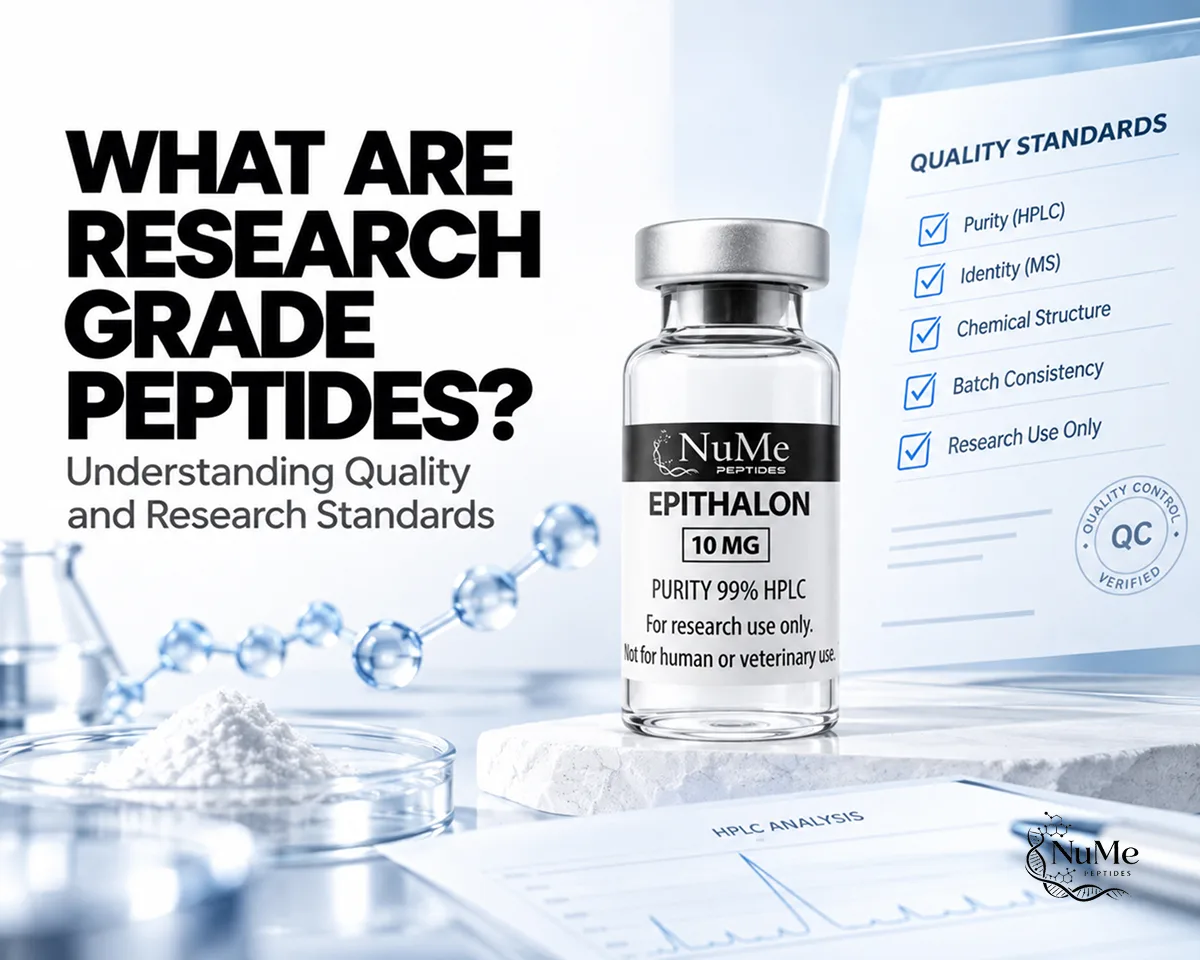
What Are Research Grade Peptides? Understanding Quality and Research Standards


The term research grade peptides appears frequently in laboratory and scientific supply contexts, but the label alone does not provide a complete picture of quality. It does not automatically tell researchers how pure a peptide is, how its identity was confirmed, whether impurities were investigated, or whether analytical results apply to the specific batch being supplied.
Instead, researchers should evaluate measurable characteristics such as:
- peptide identity;
- chromatographic purity;
- peptide content;
- impurity profile;
- batch traceability;
- analytical methods;
- storage and handling information;
- supporting Certificates of Analysis.
In Canada, Health Canada’s GMP guidance for active pharmaceutical ingredients provides a useful quality reference because it emphasizes defined specifications for identity, potency, purity, analytical methods, and acceptance criteria. These requirements apply to regulated APIs rather than ordinary research materials, but they demonstrate why objective analytical evidence is more informative than a general quality label. (Health Canada, 2022)
NuMe Peptides Canada states that its research compounds undergo independent HPLC and mass-spectrometry analysis and are supported by Certificates of Analysis.
For researchers looking for peptide materials for laboratory investigation, visit the Nume Peptides to explore the available research peptide collection.
What Does “Research Grade” Mean for Peptides?
In laboratory use, “research grade” generally indicates that a peptide is supplied for scientific investigation rather than as an approved therapeutic product.
However, there is an important distinction between a marketing or intended-use label and an analytical specification.
A useful research specification should answer questions such as:
- What molecule is present?
- How was its identity verified?
- What percentage of the chromatographic signal corresponds to the target peptide?
- Which impurities were detected?
- Which batch was tested?
- Which methods produced the reported results?
The words “research grade” alone cannot answer these questions.
Health Canada’s API guidance provides a useful comparison. For regulated APIs, specifications should include relevant tests, analytical procedures, and acceptance criteria for attributes such as identity and purity. (Health Canada, 2022)
Research peptides are not automatically subject to the same pharmaceutical framework. Therefore, researchers should avoid assuming that “research grade” means GMP-grade, pharmaceutical-grade, or suitable for clinical use.
For researchers looking for peptide materials for laboratory investigation, browse the Nume Peptides Shop to explore the available research collection.
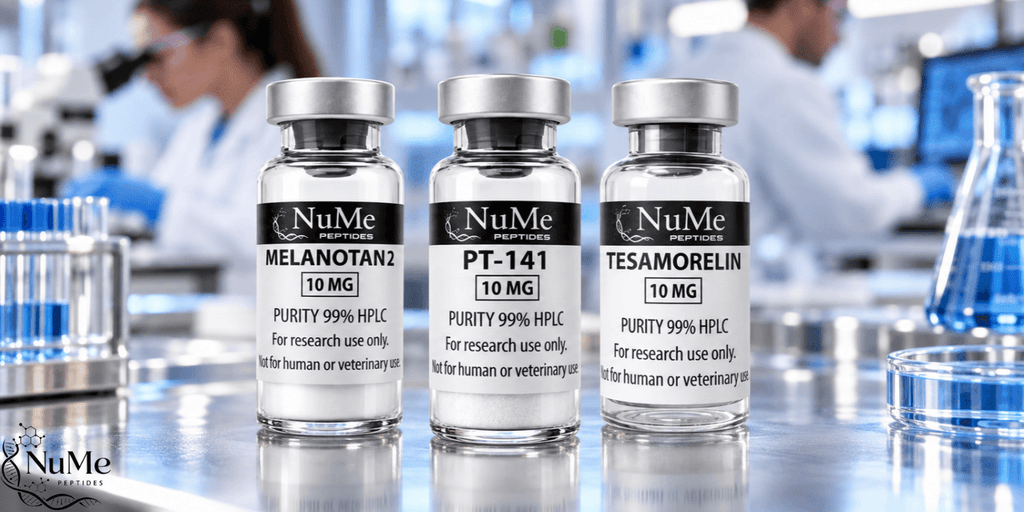
How Are Research Grade Peptides Different From Other Peptide Materials?
Peptides with the same nominal amino-acid sequence can differ substantially depending on how they were manufactured, purified, characterized, and documented.
| Peptide material | Primary purpose | Typical quality information |
|---|---|---|
| Research grade peptide | Laboratory investigation | HPLC, MS, COA, batch data |
| Crude peptide | Early screening or development | Basic identity, limited purification |
| Analytical/reference peptide | Calibration and measurement | Detailed characterization and assigned values |
| GMP API | Regulated drug manufacturing | Validated processes, specifications, impurity controls and batch records |
One study comparing synthetic obestatin obtained from multiple manufacturers found significant differences in identity and impurity profiles. The authors highlighted the importance of adequate quality-control testing before synthetic peptides are used in biomedical research. (De Spiegeleer et al., 2008)
Likewise, consensus recommendations for peptide standards used in mass-spectrometry assays emphasize several areas that can influence experimental reliability:
- peptide procurement;
- initial characterization;
- purity assessment;
- storage conditions;
- sample handling;
- documentation;
- traceability.
Therefore, two products carrying the same peptide name should not automatically be considered analytically equivalent.(Hoofnagle et al., 2016)
What Quality Characteristics Are Relevant to Research Grade Peptides?
Researchers should evaluate research grade peptides using several quality attributes rather than relying on a single purity percentage.
Identity
Identity determines whether the supplied material corresponds to the intended peptide.
Mass spectrometry is frequently used to compare the observed molecular mass with the expected mass of the target peptide. It can also reveal molecular species that differ in mass because of degradation or synthesis-related modifications.
However, mass alone may not distinguish every structural variant. Researchers should therefore interpret MS results alongside chromatographic and other analytical information.
Chromatographic purity
Reverse-phase HPLC is commonly used to evaluate chromatographic purity.
A typical HPLC analysis may help researchers identify:
- the main peptide peak;
- additional chromatographic peaks;
- relative peak areas;
- possible process-related impurities;
- changes between samples or batches.
Importantly, a reported HPLC purity percentage is not necessarily equivalent to the percentage of peptide by total vial mass.
Salts, water, counterions, and other components may not contribute to the chromatogram in the same way as peptide-related species.
Peptide content
Peptide content addresses how much of the material actually consists of peptide.
This distinction can be especially relevant in quantitative experiments because two samples with similar chromatographic purity may contain different amounts of peptide per unit of total material.
Research involving synthetic C-peptide demonstrated that structurally related peptide impurities can influence purity determination and that LC-high-resolution mass spectrometry can help identify and quantify these species. (Li et al., 2018)
Impurity profile
Peptide synthesis can generate several types of related impurities, including:
- deletion sequences;
- incomplete coupling products;
- amino-acid misincorporations;
- oxidation products;
- deamidated species;
- epimers;
- process-related modifications;
- degradation products formed during storage.
Because some impurities can closely resemble the intended peptide, multiple analytical methods may be necessary.
A review of synthetic peptide characterization describes LC-MS as an important technique for identifying peptide-related impurities originating from starting materials, manufacturing, processing, and storage. (Lian et al., 2021)
What Documentation Can Help Evaluate Research Grade Peptides?
Documentation is one of the most useful ways to distinguish a general quality statement from verifiable analytical evidence.
Certificate of Analysis
A useful Certificate of Analysis should ideally allow researchers to connect analytical results with the actual material received.
Key information may include:
- product or peptide name;
- lot or batch number;
- analytical test date;
- identity result;
- HPLC purity result;
- mass-spectrometry result;
- analytical method used;
- test laboratory;
- applicable specifications or acceptance criteria.
For regulated APIs, Health Canada states that Certificates of Analysis should identify the batch, provide test results, reference specifications, and contain appropriate laboratory or approval information. (Health Canada, 2022)
Although research peptides operate in a different regulatory context, these principles illustrate why a batch-specific COA is more informative than a generic statement such as “lab tested.”
HPLC documentation
Researchers should look beyond the headline purity percentage when HPLC documentation is available.
Useful information can include:
- chromatogram;
- retention time;
- main peak area;
- secondary peaks;
- integration method;
- test conditions.
Closely related peptide impurities may sometimes be difficult to distinguish using chromatography alone, which is why additional structural analysis can be valuable. (Li et al., 2018)
Mass spectrometry documentation
Mass spectrometry can provide independent evidence that the observed molecular mass is consistent with the intended peptide.
Combining MS and chromatography is particularly useful because the two methods answer different questions:
- HPLC primarily evaluates separation and relative chromatographic purity.
- MS provides molecular-mass information.
- LC-MS can combine separation with structural information about individual peaks. (Lian et al., 2021)
For researchers looking for peptide materials for laboratory investigation, browse the Nume Peptides Shop to explore the available research collection.
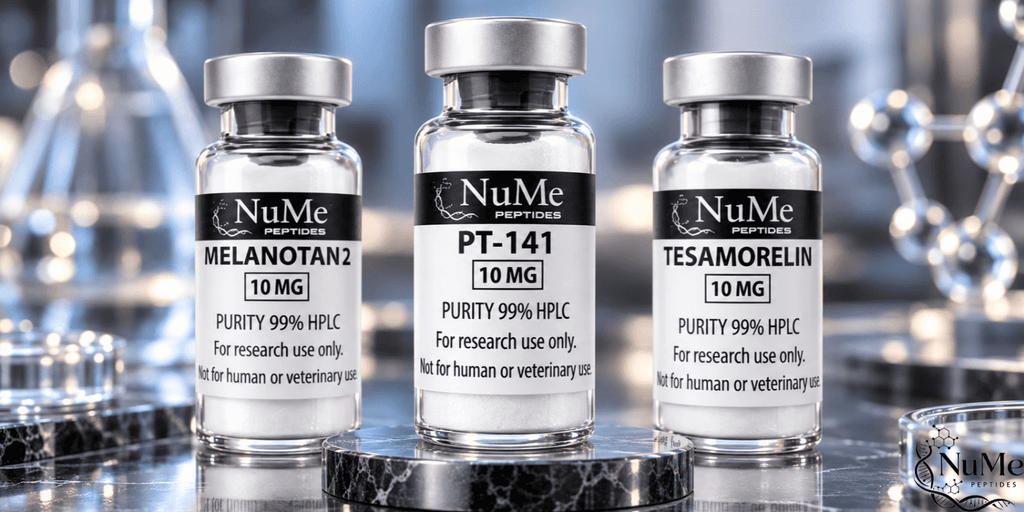
Why Should Researchers Avoid Relying on the “Research Grade” Label Alone?
The term “research grade” can be useful for describing intended laboratory use, but it becomes less useful when researchers treat it as proof of analytical quality.
Several important questions remain unanswered by the label alone:
- Was the specific batch actually tested?
- Was identity independently confirmed?
- Which analytical method generated the purity value?
- Are chromatograms available?
- Were peptide-related impurities investigated?
- Does the COA correspond to the supplied lot?
- Is testing recent enough to reflect the material being supplied?
- Were storage conditions documented?
Health Canada’s regulated API framework illustrates how broad quality assurance extends beyond a single purity result. It includes specifications, analytical procedures, impurity controls, documentation, supplier qualification, stability, storage, and batch traceability. (Health Canada, 2022)
Research peptides should not automatically be assumed to meet these pharmaceutical standards.
A practical evaluation can therefore follow this sequence:
- Confirm the intended peptide identity.
- Check that analytical documentation matches the batch number.
- Review HPLC purity rather than relying only on the supplier headline.
- Review mass-spectrometry identity information.
- Check whether additional impurity information is available.
- Consider storage, handling, and stability requirements.
- Decide whether the available evidence is sufficient for the planned experiment.
This evidence-based approach can make unexpected experimental results easier to investigate because researchers have documented starting information about the material itself.
If you’re new to peptide research, start with our beginner-friendly guide What Are Research Peptides? A Beginner’s Guide to Peptide Research to learn more about peptide structure, molecular mechanisms, scientific applications, and key considerations before exploring the differences between research and pharmaceutical peptides.
FAQs About Research Grade Peptides
Does “Research Grade” Mean 99% Purity?
No. The phrase does not define one universal purity threshold.
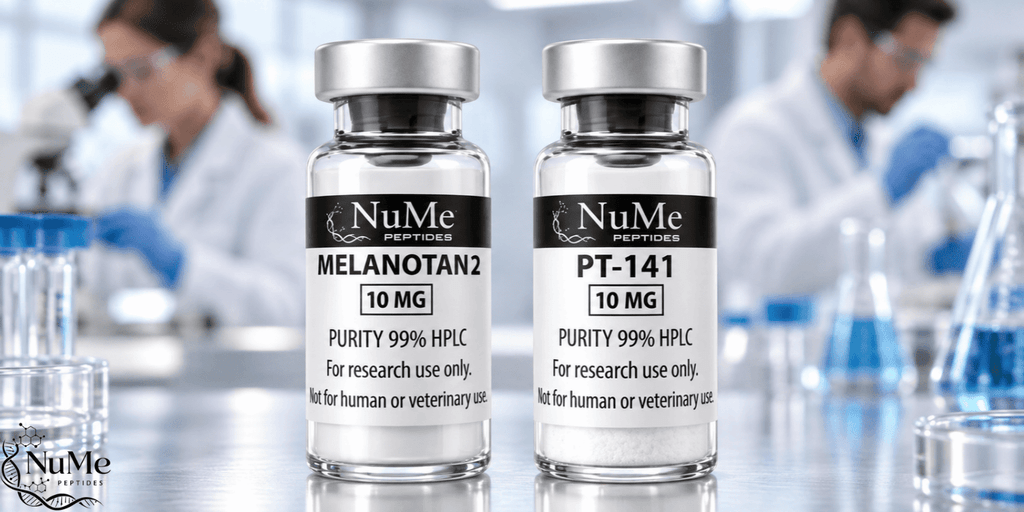
A supplier may report 99% or higher chromatographic purity, but researchers should determine which method produced that result and whether the result applies to the specific batch.
Is HPLC Purity the Same as Peptide Content?
No. HPLC purity generally describes the relative chromatographic area associated with the target peptide under defined test conditions. Peptide content describes the amount of actual peptide within the total material.
These measurements answer different questions.
Why Are HPLC and Mass Spectrometry Often Used Together?
The techniques provide complementary information.
HPLC helps separate the target peptide from chromatographically distinct impurities, while mass spectrometry provides molecular-mass information that can support identity confirmation or impurity characterization. (Lian et al., 2021)
What Should Researchers Check Before Choosing a Research Peptide?
A practical checklist includes:
- batch-specific COA;
- HPLC results;
- MS identity results;
- batch or lot traceability;
- available impurity information;
- storage documentation;
- supplier testing transparency.
Researchers should choose the level of characterization appropriate for the sensitivity and objectives of their experiment.
Are Research Grade Peptides the Same as Pharmaceutical APIs?
No.
APIs intended for regulated drug manufacturing operate within formal regulatory and quality systems. Health Canada’s Canadian GMP framework includes requirements extending far beyond the use of a “research grade” designation. (Health Canada, 2022)
Can High-Purity Peptides Still Produce Inconsistent Research Results?
Yes. Several variables beyond initial purity can influence experimental performance, including:
- inaccurate peptide concentration;
- degradation;
- structurally related impurities;
- adsorption to surfaces;
- storage conditions;
- sample preparation;
- repeated freeze-thaw exposure;
- handling differences between experiments.
Consensus recommendations for peptide standards emphasize characterization, storage, handling, and documentation precisely because all of these factors may affect analytical reliability. (Hoofnagle et al., 2016)
Conclusion
Research grade peptides should be evaluated using analytical evidence rather than terminology alone.
The “research grade” label can indicate that a material is intended for laboratory investigation, but it does not automatically establish a universal standard for purity, identity, stability, impurity control, or manufacturing quality.
Researchers should instead consider several pieces of information together:
- identity confirmation;
- chromatographic purity;
- peptide content where relevant;
- impurity characterization;
- batch-specific Certificates of Analysis;
- analytical methods;
- lot traceability;
- storage and handling information.
This approach provides a stronger foundation for reproducible experiments and makes it easier to determine whether unexpected findings come from the experimental system or from variability in the peptide material itself.
For researchers looking for peptide materials for laboratory investigation, visit the Nume Peptides to explore the available research peptide collection.
Disclaimer: This content is provided for educational and scientific research purposes only. Research peptides are intended for laboratory research only and are not intended for human consumption or medical use.


This is a helpful introduction to what “research-grade” actually means when discussing peptides. I particularly liked the focus on purity, characterization, and quality control, since these factors are important when evaluating materials for laboratory research.
I appreciate how the article distinguishes research-grade peptides from simply calling a peptide “high quality.” Understanding testing, purity levels, and analytical documentation gives researchers a better basis for assessing the materials they work with.
A useful resource for anyone new to research-grade peptides. The explanation of quality standards and analytical verification provides good context for understanding why characterization and consistent testing matter in peptide research.