

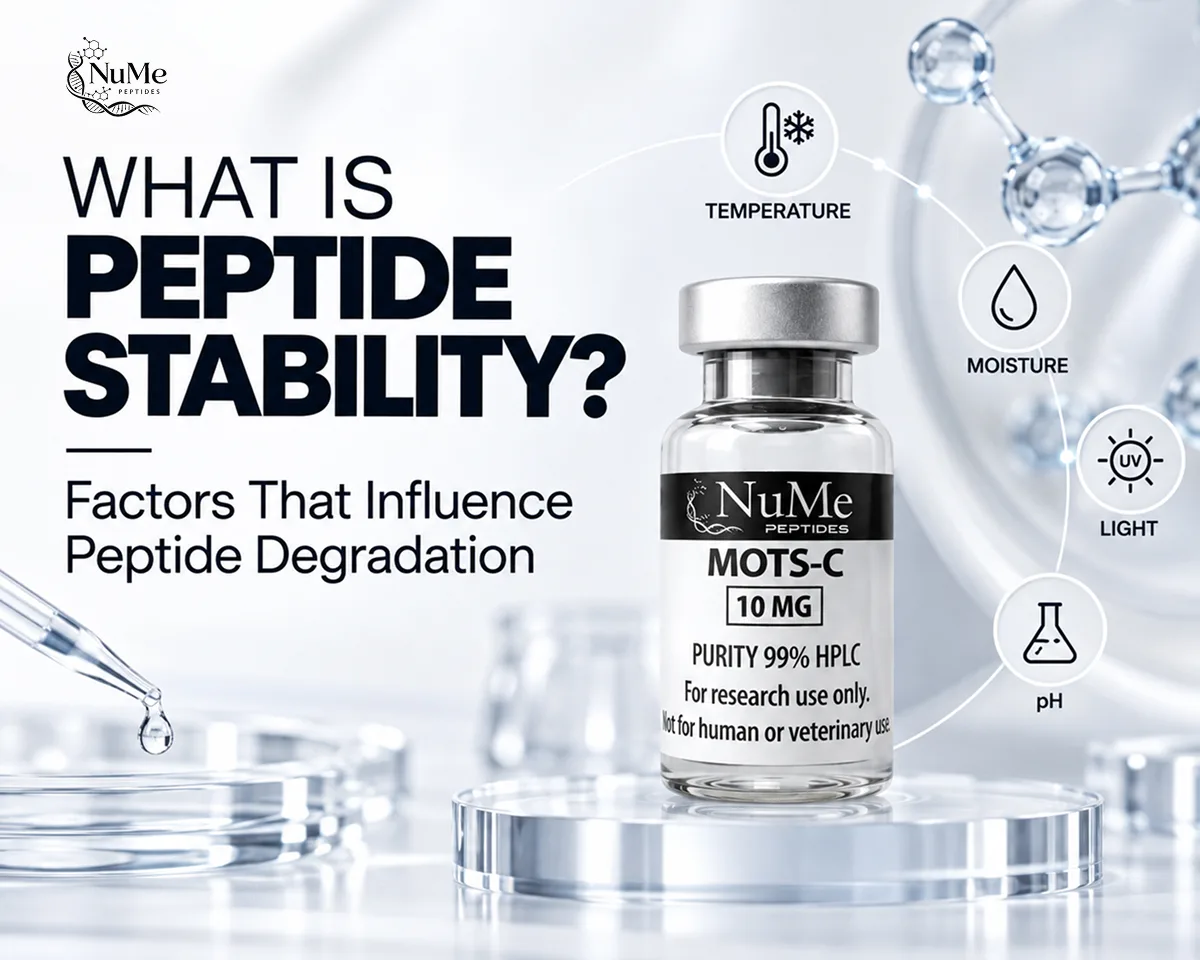
What Is Peptide Stability? Factors That Influence Peptide Degradation


Peptides are valuable tools in laboratory research, but they are not chemically inert. During storage, transportation, preparation, and analysis, a peptide may undergo chemical reactions or physical changes that affect its measurable quality. For researchers, understanding peptide stability is therefore important for distinguishing genuine experimental observations from changes in the research material itself.
In simple terms, peptide stability describes how effectively a peptide maintains its chemical identity, physical state, purity, and other relevant properties over time under defined conditions. Temperature, pH, moisture, oxygen, light, concentration, molecular structure, and handling can all influence degradation. Reviews of peptide formulations consistently show that stability is molecule-specific rather than governed by one universal set of conditions. (Nugrahadi et al., 2023)
For Canadian researchers, stability also matters during transportation because environmental conditions can vary substantially between seasons. Health Canada implements the ICH stability framework, which emphasizes controlled environmental conditions, defined testing intervals, and appropriate analytical methods when formal stability studies are performed. (Health Canada, 2003).
For researchers looking for peptide materials for laboratory investigation, visit the Nume Peptides to explore the available research peptide collection.
What Does Peptide Stability Mean in Research?
Peptide stability does not refer to a single measurement. Instead, it describes whether relevant characteristics of a peptide remain within defined limits over a particular period and under specific environmental conditions.
Depending on the research objective, investigators may monitor intact peptide concentration, chromatographic purity, molecular identity, aggregation, solubility, appearance, or recoverable material.
A sample can also appear visually unchanged even when chemical degradation has occurred. Oxidation or deamidation, for example, may generate modified molecular species without producing visible precipitation.
Conversely, a peptide may remain chemically intact while experiencing physical instability through aggregation or adsorption onto surfaces.
For this reason, stability is generally considered from two perspectives:
| Stability type | What may change | Examples |
|---|---|---|
| Chemical stability | Covalent structure or chemical composition | Oxidation, hydrolysis, deamidation, racemization |
| Physical stability | Molecular association or physical state | Aggregation, precipitation, adsorption |
Reubsaet and colleagues identified oxidation, deamidation, hydrolysis, reduction, racemization, and several other reactions as important forms of chemical peptide and protein instability. (Reubsaet et al., 1998)
Physical stability requires separate consideration because aggregation and structural association can occur without the same covalent changes observed in chemical degradation. (Reubsaet et al., 1998)
Therefore, researchers should avoid describing a peptide as simply “stable” without specifying the storage conditions, time period, and analytical criteria used to make that determination.
For researchers looking for peptide materials for laboratory investigation, browse the Nume Peptides Shop to explore the available research collection.
What Chemical and Physical Processes Can Cause Peptide Degradation?
Peptide degradation can occur through several pathways, and multiple processes may take place at the same time.
Hydrolysis
Hydrolysis involves reactions with water that can affect susceptible chemical bonds within a peptide.
The degradation rate may change considerably with pH because both acidic and alkaline environments can promote different hydrolytic pathways. Temperature, sequence, solvent composition, and exposure duration also influence the process.
Studies of aqueous peptide formulations show that hydrolysis is one of several major degradation mechanisms researchers must consider when designing stability experiments. (Nugrahadi et al., 2023)
Deamidation and isomerization
Asparagine and, generally more slowly, glutamine residues can undergo deamidation under appropriate conditions.
These reactions may alter molecular mass, charge, or local backbone structure. However, the rate varies considerably between peptide sequences.
Solid-state research also shows that deamidation may occur even when peptides are not stored in aqueous solution. Temperature, residual moisture, excipients, and the physical state of the material can influence these reactions. (Lai & Topp, 1999).
Oxidation
Several amino-acid residues can be susceptible to oxidation, including methionine, cysteine, tryptophan, tyrosine, and histidine under suitable conditions.
Oxygen exposure, light, reactive impurities, trace metals, and other environmental factors may contribute.
Oxidation can create new molecular species even when the sample still appears visually normal. Consequently, appearance alone is not sufficient for evaluating peptide stability.
Aggregation and precipitation
Not every degradation process changes the peptide’s covalent structure.
Peptide molecules may associate into larger soluble or insoluble structures. Aggregation may be influenced by concentration, sequence, pH, charge, hydrophobicity, interfaces, temperature, agitation, impurities, and lyophilization conditions. (Zapadka et al., 2017)
| Process | Important influences | Possible analytical observation |
|---|---|---|
| Hydrolysis | Water, pH, temperature | Lower parent peak or fragments |
| Deamidation | Sequence, pH, moisture | Mass or charge variants |
| Oxidation | Oxygen, light, reactive contaminants | Oxidized molecular species |
| Isomerization | Sequence, pH, temperature | New chromatographic species |
| Aggregation | Concentration, surfaces, agitation | Higher-molecular-weight species |
| Precipitation | Solubility, pH, concentration | Reduced recoverable peptide |
The dominant degradation mechanism must therefore be determined experimentally rather than assumed from peptide class alone.
How Do Temperature, pH and Moisture Affect Peptide Stability?
Environmental conditions strongly influence degradation kinetics.
Temperature
Higher temperatures generally increase the rate of many chemical reactions. This is one reason accelerated stability studies use elevated temperatures to reveal degradation trends within shorter periods.
However, colder conditions do not automatically eliminate stability problems.
Freezing may introduce ice-liquid interfaces, localized concentration changes, altered buffer conditions, and physical stresses. Freeze-thaw cycles may therefore affect peptides differently from continuous storage at one controlled temperature. Temperature and freezing are also recognized as factors capable of influencing peptide aggregation. (Zapadka et al., 2017)
Health Canada’s implementation of ICH Q1A(R2) includes predefined long-term and accelerated environmental conditions for formal pharmaceutical stability testing. Those conditions provide a useful methodological framework, but they should not be interpreted as universal storage instructions for research peptides. (Health Canada, 2003)
pH
pH influences several aspects of peptide stability.
It can affect hydrolysis, deamidation, charge state, solubility, intermolecular interactions, and aggregation. Changing pH may therefore slow one degradation route while increasing another.
Research into aqueous peptide formulations identifies pH optimization and appropriate buffer selection among the most practical approaches for controlling degradation rates. However, the optimal range remains peptide-specific. (Nugrahadi et al., 2023)
Moisture
Moisture becomes especially important when examining lyophilized peptides.
Removing water can reduce molecular mobility and slow many reactions. Nevertheless, lyophilized material is not completely protected from degradation.
Solid-state peptide research has documented deamidation, oxidation, peptide-bond cleavage, aggregation, and other reactions. Moisture content, temperature, formulation components, and whether the material is amorphous or crystalline can influence their rates. (Lai & Topp, 1999)
For Canadian laboratories, these factors are also relevant during transportation. Samples may move between cold outdoor conditions, heated indoor environments, vehicles, sorting facilities, and laboratory storage. Consequently, the complete environmental history of a sample may matter when interpreting stability-sensitive experiments.
How Does Peptide Structure Influence Stability?
External conditions are only part of the equation. The molecular structure of the peptide itself strongly influences how degradation occurs.
Amino-acid sequence
The sequence determines which reactive residues and chemical bonds are present.
For example, some sequences may contain residues susceptible to oxidation, whereas others may contain sites more likely to undergo deamidation or hydrolysis.
However, the presence of a potentially reactive amino acid does not automatically mean rapid degradation. Neighbouring residues, molecular conformation, solvent accessibility, temperature, and pH can modify its susceptibility.
Reviews of peptide degradation therefore emphasize sequence-specific analysis rather than assuming that peptides with similar molecular weights will display similar stability. (Reubsaet et al., 1998)
Charge and hydrophobicity
Charge can influence both solubility and peptide-peptide interactions.
When electrostatic repulsion decreases, self-association may become more favourable in certain peptide systems. Hydrophobic regions can also contribute to intermolecular association or interactions with container surfaces.
Zapadka and colleagues describe sequence, concentration, pH, net charge, surfaces, interfaces, impurities, and environmental stress as interconnected factors affecting peptide aggregation. (Zapadka et al., 2017)
Structural modifications
Cyclization, terminal modification, disulfide bonding, or incorporation of modified amino acids can alter stability.
Nevertheless, a structural change that reduces one degradation pathway does not guarantee improved stability in every condition. It may also modify solubility, aggregation behaviour, or analytical characteristics.
Therefore, peptide stability cannot be accurately predicted from molecular size or chain length alone.
For researchers looking for peptide materials for laboratory investigation, browse the Nume Peptides Shop to explore the available research collection.
How Do Researchers Evaluate Peptide Stability Over Time?
A well-designed stability study normally begins with a characterized baseline sample.
Comparable samples are then stored under defined environmental conditions and evaluated at predetermined time points. This allows researchers to determine not only whether degradation occurs, but also how rapidly it develops.
Several types of studies may be used.
Real-time stability studies examine changes under intended experimental or storage conditions.
Accelerated studies increase environmental stress to reveal changes sooner.
Forced-degradation studies may use stronger conditions to investigate possible degradation pathways and test whether an analytical method can distinguish the original peptide from degradation products.
Health Canada’s ICH stability framework emphasizes defined storage conditions, testing intervals, and analytical evaluation when formal stability studies are conducted. (Health Canada, 2003)
Researchers commonly combine several analytical techniques:
| Analytical method | What it can help investigate |
|---|---|
| RP-HPLC or UPLC | Parent peptide and chromatographic impurities |
| LC-MS / mass spectrometry | Molecular identity and mass changes |
| Size-exclusion chromatography | Aggregation or larger molecular species |
| Capillary electrophoresis | Charge and mobility variants |
| Karl Fischer analysis | Residual moisture in dry material |
| Spectroscopic methods | Structural or aggregation-related changes |
No single analytical method provides every answer.
Research on peptide stability analysis notes that separation techniques, spectroscopy, electrophoresis, and mass spectrometry can provide complementary information about chemical and physical instability. (Underberg et al., 2000)
This distinction is particularly important when interpreting a Certificate of Analysis. An HPLC purity measurement or mass-spectrometry result can characterize a batch at the time of testing, but it does not automatically represent a longitudinal stability study conducted across several months and environmental conditions.
If you’re new to peptide research, start with our beginner-friendly guide What Are Research Peptides? A Beginner’s Guide to Peptide Research to learn more about peptide structure, molecular mechanisms, scientific applications, and key considerations before exploring the differences between research and pharmaceutical peptides.
FAQs About Peptide Stability
Does high HPLC purity mean a peptide will remain stable?
No. HPLC purity describes the chromatographic composition of a sample when it is tested. Stability describes how that composition and other quality characteristics change over time.
A peptide with high initial purity may still be sensitive to temperature, moisture, pH, oxidation, or aggregation.
Are lyophilized peptides completely stable?
No. Lyophilization can reduce water-related degradation and molecular mobility, but chemical reactions can still occur in the solid state.
Research has documented deamidation, oxidation, peptide-bond cleavage, and aggregation in solid peptide and protein systems. (Lai & Topp, 1999)
Can the same storage conditions be used for every peptide?
No. Stability depends on sequence, physical state, formulation, concentration, moisture, environmental conditions, and other molecular characteristics.
Compound-specific evidence should therefore take priority over general storage assumptions.
Why are accelerated stability studies useful?
Accelerated studies expose samples to controlled environmental stresses so degradation trends may become detectable sooner.
They can support comparisons between conditions and reveal potential stability risks. However, researchers must interpret extreme-condition results carefully because severe stress can sometimes produce pathways that are less important under routine conditions.
Is mass spectrometry enough to evaluate peptide stability?
Not usually.
Mass spectrometry can provide valuable information about molecular identity and mass-related changes, but other methods may be necessary to investigate aggregation, charge variants, precipitation, or chromatographic impurities. Combining analytical methods generally provides a more complete picture. (Underberg et al., 2000)
Conclusion
Peptide stability is a dynamic property rather than a fixed characteristic. The condition of a peptide can change as a result of hydrolysis, oxidation, deamidation, aggregation, precipitation, and other chemical or physical processes.
At the same time, temperature, pH, moisture, oxygen exposure, concentration, molecular sequence, charge, surfaces, and handling can influence how quickly those processes occur. As a result, no single stability rule can accurately describe every peptide.
For researchers, the most reliable approach is to evaluate peptide stability under clearly defined conditions and use analytical methods capable of detecting the changes relevant to the experiment. HPLC, mass spectrometry, size-exclusion chromatography, electrophoretic methods, and complementary analytical techniques can help distinguish genuine experimental observations from degradation of the research material itself.
Understanding these factors can ultimately improve reproducibility, sample characterization, and interpretation of peptide research.
For researchers looking for peptide materials for laboratory investigation, visit the Nume Peptides to explore the available research peptide collection.
Disclaimer: This content is provided for educational and scientific research purposes only. Research peptides are intended for laboratory research only and are not intended for human consumption or medical use.


This is a useful introduction to peptide stability, especially for understanding why factors like temperature, moisture, and storage conditions can affect research samples. The explanation makes an otherwise technical topic much easier to understand.
I appreciate how the article breaks peptide stability down into practical factors rather than treating it as a single property. Understanding degradation pathways and environmental conditions is important when working with peptides in a laboratory setting.
The discussion of peptide stability provides a good foundation for anyone learning about peptide handling and quality control. I particularly liked the emphasis on how storage and environmental conditions can influence sample integrity over time.