
What Is a Peptide COA? Understanding Certificates of Analysis for Research Peptides


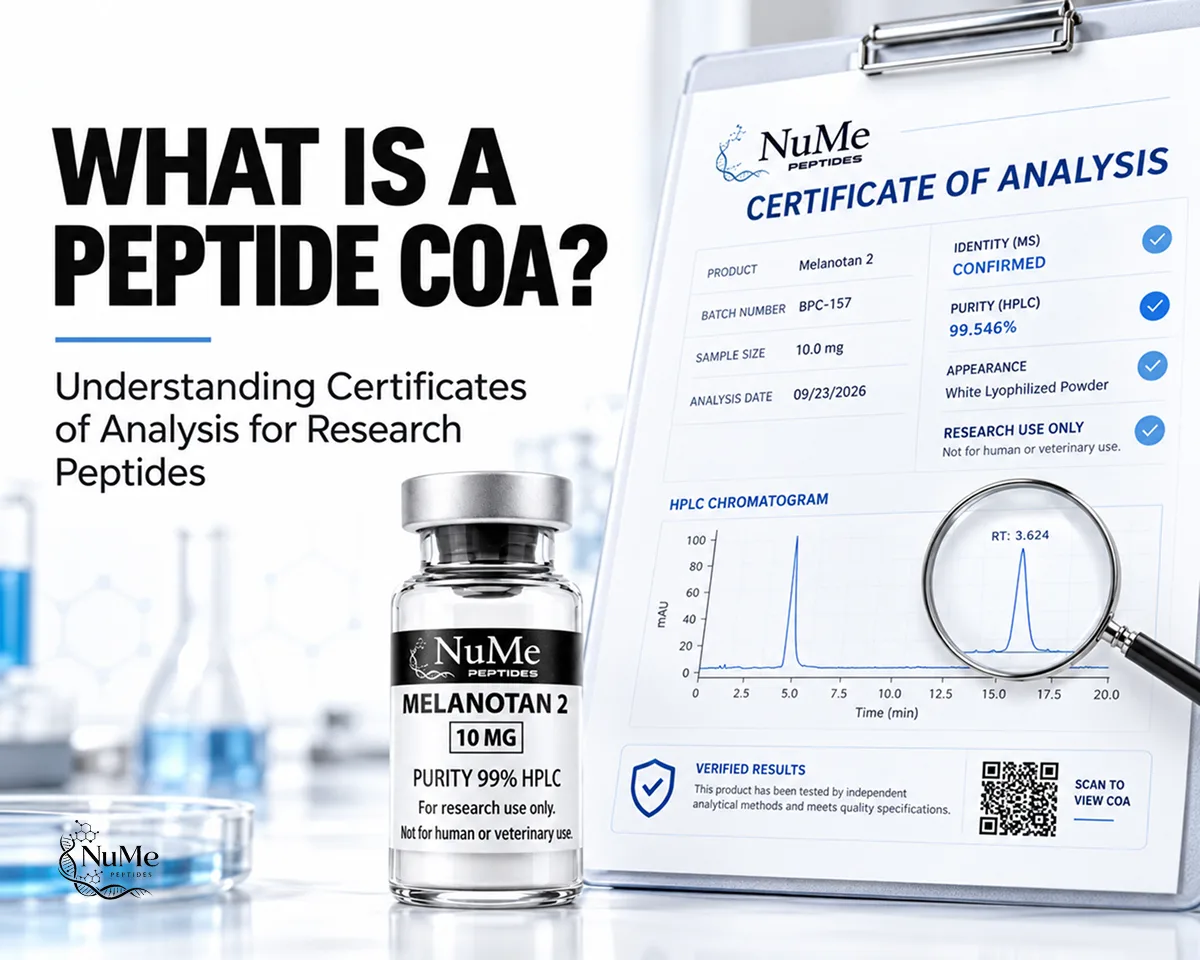
A peptide COA, or Certificate of Analysis, is one of the most useful documents researchers can review when evaluating a research peptide. However, the presence of a COA alone does not guarantee quality. Its value depends on what was tested, which analytical methods were used, whether the document corresponds to the supplied batch, and how clearly the results are reported.
For peptide research, a useful COA can connect a specific lot with analytical information such as molecular identity, chromatographic purity, testing dates, and laboratory details. Health Canada’s GMP framework for regulated active pharmaceutical ingredients provides a useful Canadian quality benchmark: batch certificates should identify the relevant batch, list tests performed, state applicable acceptance criteria, and provide numerical results where appropriate. These requirements apply to regulated APIs rather than ordinary research peptides, but they demonstrate why traceable documentation matters. (Health Canada, 2022)
NuMe Peptides also emphasizes that a COA should describe a specific production lot rather than an entire product line and that identity and purity are separate analytical questions. (NuMe Peptides COA Guide, 2026)
For researchers looking for peptide materials for laboratory investigation, visit the Nume Peptides to explore the available research peptide collection.
What Is a Certificate of Analysis for Peptides?
A Certificate of Analysis is a laboratory document that reports analytical results for a defined sample or production batch.
For research peptides, the document may include:
- peptide or compound name;
- amino-acid sequence;
- batch or lot number;
- manufacturing or testing date;
- HPLC purity result;
- mass-spectrometry identity result;
- chromatographic data;
- testing laboratory information;
- storage recommendations;
- additional analytical measurements.
A peptide COA is therefore best understood as a record of testing.
It does not automatically establish pharmaceutical status, regulatory approval, clinical suitability, or effectiveness. A highly detailed certificate may provide substantial analytical information about a sample while saying nothing about whether that material is approved for a particular use.
NuMe’s technical COA guide makes this distinction clearly: a certificate reports analyses performed on a particular lot at a particular point in time. Its usefulness depends on the tests performed and the information included. (NuMe Peptides COA Guide, 2026)
Researchers should therefore evaluate the individual fields rather than treating the existence of a COA as proof of overall quality
For researchers looking for peptide materials for laboratory investigation, browse the Nume Peptides Shop to explore the available research collection.
Why Is a COA Important in Peptide Research?
Synthetic peptide research can be sensitive to variations in identity, purity, impurity composition, degradation, and actual peptide content.
A peptide COA gives researchers a starting point for determining whether the material received matches the analytical characteristics reported by the supplier or testing laboratory.
A useful certificate can help researchers:
- confirm that analytical testing was performed;
- connect results to a specific production lot;
- compare different batches;
- identify methods used for identity and purity testing;
- review actual numerical findings;
- investigate unexpected experimental results;
- maintain records of laboratory materials.
This matters because synthetic peptides can contain structurally related impurities formed during synthesis, purification, manufacturing, or storage. Reviews of synthetic peptide characterization show that LC-MS can be valuable for identifying peptide-related impurities, including closely related structural variants. (Lian et al., 2021)
Furthermore, recommendations for peptide reference materials emphasize that reliable characterization often requires multiple analytical approaches rather than a single measurement. (Hoofnagle et al., 2016)
| COA function | Why it matters |
|---|---|
| Batch identification | Connects results to a specific production lot |
| Identity testing | Helps verify the intended peptide |
| Purity testing | Shows chromatographic composition |
| Testing date | Indicates when analysis occurred |
| Laboratory information | Identifies who performed testing |
| Analytical method | Provides context for interpreting results |
What Information Is Commonly Found on a Peptide COA?
Not every peptide COA contains the same information. Researchers should therefore focus on whether the document provides enough detail to interpret the analytical claims.
Product and sequence information
The certificate should clearly identify the compound being analyzed.
For peptides, the amino-acid sequence can provide greater specificity than a product name alone, particularly when multiple naming conventions exist.
Batch or lot number
The batch number is one of the most important fields on a peptide COA.
It connects the certificate to the physical research material. If the lot number on the certificate differs from the lot number on the vial, the analytical findings cannot automatically be assumed to represent that sample.
Health Canada’s regulated API framework similarly requires Certificates of Analysis to identify the relevant batch. (Health Canada, 2022)
Manufacturing and testing dates
Dates provide context for analytical findings.
A COA describes a sample at the time it was tested. Therefore, a historical certificate does not independently prove that the material remains chemically unchanged after extended storage or environmental exposure.
HPLC purity
High-performance liquid chromatography is commonly used to evaluate chromatographic purity.
A detailed report may include:
- purity percentage;
- chromatogram;
- retention time;
- major and minor peaks;
- detector wavelength;
- column information;
- mobile-phase conditions.
Researchers should look beyond the headline percentage because chromatographic resolution and analytical conditions can influence how impurities are detected.
Mass-spectrometry identity
Mass spectrometry compares an observed molecular mass with the theoretical mass expected from the peptide sequence.
MS is widely used in synthetic peptide characterization because it can support molecular identity and help investigate mass-related variants or degradation products. (Højrup, 2024)
However, confirming an expected molecular mass does not automatically establish purity.
Additional analytical fields
More detailed certificates may also report:
- net peptide content;
- residual water;
- counterion or salt form;
- residual solvents;
- physical appearance;
- storage conditions;
- laboratory name or authorization.
NuMe’s COA guide notes that these additional fields can provide useful context when interpreting the material beyond HPLC purity alone. (NuMe Peptides COA Guide, 2026)
For researchers looking for peptide materials for laboratory investigation, browse the Nume Peptides Shop to explore the available research collection.
How Are Analytical Test Results Presented on a COA?
Researchers need to understand what each result actually measures before interpreting a peptide COA.
HPLC purity percentage
An HPLC result such as 99% generally represents the proportion of chromatographic detector response attributed to the primary peak under the analytical conditions used.
It does not necessarily mean:
- 99% of the total vial mass is peptide;
- the complete amino-acid sequence was independently confirmed;
- every possible impurity was detected;
- the material contains exactly 99% target peptide by weight.
Structurally related impurities can make interpretation more complicated. Research using LC-high-resolution mass spectrometry on synthetic human C-peptide showed that related peptide impurities may need to be identified and considered when accurately determining purity. (Li et al., 2018)
Mass-spectrometry results
A peptide COA may include:
- theoretical molecular mass;
- observed molecular mass;
- mass spectrum;
- detected ion peaks;
- instrument or method details.
When the observed mass is consistent with the expected value within appropriate analytical tolerance, the finding can support peptide identity.
However, MS identity and HPLC purity should remain separate analytical concepts.
Numerical results and specifications
More complete certificates may show both the measured value and an acceptance criterion.
| Test | Example result | Main question |
|---|---|---|
| Identity by MS | Observed vs theoretical mass | Is the compound consistent with the intended peptide? |
| HPLC purity | 99.x% | How dominant is the primary chromatographic peak? |
| Water content | Percentage | How much residual water is present? |
| Peptide content | Percentage or assigned mass | How much actual peptide is present? |
| Appearance | Descriptive result | Does the sample match expected physical characteristics? |
Within Canada’s regulated API framework, Certificates of Analysis are expected to report relevant tests, acceptance criteria, and numerical findings where appropriate. These rules do not automatically apply to research-use peptides, but they provide a useful model for transparent documentation. (Health Canada, 2022)
For researchers looking for peptide materials for laboratory investigation, browse the Nume Peptides Shop to explore the available research collection.
What Are the Limitations of a Peptide COA?
A peptide COA can provide valuable information, but it cannot answer every quality question.
A COA represents one batch
Testing one production lot does not establish the analytical characteristics of every future batch.
Researchers should always verify that the certificate matches the lot number of the material being used.
A COA represents one point in time
Analytical testing provides a snapshot.
Temperature, moisture, oxygen, light, and storage duration can influence peptide material after testing. Therefore, an older COA cannot demonstrate that the sample remains unchanged indefinitely.
HPLC cannot answer every question
High HPLC purity does not independently confirm:
- molecular identity;
- exact peptide content;
- absence of all impurities;
- long-term stability;
- proper storage after testing.
Additionally, inadequate separation can cause closely related compounds to overlap with the primary peak. Consensus recommendations for peptide standards therefore emphasize reviewing detailed chromatographic information rather than relying only on a reported percentage. (Hoofnagle et al., 2016)
MS also has limitations
Mass spectrometry is powerful for identity and impurity characterization, but closely related structural variants can still present analytical challenges.
For this reason, chromatographic separation and MS are often combined through LC-MS workflows. (Lian et al., 2021)
Documentation quality matters
A COA becomes less useful when key details are absent.
Researchers should pay particular attention when a document lacks:
- a matching batch number;
- testing date;
- analytical method;
- numerical findings;
- laboratory identification;
- relevant chromatographic evidence.
A practical rule is that the document should allow the reader to determine what was tested, which batch was tested, how it was tested, and what was actually measured.
Learn how identity, purity, analytical testing, and documentation work together when evaluating peptide materials in our guide: Research Peptide Quality: How to Evaluate Testing, Documentation and Verification
FAQs About Peptide COAs
Does a Peptide COA Prove That a Peptide Is 99% Pure?
Only if an appropriate purity test was performed and the certificate reports that result.
Even then, researchers should determine which method produced the percentage. A 99% HPLC result specifically describes chromatographic purity under the analytical conditions used.
Is HPLC Purity the Same as Peptide Content?
No.
HPLC purity usually describes relative chromatographic peak area, while peptide content refers to how much peptide is present within the total material.
Should the COA Batch Number Match the Vial?
Yes.
A certificate linked to another batch does not directly characterize the material currently being used.
Why Are HPLC and MS Often Listed Together?
They provide complementary information.
HPLC primarily evaluates chromatographic separation and relative purity, while MS provides molecular-mass information that can support identity confirmation and impurity investigation. (Højrup, 2024)
Is a Third-Party COA Better Than a Manufacturer COA?
Not automatically.
A manufacturer laboratory can provide routine production and batch testing, while independent testing creates separation between the supplier and analytical laboratory. Researchers should evaluate method quality, batch traceability, laboratory identity, and the actual results rather than relying on the “third-party” label alone.
Does Having a COA Mean a Peptide Is Approved?
No.
A Certificate of Analysis is an analytical document. It does not represent regulatory authorization, clinical approval, or permission for a particular use.
Conclusion
A peptide COA is most useful when researchers treat it as analytical evidence rather than a quality badge.
A well-documented certificate can connect a specific production batch with information about identity, chromatographic purity, testing date, analytical methods, and laboratory findings. However, each field answers a different question, and no single result provides a complete assessment of peptide quality.
Before relying on a COA, researchers should check:
- whether the lot number matches the supplied material;
- whether identity and purity were evaluated separately;
- which analytical methods were used;
- whether actual numerical results are shown;
- when testing occurred;
- whether the testing laboratory is identifiable;
- whether important analytical information is missing.
Reading a peptide COA systematically helps researchers distinguish traceable analytical evidence from unsupported quality claims and provides a stronger foundation for reproducible laboratory research.
For researchers looking for peptide materials for laboratory investigation, visit the Nume Peptides to explore the available research peptide collection.
Disclaimer: This content is provided for educational and scientific research purposes only. Research peptides are intended for laboratory research only and are not intended for human consumption or medical use.


This is a helpful introduction to peptide Certificates of Analysis. I particularly liked the explanation of purity testing and analytical data, since understanding a COA is important when evaluating the quality and identity of research materials.
I appreciate how the article explains what researchers should look for in a peptide COA. Details such as purity results, analytical methods, and batch information provide useful context for assessing whether a sample has been properly characterized.
A useful resource for anyone new to peptide quality control. Learning how to interpret a COA and understand the analytical information it contains can make it much easier to compare research materials based on documented testing rather than simple quality claims.