
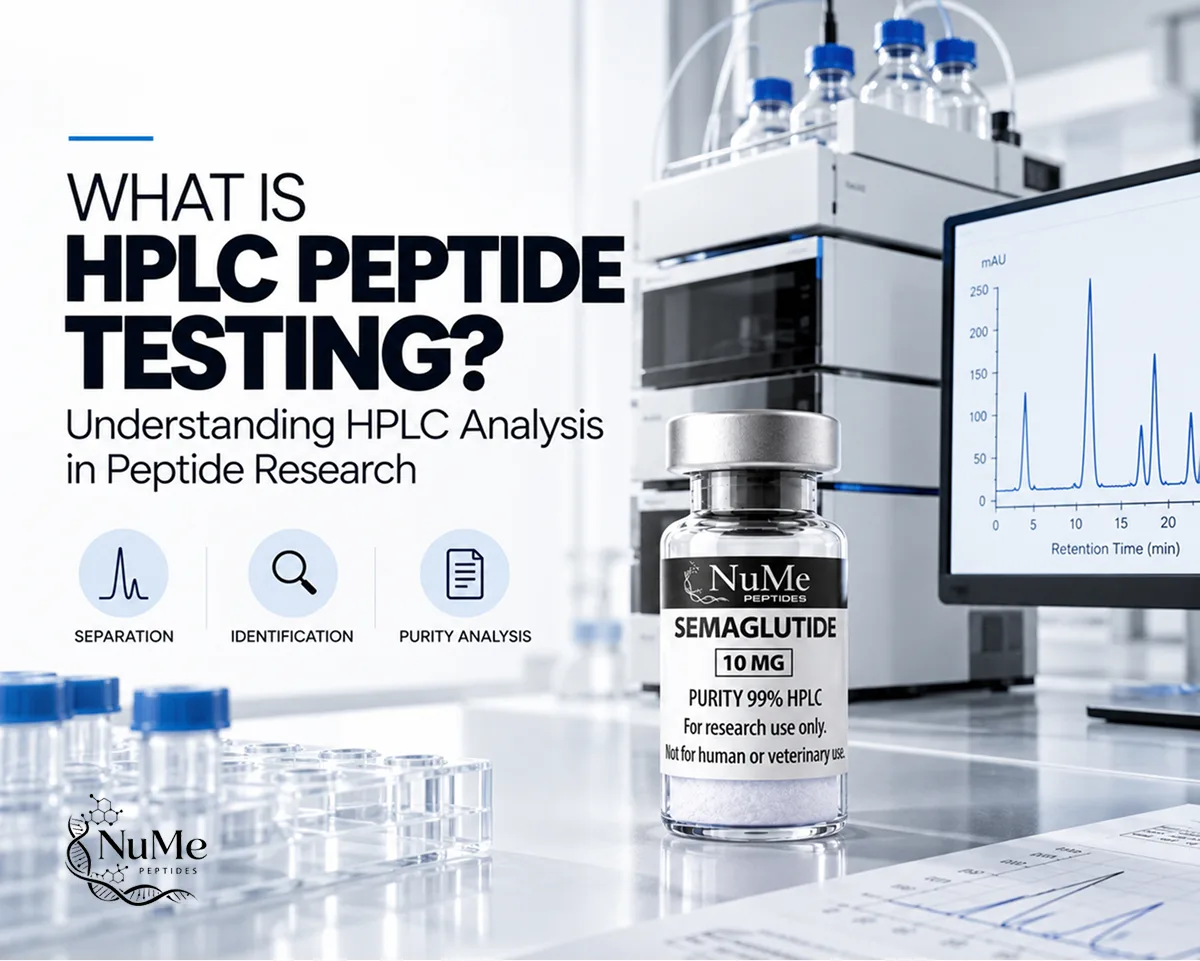
What Is HPLC Peptide Testing? Understanding HPLC Analysis in Peptide Research


HPLC peptide testing is one of the most common analytical approaches used to examine the chromatographic composition of synthetic research peptides. By separating components within a sample, HPLC can provide information about the dominant peptide peak, detectable impurities, retention behaviour, and relative chromatographic purity.
However, HPLC peptide testing should not be interpreted through a single number alone. A result such as “99% purity” depends on the analytical method, column chemistry, solvent gradient, detector settings, chromatographic resolution, and data integration. Therefore, researchers should consider both the chromatogram and the reported percentage when evaluating a sample.
In Canada, Health Canada’s quality framework for regulated active pharmaceutical ingredients emphasizes appropriate analytical procedures, documented specifications, and scientifically sound testing. These requirements apply to regulated APIs rather than ordinary research-use peptides, but they illustrate why method quality matters when interpreting analytical results. (Health Canada, 2022)
For researchers looking for peptide materials for laboratory investigation, visit the Nume Peptides to explore the available research peptide collection.
What Is HPLC and How Does It Work?
HPLC stands for high-performance liquid chromatography. It is an analytical separation technique used to distinguish compounds within a mixture.
During HPLC peptide testing, a dissolved sample is introduced into a flowing liquid mobile phase and carried through an analytical column containing a stationary phase. Different molecules interact with the stationary and mobile phases to different degrees. Consequently, they pass through the column at different rates.
The time a compound takes to reach the detector is called its retention time.
For peptide analysis, reverse-phase HPLC, or RP-HPLC, is especially common because it can separate peptides and related species based largely on differences in hydrophobic interactions.
Main components of an HPLC system
A typical analytical system contains:
- solvent reservoirs;
- high-pressure pumps;
- sample injector;
- analytical column;
- detector;
- chromatography software.
During reverse-phase analysis, the proportion of organic solvent is often gradually increased. Less strongly retained molecules generally leave the column earlier, while more strongly retained species elute later.
Recommendations for synthetic peptide standards identify reverse-phase chromatography as an important technique for evaluating chemical purity and peptide-related contaminants. (Hoofnagle et al., 2016)
For researchers looking for peptide materials for laboratory investigation, browse the Nume Peptides Shop to explore the available research collection.
How Is HPLC Used to Analyze Research Peptides?
HPLC peptide testing can support several areas of peptide research.
Researchers may use it to examine:
- chromatographic purity;
- synthesis-related impurities;
- degradation products;
- purification efficiency;
- differences between production batches;
- changes during stability experiments.
Evaluating chromatographic purity
One of the most familiar applications is calculating the relative area of the main chromatographic peak.
If one peak represents most of the integrated detector signal, the laboratory may report that value as a percentage of chromatographic purity.
For example, if the primary peak contributes approximately 99% of the total integrated peak area, a report may state 99% HPLC purity.
However, that percentage remains dependent on the analytical conditions used.
Detecting peptide-related impurities
Synthetic peptide preparation can produce several related species, including:
- truncated sequences;
- deletion peptides;
- incomplete coupling products;
- oxidation products;
- deamidated variants;
- epimers;
- storage-related degradation products.
Some impurities differ only slightly from the intended peptide. As a result, researchers may need carefully optimized chromatography to separate them.
Reviews of synthetic peptide characterization describe LC-MS and chromatographic methods as important tools for investigating impurities formed during synthesis, manufacturing, purification, and storage. (Lian et al., 2021)
Comparing peptide batches
HPLC can also provide a useful chromatographic fingerprint for comparing different batches.
Researchers may compare:
- main peak retention time;
- secondary peaks;
- relative peak areas;
- overall chromatographic pattern;
- appearance of new peaks.
However, direct comparison is most reliable when the same analytical method is used for each sample.
What Does an HPLC Chromatogram Show?
An HPLC chromatogram is a graphical representation of detector response during a chromatographic run.
The horizontal axis usually shows retention time, while the vertical axis represents detector response.
Each resolved peak represents material detected after leaving the analytical column.
| Chromatogram feature | Possible interpretation |
|---|---|
| Large main peak | Dominant detected component |
| Small secondary peaks | Potential impurities or related compounds |
| Different retention time | Method or sample variation |
| Broad peak | Separation or sample-related issue |
| Overlapping peaks | Possible co-elution |
| New peaks after storage | Potential degradation |
Retention time
Retention time can help compare samples analyzed under identical experimental conditions.
Nevertheless, retention time alone is not definitive proof that a peak is the intended peptide. Different molecules can sometimes display similar chromatographic behaviour.
For this reason, mass spectrometry is frequently used as a complementary technique for molecular identity.
Peak area
Chromatographic software integrates the detector response associated with each peak.
Peak area is commonly used because it represents the signal across the entire peak rather than only its maximum height.
During HPLC peptide testing, the relative area of the principal peak is often used to calculate the reported chromatographic purity.
For researchers looking for peptide materials for laboratory investigation, browse the Nume Peptides Shop to explore the available research collection.
How Are Peaks and Purity Results Interpreted in HPLC Analysis?
A high reported HPLC percentage can be useful, but researchers should understand precisely what the number represents.
HPLC purity is not automatically peptide content
Suppose the principal peak represents 99% of the detected chromatographic area.
This does not necessarily mean that 99% of the total dry material in the vial consists of target peptide.
Other material may include:
- water;
- salts;
- counterions;
- residual solvents;
- substances that respond differently to the detector.
Therefore, chromatographic purity and peptide content are separate analytical concepts.
Consensus recommendations for peptide standards specifically distinguish chemical purity from net peptide content when accurate quantitative measurements are required. (Hoofnagle et al., 2016)
Chromatographic resolution matters
A purity result is only as informative as the separation produced by the method.
If a peptide impurity co-elutes with the main component, software may integrate both compounds as one peak.
Consequently, a clean-looking chromatogram does not prove that every structurally related impurity has been resolved.
Research using high-resolution LC-MS to characterize synthetic human C-peptide demonstrated that related peptide impurities may require more detailed separation and mass analysis for accurate purity assessment. (Li et al., 2018)
Integration settings also matter
Data-processing software determines where a chromatographic peak begins and ends.
Important variables can include:
- baseline selection;
- noise threshold;
- peak splitting;
- peak merging;
- treatment of very small peaks.
Different integration settings may slightly change the reported purity value.
Method conditions influence results
Researchers should also consider:
- column chemistry;
- mobile-phase composition;
- solvent gradient;
- flow rate;
- column temperature;
- injection amount;
- detection wavelength.
Therefore, HPLC results are more useful when the analytical conditions are documented rather than when only a percentage is provided.
For researchers looking for peptide materials for laboratory investigation, browse the Nume Peptides Shop to explore the available research collection.
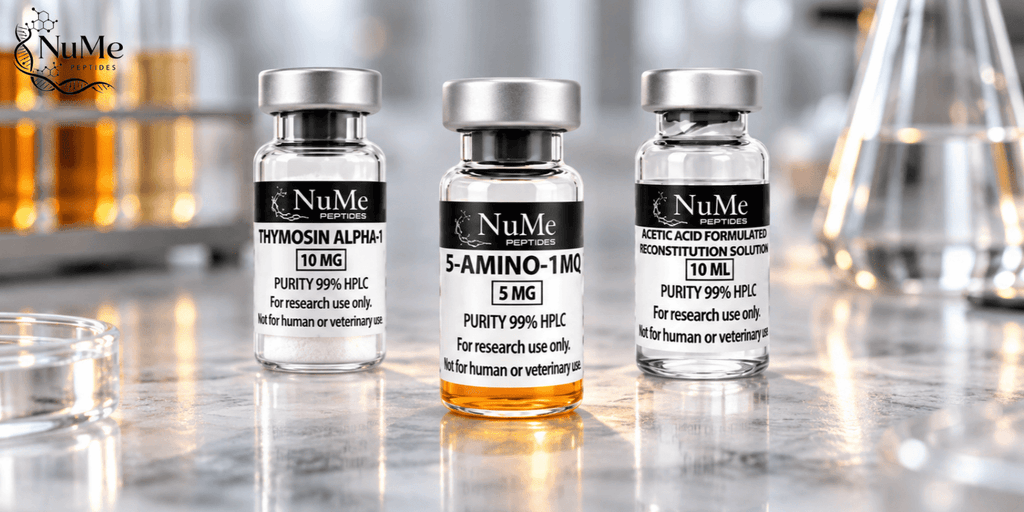
What Are the Limitations of HPLC Peptide Testing?
HPLC peptide testing is highly useful, but it does not answer every quality question.
HPLC does not independently confirm molecular identity
A large chromatographic peak may represent the expected peptide, but chromatography alone does not provide the same molecular information as mass spectrometry.
MS can compare the observed molecular mass with the expected peptide mass and provide complementary evidence for identity. (Højrup, 2024)
Co-elution may conceal impurities
Closely related peptide species can exhibit very similar retention behaviour.
If the chromatographic method cannot adequately separate them, several molecular species may appear as a single peak.
Detector response is not identical for every compound
Different molecules can absorb or respond differently under the selected detection conditions.
For this reason, relative peak area should not automatically be interpreted as an exact mass percentage.
HPLC does not establish long-term stability
A chromatogram describes the sample when the analysis occurs.
Temperature, moisture, oxygen, light, and storage duration may subsequently alter peptide material.
Therefore, one HPLC result does not prove that a peptide will remain unchanged indefinitely.
HPLC should be interpreted with other evidence
A broader quality assessment may include:
- mass-spectrometry identity confirmation;
- batch-specific Certificate of Analysis;
- peptide content when relevant;
- storage documentation;
- impurity characterization;
- repeat testing over time.
Health Canada’s analytical quality framework similarly reflects the principle that analytical methods should be suitable for their intended purpose rather than interpreted outside their methodological context. (Health Canada, ICH Quality Guidelines)
Learn how identity, purity, analytical testing, and documentation work together when evaluating peptide materials in our guide: Research Peptide Quality: How to Evaluate Testing, Documentation and Verification
FAQs About HPLC Peptide Testing
What Does HPLC Peptide Testing Measure?
HPLC peptide testing primarily examines chromatographic composition. It can show the relative abundance of the main detected component and other chromatographically resolved species.
Does 99% HPLC Purity Mean 99% Peptide by Weight?
Not necessarily.
A 99% result normally represents the relative area of the primary chromatographic peak compared with other detected peaks under the method used.
Can HPLC Confirm Peptide Identity?
Not independently.
HPLC retention behaviour can support comparison, while mass spectrometry provides molecular-mass information that is more directly relevant to identity confirmation. (Højrup, 2024)
Why Can Two Laboratories Report Different HPLC Results?
Different laboratories may use different:
- columns;
- mobile phases;
- solvent gradients;
- temperatures;
- detectors;
- sample concentrations;
- integration settings.
As a result, slightly different chromatographic purity values can occur.
What Do Small Peaks on a Chromatogram Represent?
They may represent synthesis-related impurities, degradation products, process-related compounds, or other detectable components.
However, the molecular identity of a peak cannot normally be established from peak size alone.
Should Researchers Review the Chromatogram or Only the Purity Percentage?
Both should be reviewed when available.
The chromatogram provides information about peak separation and secondary components that cannot be understood from the headline purity value alone.
Conclusion
HPLC peptide testing is an important analytical approach for examining chromatographic purity, detecting peptide-related species, comparing production lots, and monitoring changes in research materials.
However, a reported HPLC percentage should always be interpreted within the context of the complete analytical method.
Researchers should consider:
- chromatogram quality;
- peak separation;
- retention behaviour;
- secondary peaks;
- integration settings;
- analytical conditions;
- complementary MS testing;
- batch-specific documentation.
Most importantly, HPLC purity should not be confused with molecular identity or total peptide content. These are separate analytical characteristics and may require different testing methods.
Understanding these distinctions allows researchers to interpret HPLC peptide testing more accurately and reduces the risk of treating a single purity percentage as a complete description of sample quality.
For researchers looking for peptide materials for laboratory investigation, visit the Nume Peptides to explore the available research peptide collection.
Disclaimer: This content is provided for educational and scientific research purposes only. Research peptides are intended for laboratory research only and are not intended for human consumption or medical use.


This is a clear introduction to HPLC testing for peptides. I found the explanation of how HPLC can be used to assess peptide purity particularly useful, especially for understanding why analytical testing matters in research workflows.
I appreciate how the article breaks down the HPLC process into an easier-to-understand format. Understanding retention time, chromatograms, and purity results provides useful context for evaluating peptide samples more objectively.
A helpful resource for anyone learning about peptide quality testing. The discussion of HPLC analysis shows why chromatographic data can be an important part of characterizing peptide samples and verifying their reported purity.