
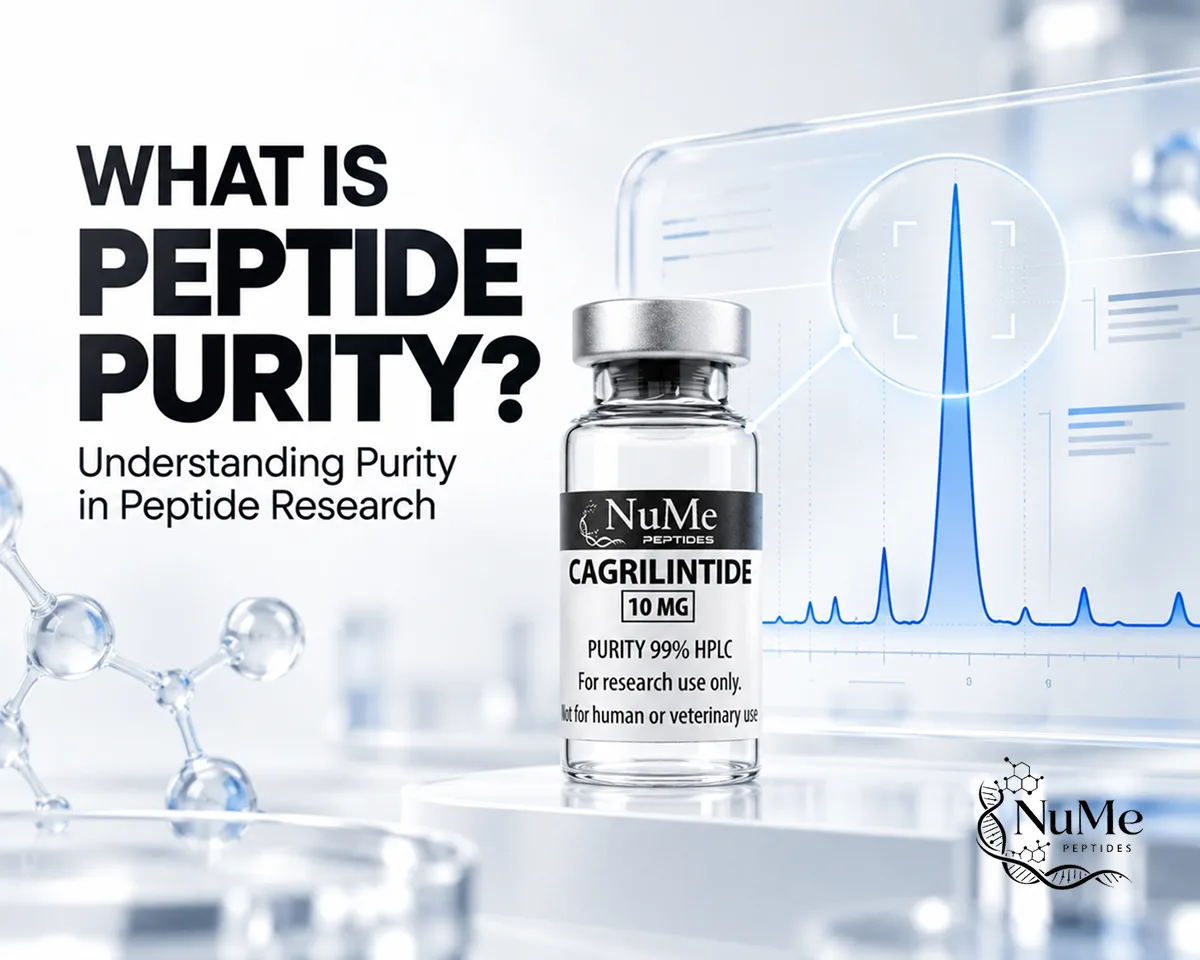
What Is Peptide Purity? Understanding Purity in Peptide Research


Peptide purity is one of the most important analytical characteristics researchers consider when evaluating a synthetic peptide. Whether a peptide is being studied for molecular interactions, structural properties, biochemical mechanisms, or other laboratory applications, researchers need to understand what the reported purity value actually represents. Peptide purity can provide useful information about the proportion of the target peptide within a sample, but it should not be interpreted as the only measure of overall research material quality.
At Nume Peptides, researchers can explore research peptide materials intended for laboratory and scientific research.
Evaluating a peptide requires looking beyond a single percentage printed on a specification sheet. Researchers should also consider how purity was measured, which analytical method was used, what impurities may be present, and whether the reported result accurately reflects the characteristics relevant to the intended experiment.
This guide explains how purity is defined, how laboratories determine it, what a 99% purity claim actually indicates, which impurities can occur during peptide synthesis, and why this measurement should be considered alongside identity, characterization, stability, and other quality attributes.
What Does Peptide Purity Mean?
Peptide purity generally refers to the proportion of the desired peptide relative to other detectable components in a sample. These additional components may include truncated sequences, modified peptides, synthesis-related by-products, degradation products, residual materials, or other impurities.
For synthetic peptides, assessing composition can be challenging because unwanted molecules may have structures that are very similar to the target peptide. (Fields, 1997)
Therefore, this measurement is not simply a visual or qualitative characteristic. It is an analytical measurement that depends on the method used to separate, detect, and quantify the components of a sample.
A peptide sample can contain several categories of material:
| Component | Description |
|---|---|
| Target peptide | The intended peptide sequence being studied |
| Truncated peptides | Sequences missing one or more residues |
| Modified peptides | Molecules altered through chemical reactions |
| Degradation products | Products formed during storage or environmental exposure |
| Isomeric impurities | Structurally different forms with similar or identical mass |
| Residual process materials | Substances remaining from synthesis or purification |
The analytical definition of purity therefore depends partly on the measurement technique. A chromatographic purity result, for example, may describe the percentage of the detected chromatographic area attributed to the target peak. It does not necessarily represent an absolute measurement of every possible impurity in the sample. (Lian et al., 2021)
For this reason, researchers should interpret the reported result together with other analytical information rather than treating a single percentage as a complete description of the material.
For researchers looking for peptide materials for laboratory investigation, browse the Nume Peptides Shop to explore the available research collection.
How Is Peptide Purity Determined?
Several analytical techniques can be used to evaluate the composition of a peptide sample, with reversed-phase high-performance liquid chromatography (RP-HPLC) being one of the most widely used approaches for peptide separation and analysis.
HPLC separates compounds according to differences in their chemical interactions with the stationary and mobile phases. For peptides, reversed-phase chromatography can separate the target molecule from many related impurities based on differences in hydrophobicity and other physicochemical characteristics.
HPLC can be particularly useful because synthetic peptide mixtures may contain closely related molecules generated during synthesis. Researchers can examine chromatographic peaks to assess whether additional components are present alongside the primary peptide peak. (Fields, 1997)
However, HPLC alone does not necessarily establish molecular identity. This is where mass spectrometry can provide complementary information.
Mass spectrometry measures the mass-to-charge ratio of ions and can help researchers verify whether a detected component has a molecular mass consistent with the expected peptide. It can also assist in identifying structurally related impurities that may not be obvious from a basic chromatographic result. (Characterization of Synthetic Peptides by Mass Spectrometry, 2024)
Consequently, laboratories may combine chromatography and mass spectrometry when evaluating both the composition and identity of a peptide sample.
Other analytical techniques can also contribute to peptide characterization. Depending on the research application, laboratories may use:
- HPLC or UHPLC
- LC-MS
- High-resolution mass spectrometry
- Capillary electrophoresis
- Size-exclusion chromatography
- Ion-exchange chromatography
- Nuclear magnetic resonance spectroscopy
Recent analytical research has highlighted the value of complementary separation techniques because different peptide impurities can behave differently under different chromatographic conditions. A 2025 study of synthetic cyclic peptides, for example, found that hydrophilic-interaction chromatography and reversed-phase HPLC could provide complementary impurity profiles. (Yoshida et al., 2025)
More recently, research published in 2026 examined ion-exchange chromatography as a complementary approach for impurity profiling of therapeutic peptides, illustrating how analytical workflows continue to evolve as peptide structures become increasingly diverse. (Goyon et al., 2026)
Thus, reliable analytical evaluation often depends on selecting methods that are appropriate for the peptide’s structure and the impurities being investigated.
What Does 99% Peptide Purity Actually Mean?
A reported 99% purity value can sound straightforward, but researchers should understand what that number actually represents.
In many analytical contexts, a 99% purity result means that approximately 99% of the measured chromatographic signal is attributed to the target peptide under the specified analytical conditions. It does not necessarily mean that exactly 99% of the total physical material in the container consists exclusively of the desired peptide.
The distinction is important because analytical detectors may respond differently to different molecules. Some impurities can produce stronger or weaker detector responses than the target peptide. As a result, calculating impurity levels solely from chromatographic peak areas can sometimes introduce measurement bias. (Critical Need for Implementing RRF, 2025)
The meaning of a 99% result can therefore depend on:
- The analytical method
- The chromatographic conditions
- The detector used
- The reference standard
- The response characteristics of individual impurities
- The calculation method
- The types of impurities present
This is why researchers should not automatically assume that two products both labeled “99%” have been characterized in exactly the same way.
For example, an impurity with a similar structure and mass to the target peptide may be difficult to distinguish using one analytical method but easier to detect using another. Structural isomers and stereoisomers can present particular analytical challenges because they may have identical or nearly identical molecular masses. (Lian et al., 2021)
Chiral impurities are another example. D-amino-acid-containing species can arise during synthesis or from starting materials, and specialized analytical methods may be required to identify and quantify them accurately. (Badgujar et al., 2024)
Therefore, the reported percentage should be interpreted as a method-dependent analytical result rather than an absolute guarantee that a sample contains no other molecular species.
What Types of Impurities Can Occur in Peptide Samples?
Evaluating a purity result also requires understanding where impurities come from.
Synthetic peptide production involves multiple chemical steps, and each stage can potentially introduce related impurities. Incomplete reactions, side reactions, purification limitations, and subsequent degradation can all contribute to the final impurity profile.
One common category is truncated peptides. These molecules can result when one amino acid coupling step does not proceed completely. The resulting sequence may therefore lack one or more residues from the intended peptide. Because the difference can be small, these impurities may be challenging to separate from the target molecule.
Another category involves modified peptide sequences. Chemical reactions during synthesis can alter amino acid residues or peptide structures. Published research has reported impurities associated with oxidation, racemization, side-chain reactions, and other synthesis-related processes. (Related Impurities in Peptide Medicines, 2014)
Degradation products can also form after synthesis. Environmental conditions such as heat, moisture, oxidation, or other stresses can influence peptide stability. Consequently, impurity profiles can change during storage as well as during manufacturing. (Lian et al., 2021)
Researchers may encounter several types of impurities:
| Impurity Type | Possible Origin |
|---|---|
| Truncated sequences | Incomplete amino acid coupling |
| Deletion sequences | Synthesis-related coupling or deprotection issues |
| Oxidized species | Chemical oxidation |
| Epimers or stereoisomers | Racemization or epimerization |
| Aggregates | Intermolecular association |
| Degradation products | Storage or environmental conditions |
| Residual process-related materials | Synthesis and purification |
Some impurities can be particularly difficult to characterize because they share similar molecular properties with the intended peptide. LC-MS has therefore become an important tool for identifying structurally related peptide impurities and supporting more detailed impurity profiling. (Lian et al., 2021)
This complexity explains why the reported result should ideally be considered alongside information about peptide identity, analytical methodology, and impurity characterization.
Why Is Purity Only One Factor in Evaluating Peptide Quality?
Although purity is important, it should not be treated as the only indicator of overall peptide quality.
A research material can have a high reported purity value while still requiring additional characterization. Researchers may also need to understand identity, molecular mass, sequence confirmation, stability, physical form, residual solvents, counterions, and other characteristics relevant to their experimental application.
A 2017 review on quality considerations for synthetic peptides emphasizes that peptide quality assessment can involve structural and physicochemical characterization, manufacturing controls, impurity assessment, and aggregation. (Bergmann et al., 2017)
This means that a purity result answers one important question: how much of the analytically measured sample corresponds to the intended peptide under the specified test conditions?
It does not necessarily answer every other question a researcher may have.
For example, identity confirms whether the material corresponds to the expected molecular structure. Mass spectrometry can contribute to identity confirmation, while other techniques may provide additional structural information.
Stability is another separate consideration. A sample may meet its initial specification but change over time if its storage conditions are unsuitable. Research into peptide characterization therefore considers both manufacturing-related impurities and degradation-related changes. (Lian et al., 2021)
Analytical method quality also matters. A reliable purity assessment depends on appropriate separation, detection, calibration, and interpretation. Recent work on peptide purification has shown that changes in chromatographic conditions can influence separation quality and the ability to resolve impurities.
For researchers evaluating peptide materials, a broader checklist can therefore be useful:
| Quality Consideration | What It Helps Establish |
|---|---|
| Purity | Proportion of detected target material |
| Identity | Whether the material matches the expected peptide |
| Molecular mass | Evidence supporting molecular identity |
| Sequence | Confirmation of amino acid composition |
| Impurity profile | Information about related and unrelated components |
| Stability | Changes during storage or under stress |
| Documentation | Traceability and analytical context |
Ultimately, this measurement is most meaningful when interpreted as one component of a broader characterization strategy.
If you’re new to peptide research, start with our beginner-friendly guide What Are Research Peptides? A Beginner’s Guide to Peptide Research to learn more about peptide structure, molecular mechanisms, scientific applications, and key considerations before exploring the differences between research and pharmaceutical peptides.
FAQs About Peptide Purity
What is peptide purity?
Peptide purity describes the proportion of the desired peptide relative to other detectable components under a defined analytical method. It is commonly assessed using chromatographic techniques such as HPLC. (Fields, 1997)
How is peptide purity commonly tested?
HPLC is one of the most widely used techniques for assessing peptide composition and purity. Mass spectrometry can then provide complementary information about molecular mass and the identity of related impurities. (Characterization of Synthetic Peptides by Mass Spectrometry, 2024)
Does 99% purity mean a peptide is completely free of impurities?
No. A 99% analytical result generally indicates that approximately 99% of the measured signal is associated with the target peptide under the specified testing conditions. Trace impurities or compounds that are difficult to detect using that method may still be present. (Critical Need for Implementing RRF, 2025)
What are common peptide impurities?
Common impurities can include truncated sequences, deletion products, oxidized species, stereoisomers, degradation products, aggregates, and residual process-related materials.
Is HPLC enough to confirm peptide identity?
HPLC is highly useful for separation and assessing sample composition, but it does not necessarily establish molecular identity by itself.
Why can two peptides with the same purity percentage differ analytically?
The same reported percentage can come from different analytical methods, chromatographic conditions, detectors, calculations, and impurity profiles. Therefore, researchers should consider the testing methodology rather than comparing percentages alone.
Why is peptide purity important in research?
Purity can influence how confidently researchers interpret experimental results because unexpected molecular components may introduce additional variables. However, purity should be evaluated alongside identity, stability, analytical methodology, and other relevant characteristics.
Understanding this analytical characteristic is an important part of evaluating synthetic peptide materials for laboratory research. A reported percentage can provide useful information, but its meaning depends on the analytical method, detection system, impurity profile, and calculation approach.
Modern peptide characterization increasingly combines chromatography, mass spectrometry, structural analysis, and complementary analytical methods. This approach gives researchers a more complete picture of what is present in a sample rather than relying on a single numerical purity value.
For researchers exploring peptide materials for laboratory applications, visit the Nume Peptides to browse the available research peptide collection.
Disclaimer: This content is provided for educational and scientific research purposes only. Research peptides are intended for laboratory research only and are not intended for human consumption or medical use.


This was a really clear explanation of peptide purity and why it matters in research. I especially found the discussion about impurities and analytical testing helpful because purity percentages alone don’t always tell the full story. It would be interesting to learn more about how researchers interpret HPLC results when comparing different samples.
I liked how this article breaks down a technical topic into something much easier to understand. The point about identity and purity being two different things was particularly useful and something I hadn’t considered before. Are there other analytical methods researchers commonly use alongside HPLC to verify peptide quality?
Really helpful read, especially for someone who is still learning how peptide quality is evaluated in a research setting. I appreciated the explanation of why impurities can affect the interpretation of experimental results. Do different research applications generally require different standards or testing methods for peptide purity?