
How Are Research Peptides Made? From Synthesis to Quality Analysis


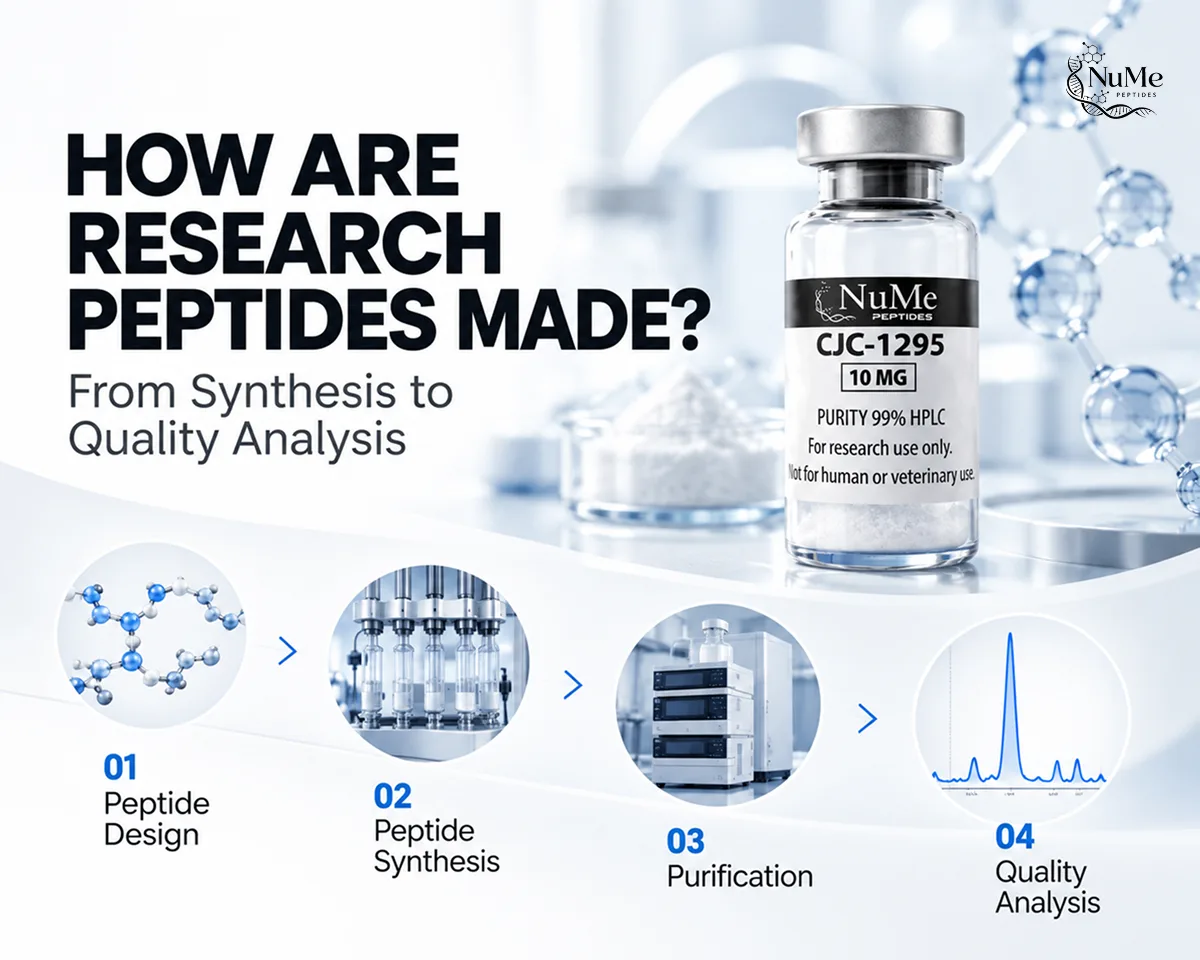
If you have ever wondered how are research peptides made, the answer involves much more than simply combining amino acids. Modern peptide production can involve sequence design, protected amino acids, solid-phase synthesis, cleavage, purification, analytical testing, and quality assessment. Each stage can influence the characteristics of the final research material.
At Nume Peptides, researchers can explore peptide materials intended for laboratory and scientific research.
Understanding the complete workflow is useful because the final peptide is the result of several interconnected chemical and analytical processes. The exact approach can vary according to peptide sequence, length, structural complexity, and intended research application. (Amblard et al., 2006)
This guide follows the process from initial sequence planning through synthesis, cleavage, purification, identity confirmation, purity analysis, and final quality evaluation.
How Does the Research Peptide Manufacturing Process Begin?
Before examining the manufacturing process, it helps to understand that production begins with the peptide sequence itself.
Peptides are chains of amino acids connected by peptide bonds. However, synthesizing a specific sequence requires controlled chemistry because multiple amino acids can participate in unwanted reactions if they are not appropriately protected. Modern peptide synthesis therefore relies on protecting-group strategies and carefully controlled coupling reactions. Amblard et al., 2006
For many short and medium-length sequences, solid-phase peptide synthesis (SPPS) is the most established approach. In SPPS, the growing peptide chain remains attached to a solid support while individual amino acids are added sequentially. This makes repeated reaction, washing, and deprotection steps practical. (Fields, 2002)
The commonly used Fmoc/tBu strategy is one example of modern SPPS. In this approach, amino acids are protected so that the desired coupling reactions can occur selectively. The process can be automated, making it suitable for systematic peptide production.
The initial planning stage can therefore involve several considerations:
| Consideration | Why It Matters |
|---|---|
| Amino acid sequence | Defines the target peptide |
| Peptide length | Influences synthesis difficulty |
| Protected amino acids | Control unwanted reactions |
| Solid support | Holds the growing chain |
| Coupling strategy | Controls amino acid addition |
| Final structure | Determines downstream cleavage and purification |
This explains why peptide production is not a single-step process. Sequence design and synthesis planning establish the foundation for everything that follows.
For researchers looking for peptide materials for laboratory investigation, browse the Nume Peptides Shop to explore the available research collection.
How Are Peptide Chains Synthesized?
The central step in this process is peptide-chain assembly.
In conventional Fmoc-based SPPS, the first amino acid is attached to a solid resin. A temporary protecting group is then removed, exposing the reactive site for the next amino acid. The next protected amino acid is activated and coupled to the growing chain. After washing, the cycle is repeated until the desired sequence has been assembled. (Amblard et al., 2006)
The general cycle can be summarized as:
- Anchor the first amino acid to the resin.
- Remove the temporary protecting group.
- Add and activate the next protected amino acid.
- Allow the coupling reaction to occur.
- Wash away excess reagents.
- Repeat the cycle until the sequence is complete.
This repetitive process is one reason SPPS became so influential in peptide chemistry. The growing chain remains attached to the solid support while soluble reagents and by-products can be removed through washing. (Fields, 2002)
However, synthesis is not always perfectly efficient. Incomplete coupling, incomplete deprotection, aggregation, and side reactions can create related peptide impurities. As the number of amino acids increases, maintaining high overall efficiency becomes increasingly challenging because each additional synthetic cycle introduces another opportunity for an incomplete reaction.
This is important because synthesis quality directly affects the complexity of the mixture that must later be purified.
Researchers can also use alternative approaches. Solution-phase peptide synthesis, liquid-phase approaches, and emerging chemical methods may be appropriate depending on peptide size, sequence, scalability, and process requirements. A recent review describes SPPS, classical solution-phase synthesis, liquid-phase synthesis, and emerging catalytic and electrochemical approaches as part of the expanding peptide-synthesis landscape. (Peptide Synthesis: A Review of Classical and Emerging Methods, 2025)
Recent work is also examining ways to make peptide synthesis more efficient and sustainable. Researchers have investigated solvent reduction, alternative solvents, recycling strategies, and new synthetic approaches because conventional SPPS can involve substantial solvent and reagent use. (Hughes et al., 2022)
How Are Synthesized Peptides Cleaved and Purified?
Once the amino acid sequence has been assembled, the next stage is separating the completed peptide from the solid support and removing unwanted chemical components.
In a typical SPPS workflow, the finished peptide remains attached to the resin after the final coupling cycle. A cleavage step releases the peptide from the solid support. Depending on the chemistry used, cleavage can also remove protecting groups from amino acid side chains. (Amblard et al., 2006)
The resulting material is rarely a perfectly pure single molecular species immediately after cleavage. Instead, it can contain the desired peptide alongside truncated sequences, modified products, residual reagents, protecting-group by-products, and other related compounds.
Purification is therefore a critical stage.
One of the most widely used approaches is preparative reversed-phase high-performance liquid chromatography (RP-HPLC). Chromatography separates compounds according to differences in their interactions with the stationary and mobile phases. Researchers can collect the fraction corresponding to the target peptide and remove many unwanted components. (Fields, 2002)
HPLC became particularly important as peptide chemistry developed because increasingly sophisticated purification methods made it possible to isolate synthetic peptides from complex reaction mixtures. (Solid Phase Peptide Synthesis: A Silver Anniversary Report, 1987)
The purification workflow can involve:
- Dissolving the crude peptide
- Selecting appropriate chromatographic conditions
- Separating the target from related compounds
- Collecting relevant fractions
- Combining suitable fractions
- Removing solvents
- Drying or isolating the purified material
This stage highlights an important distinction: synthesis and purification are separate processes.
Peptide size and structure can also influence purification difficulty. Longer sequences, hydrophobic regions, aggregation-prone sequences, and complex modifications can make separation more challenging. For larger peptides and proteins, researchers may use alternative strategies or combine multiple purification approaches.
How Are Peptide Identity and Purity Evaluated After Synthesis?
The next step is determining whether the isolated material is actually the intended peptide and how much of the sample corresponds to that target.
Two major analytical questions are identity and purity.
Identity analysis asks whether the molecular material corresponds to the expected peptide. Mass spectrometry is particularly useful because it can measure molecular mass and provide evidence that a detected component is consistent with the expected molecular composition. (Chandrudu et al., 2013)
Purity analysis, meanwhile, examines how much of the measured sample corresponds to the desired peptide relative to detectable impurities. RP-HPLC is commonly used because it can separate the target peptide from related compounds and generate a chromatographic profile.
However, HPLC and mass spectrometry provide different information. A strong analytical workflow may therefore combine multiple techniques rather than relying on a single measurement. (Fields, 2002)
For example:
| Analytical Approach | Primary Information |
|---|---|
| RP-HPLC | Chromatographic separation and purity profile |
| Mass spectrometry | Molecular mass and identity evidence |
| LC-MS | Combined separation and mass information |
| Spectroscopy | Structural or chemical information |
| Other chromatography | Additional impurity separation |
This distinction is important because a reported purity percentage does not necessarily tell researchers everything about molecular identity or structural integrity.
Synthetic peptide production can generate closely related impurities that have similar chemical properties to the target molecule. These may include deletion sequences, oxidation products, epimers, or other modified species. Consequently, researchers may use complementary analytical techniques to investigate the final material more thoroughly. (Chandrudu et al., 2013)
Modern peptide characterization continues to evolve alongside synthesis technology. As researchers develop more complex peptide structures, analytical methods must also become more capable of resolving and identifying closely related molecular species.
What Factors Can Affect the Quality of a Finished Research Peptide?
Understanding peptide production is incomplete without considering the factors that can influence the final material.
One major factor is sequence complexity. Longer peptides require more synthesis cycles, and every additional cycle can create another opportunity for incomplete coupling or side reactions. This can increase the number of related impurities that must later be removed. (Chandrudu et al., 2013)
Another factor is peptide aggregation. Some sequences can interact with one another during synthesis, potentially reducing accessibility of reactive groups and making coupling less efficient. Aggregation has therefore been identified as one of the practical challenges associated with SPPS.
Purification strategy also matters. A purification method needs to separate the target peptide from the specific impurities generated during synthesis. Different peptide structures may behave differently during chromatography, meaning that purification conditions often need to be optimized for the individual sequence.
Storage and stability are additional considerations. Peptides can undergo chemical changes after synthesis, including oxidation, hydrolysis, or other degradation processes depending on their sequence and environment. Therefore, the condition of a peptide can change over time even after successful synthesis and purification.
The broader manufacturing environment can also influence consistency. For regulated pharmaceutical substances, ICH Q11 emphasizes understanding manufacturing processes and controlling steps that can influence impurity profiles. While research peptides are not automatically pharmaceutical products, the underlying principle demonstrates why process control matters when producing chemically defined peptide materials. (FDA, 2012)
Finally, sustainability is becoming an increasingly important consideration in peptide production. Conventional SPPS can require significant quantities of solvents and reagents, prompting research into greener solvents, solvent recycling, reduced reagent use, and alternative synthesis strategies. (Hughes et al., 2022)
Therefore, producing a research peptide involves not only creating the correct amino acid sequence but also controlling synthesis, purification, characterization, and handling throughout the process.
If you’re new to peptide research, start with our beginner-friendly guide What Are Research Peptides? A Beginner’s Guide to Peptide Research to learn more about peptide structure, molecular mechanisms, scientific applications, and key considerations before exploring the differences between research and pharmaceutical peptides.
FAQs About How Research Peptides Are Made
How are research peptides made?
Most short and medium-length research peptides are commonly produced using solid-phase peptide synthesis, where protected amino acids are added sequentially to a growing chain attached to a solid support. The completed peptide is then cleaved, purified, and analyzed.
What is solid-phase peptide synthesis?
Solid-phase peptide synthesis is a chemical method in which a growing peptide chain remains attached to a solid support while amino acids are added sequentially. Fmoc-based SPPS is one widely used approach.
Why are protecting groups used during peptide synthesis?
Protecting groups help control which chemical sites participate in each reaction. This reduces unwanted reactions and allows amino acids to be added in the intended sequence.
How are synthesized peptides purified?
After cleavage from the resin, synthetic peptides can be purified using chromatographic methods such as preparative RP-HPLC. The specific purification strategy depends on the peptide and its impurity profile.
How is peptide identity confirmed?
Mass spectrometry is commonly used to evaluate molecular mass and support peptide identity. Researchers may combine it with chromatographic and other analytical techniques for more comprehensive characterization.
What can reduce the quality of a synthesized peptide?
Incomplete coupling, side reactions, aggregation, difficult sequences, purification limitations, and degradation can all affect the characteristics of the final peptide material.
Understanding how are research peptides made reveals why peptide production is a multi-stage scientific process rather than a single manufacturing step. Sequence design determines the target, synthesis builds the molecular chain, cleavage releases it, purification separates it from unwanted components, and analytical testing helps establish identity and purity.
Modern peptide chemistry continues to develop as researchers investigate more efficient synthesis methods, improved purification strategies, automation, and greener production approaches. SPPS remains an important foundation, while liquid-phase, electrochemical, catalytic, and other emerging approaches are expanding the available toolbox. (Peptide Synthesis: A Review of Classical and Emerging Methods, 2025)
For researchers who want to explore peptide materials for laboratory applications, visit the Nume Peptides to browse the available research peptide collection.
Disclaimer: This content is provided for educational and scientific research purposes only. Research peptides are intended for laboratory research only and are not intended for human consumption or medical use.


I found this article really interesting, especially the explanation of how peptide synthesis is carried out step by step. The differences between synthesis, purification, and quality testing were explained in a way that was easy to follow. I’d be interested in learning more about what factors can affect the final purity of a synthesized peptide.
This is a great beginner-friendly introduction to how research peptides are produced. I particularly liked the section on purification because it shows that synthesis is only one part of producing a research-grade peptide. Are there particular challenges researchers commonly encounter during the purification stage?
Really useful overview of the process from synthesis through quality control. I appreciated that the article explains why analytical testing is important rather than treating peptide production as a simple manufacturing process. It would be interesting to see a follow-up on how HPLC and mass spectrometry are used to confirm the final product.