

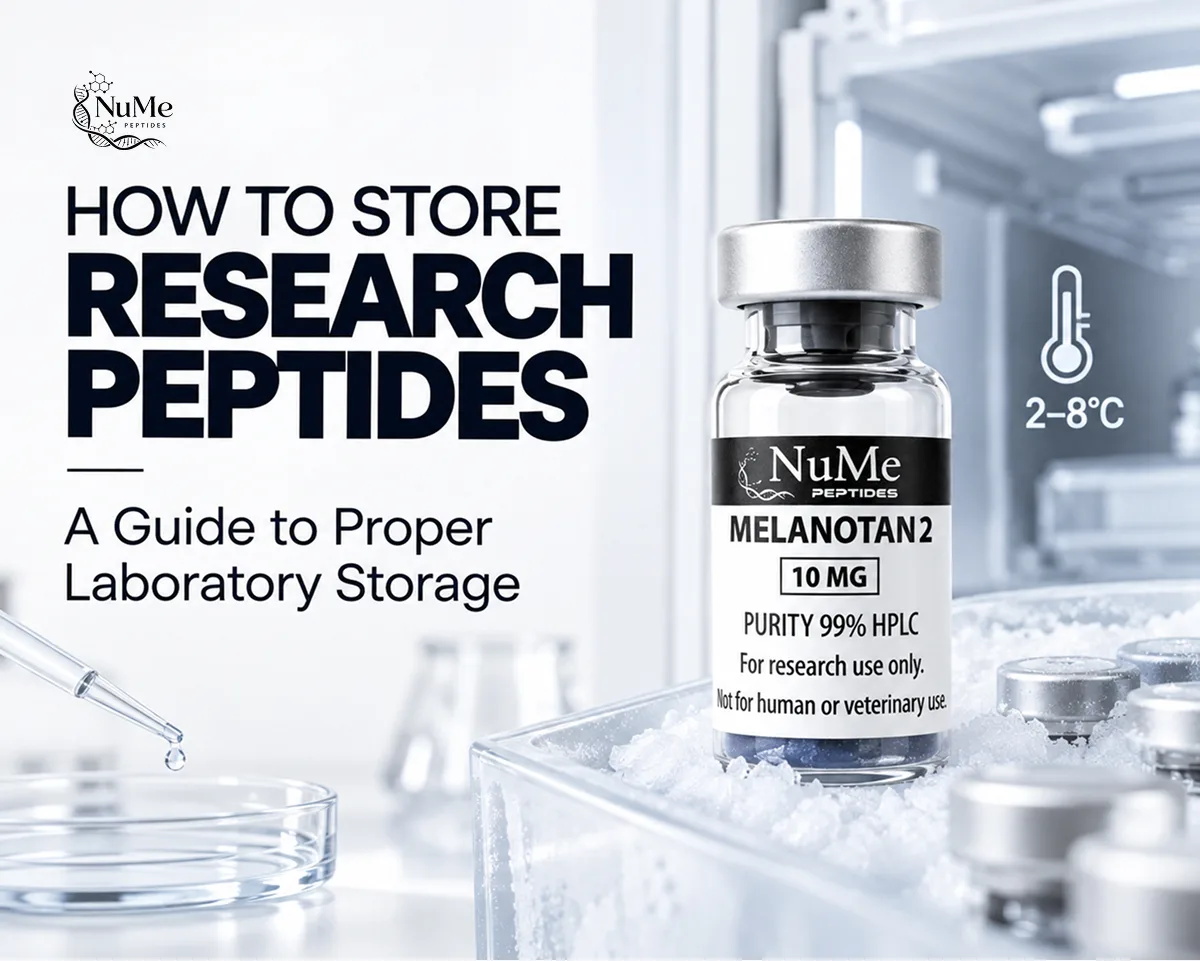
How to Store Research Peptides: A Guide to Proper Laboratory Storage


Knowing how to store research peptides is an important part of maintaining consistency in laboratory work. Peptides can undergo chemical degradation, oxidation, aggregation, adsorption, or changes in concentration when exposed to unsuitable environmental conditions. For that reason, storage should be considered part of the overall research workflow rather than an afterthought.
At Nume Peptides, researchers can explore peptide materials intended for laboratory and scientific research. Browse the Nume Peptides research collection to explore available materials and review the information provided for individual research peptides.
The correct storage approach depends on several factors, including whether the peptide is lyophilized or dissolved, its amino acid sequence, expected storage duration, container, and sensitivity to environmental conditions.. (Hoofnagle et al., 2016)
This guide explains the scientific principles behind peptide storage, with particular attention to lyophilized materials, temperature, moisture, light, air exposure, freeze-thaw cycles, containers, and practical laboratory handling.
Why Do Storage Conditions Matter for Research Peptides?
Understanding proper peptide storage starts with recognizing that peptides are chemically active molecules rather than completely inert powders. Their stability depends on their amino acid sequence, physical state, surrounding environment, and storage duration. (Lian et al., 2021)
Several chemical reactions can affect peptides during storage. These include oxidation, deamidation, hydrolysis, peptide-bond cleavage, and other structural modifications. A classic review of solid-state peptide stability identifies temperature, moisture, formulation environment, and physical state among the factors that can influence degradation. (Manning et al., 1989)
Physical changes can also occur. Peptides may aggregate or interact with surfaces, potentially changing their apparent concentration or behavior during an experiment. Research on peptide stability has shown that sequence, concentration, pH, temperature, agitation, surfaces, impurities, and storage conditions can all influence aggregation. (Zapadka et al., 2017)
For laboratory research, these changes matter because an altered sample can introduce additional variables into an experiment. If a peptide has degraded or its concentration has changed during storage, the researcher may no longer be working with the same material characterized at the beginning of the project.
Therefore, proper storage is closely connected to experimental reproducibility. Appropriate storage helps reduce avoidable changes between the time a peptide is received, prepared, and used.
For researchers looking for peptide materials for laboratory investigation, browse the Nume Peptides Shop to explore the available research collection.
What Factors Can Affect Research Peptides During Storage?
Several factors influence how to store research peptides effectively. The most important include temperature, moisture, oxygen, light, storage duration, physical state, concentration, container material, and the peptide’s individual sequence.
Temperature
Several factors influence peptide stability during storage. In general, lower temperatures can slow certain degradation processes, although the optimal condition depends on the specific peptide and its formulation. (Manning et al., 1989)
Moisture
Moisture is particularly relevant for lyophilized peptides. Exposure to humidity can cause a dried peptide material to absorb water, potentially affecting stability and physical properties. Researchers working with lyophilized materials should therefore minimize unnecessary exposure to ambient humidity. (Hoofnagle et al., 2016)
Oxygen
Oxygen exposure can contribute to oxidation of susceptible amino acid residues. Cysteine, methionine, and tryptophan are among the residues that can be particularly susceptible to oxidation under certain conditions. (Hoofnagle et al., 2016)
Light
Some peptide sequences contain residues that can undergo photochemical reactions. Tryptophan and other aromatic residues can be sensitive to light-related degradation under appropriate conditions. For sensitive sequences, limiting light exposure can therefore be useful. (Hoofnagle et al., 2016)
Freeze-Thaw Cycles
Repeated freezing and thawing can contribute to chemical and physical changes in peptide solutions. For this reason, research protocols commonly recommend minimizing unnecessary freeze-thaw cycles. (Hoofnagle et al., 2016)
Container and Surface Interactions
Peptides can adsorb to surfaces such as glass, plastic, and other container materials. The extent of adsorption varies according to peptide properties and experimental conditions. (Wang et al., 2014)
These factors show why storage conditions should be determined according to the characteristics of the individual peptide rather than relying on a generic rule.
How Should Lyophilized Research Peptides Be Stored?
Lyophilized peptides are commonly supplied in a dry, freeze-dried form because reducing water content can improve stability for many peptide sequences. However, lyophilization does not make a peptide permanently stable under every condition.
For long-term storage, lyophilized materials are generally maintained under frozen conditions. The consensus recommendations published by the Clinical Proteomic Tumor Analysis Consortium indicate that peptides intended for long-term storage can be maintained in lyophilized form at approximately −20°C to −80°C, depending on the peptide. (Hoofnagle et al., 2016)
However, storage temperature should always be checked against the supplier’s product-specific information and the requirements of the experimental protocol. Different peptide sequences can exhibit substantially different stability profiles.
Minimize Moisture Exposure
One practical consideration is moisture. A lyophilized peptide can absorb water from humid air, particularly when a container is opened repeatedly.
The Hoofnagle et al. recommendations specifically suggest allowing lyophilized material to reach room temperature in a desiccator before reconstitution, helping reduce water absorption and concentration variability. (Hoofnagle et al., 2016)
Limit Light Exposure
For light-sensitive sequences, dark or amber containers can help reduce photochemical exposure. This consideration becomes particularly relevant for peptides containing residues susceptible to photo-oxidation. (Hoofnagle et al., 2016)
Maintain Container Integrity
The storage container should remain appropriately sealed when the material is not being handled. Minimizing unnecessary opening can reduce exposure to moisture, oxygen, and environmental contaminants.
Published peptide microarray protocols have reported long-term storage of lyophilized peptides at −80°C and emphasize that certain sequences containing residues such as methionine, cysteine, aspartate, asparagine, or tryptophan may warrant additional monitoring for deterioration. (Rothbart et al., 2012)
Thus, storing lyophilized peptides involves more than simply selecting a freezer. Researchers should also control humidity exposure, light, container handling, and storage duration.
How Can Light, Moisture and Temperature Affect Stored Peptides?
Environmental exposure deserves particular attention because temperature, light, and moisture can interact rather than acting independently.
Temperature and Chemical Degradation
Temperature can accelerate many chemical reactions. In peptide materials, higher temperatures may increase rates of degradation, while freezing can slow many processes. However, freezing and thawing can also introduce physical stresses, particularly when peptides are stored in solution.
Moisture and Solid-State Stability
Moisture can influence chemical reactions in solid peptide materials. Research on solid-state peptide chemistry has identified moisture content as one of the factors that can affect degradation pathways such as deamidation, hydrolysis, oxidation, and aggregation.
This is one reason why unnecessary exposure of lyophilized peptides to humid laboratory air should be avoided.
Light and Oxidation
Light can contribute to photochemical degradation in susceptible molecules. The effects depend strongly on the peptide sequence and its environment. For sequences considered light-sensitive, minimizing direct light exposure and using suitable storage containers can be appropriate. (Hoofnagle et al., 2016)
Temperature Changes During Handling
Temperature stability is not only about the final freezer temperature. Repeated transitions between frozen and room-temperature conditions can also influence peptide solutions. The peptide-storage recommendations developed for mass spectrometry applications specifically advise avoiding multiple freeze-thaw cycles. (Hoofnagle et al., 2016)
These observations reinforce an important principle: consistent environmental conditions are generally preferable to repeated unnecessary changes.
For researchers looking for peptide materials for laboratory investigation, browse the Nume Peptides Shop to explore the available research collection.
What Laboratory Practices Can Help Maintain Peptide Integrity During Storage?
Good laboratory practice can make peptide storage much easier to manage consistently.
Keep an Organized Storage System
Researchers should maintain clear labels showing the peptide identity, batch or lot information, preparation date where applicable, and relevant storage conditions. A structured inventory reduces unnecessary handling and makes it easier to track materials.
Minimize Container Openings
Every time a peptide container is opened, the material can be exposed to air and moisture. Opening containers only when necessary can reduce these exposures.
Use Appropriate Aliquots for Solutions
For peptide solutions, aliquoting can help reduce repeated freeze-thaw cycles. Instead of repeatedly thawing one large stock solution, researchers can prepare smaller portions appropriate for planned experiments. (Hoofnagle et al., 2016)
Avoid Unnecessary Agitation
Physical agitation can influence peptide aggregation in some systems. Research on peptide physical stability identifies agitation as one of several external factors that can influence aggregation behavior. (Zapadka et al., 2017)
Consider Container Materials
Container selection can matter because peptides may adsorb to surfaces. Published guidance recommends evaluating materials such as polypropylene or appropriately treated glass depending on the peptide and analytical application. (Hoofnagle et al., 2016)
Follow Product-Specific Instructions
There is no universal storage temperature that guarantees stability for every peptide. Researchers should prioritize product-specific documentation when it is available and consider published stability information for the particular sequence.
Monitor Long-Term Samples
For long-term projects, researchers may periodically evaluate stored materials when the experimental design requires confirmation of stability. Analytical approaches such as HPLC or LC-MS can help identify changes in peptide composition or degradation profiles.
Ultimately, effective peptide storage is best approached as a combination of temperature control, moisture management, light protection, careful handling, appropriate containers, and documented laboratory procedures.
If you’re new to peptide research, start with our beginner-friendly guide What Are Research Peptides? A Beginner’s Guide to Peptide Research to learn more about peptide structure, molecular mechanisms, scientific applications, and key considerations before exploring the differences between research and pharmaceutical peptides.
FAQs About Research Peptide Storage
How should research peptides generally be stored?
Lyophilized peptides are commonly stored under frozen conditions for longer-term research storage, with −20°C to −80°C cited in published peptide-storage recommendations depending on the sequence and application. Researchers should always follow the product-specific storage information available for the material.
Should lyophilized research peptides be protected from moisture?
Yes. Unnecessary moisture exposure should be minimized because water can influence solid-state peptide stability and degradation. Keeping containers properly sealed and limiting exposure to humid laboratory air can help.
Can light affect peptide stability?
Some peptide sequences can be susceptible to photochemical reactions. For sensitive materials, minimizing direct light exposure and using amber or dark storage containers may be appropriate.
Why should repeated freeze-thaw cycles be avoided?
Repeated freeze-thaw cycles can contribute to chemical and physical changes in peptide solutions. For that reason, published peptide-handling recommendations advise minimizing unnecessary freeze-thaw events.
Is lyophilized peptide more stable than peptide in solution?
For many peptides, the dry lyophilized state is more suitable for longer-term storage than an aqueous solution. However, stability remains sequence-dependent, and lyophilization itself can introduce stresses that may affect some molecules.
Can peptides degrade even when stored frozen?
Yes. Freezing can slow many degradation processes, but it does not guarantee that no chemical or physical changes will occur. Certain sequences remain susceptible to oxidation, degradation, or other changes depending on their characteristics and storage environment.
What is the best container for storing research peptides?
The appropriate container depends on the peptide and research application. Glass and polypropylene containers are commonly considered in peptide-storage workflows, while surface adsorption should also be taken into account.
Knowing how to store research peptides is an important part of maintaining consistency throughout a laboratory research workflow. Storage conditions can influence chemical stability, physical behavior, concentration, and the overall characteristics of a peptide sample.
For many lyophilized peptides, long-term frozen storage can be appropriate, while moisture, light exposure, repeated handling, and freeze-thaw cycles should be carefully controlled. At the same time, peptide sequence matters: different amino acid compositions can create substantially different stability profiles. (Hoofnagle et al., 2016)
Researchers should therefore avoid treating storage as a one-size-fits-all process. Product-specific documentation, published stability research, appropriate laboratory practices, and analytical verification can provide a more reliable framework for maintaining research materials.
For researchers looking for peptide materials for laboratory investigation, visit the Nume Peptides to explore the available research peptide collection.
Disclaimer: This content is provided for educational and scientific research purposes only. Research peptides are intended for laboratory research only and are not intended for human consumption or medical use.


This is a practical guide for anyone working with research peptides. I found the information about temperature, moisture, and storage conditions especially useful because these factors can have a significant impact on sample stability over time.
I appreciate how the article explains peptide storage in a straightforward way. Understanding how environmental conditions and handling practices affect sample integrity is an important part of maintaining consistency in laboratory research.
A helpful reference for researchers who want to improve their peptide storage practices. The emphasis on proper handling and controlled storage conditions makes the article particularly relevant for protecting sample quality during laboratory work.