
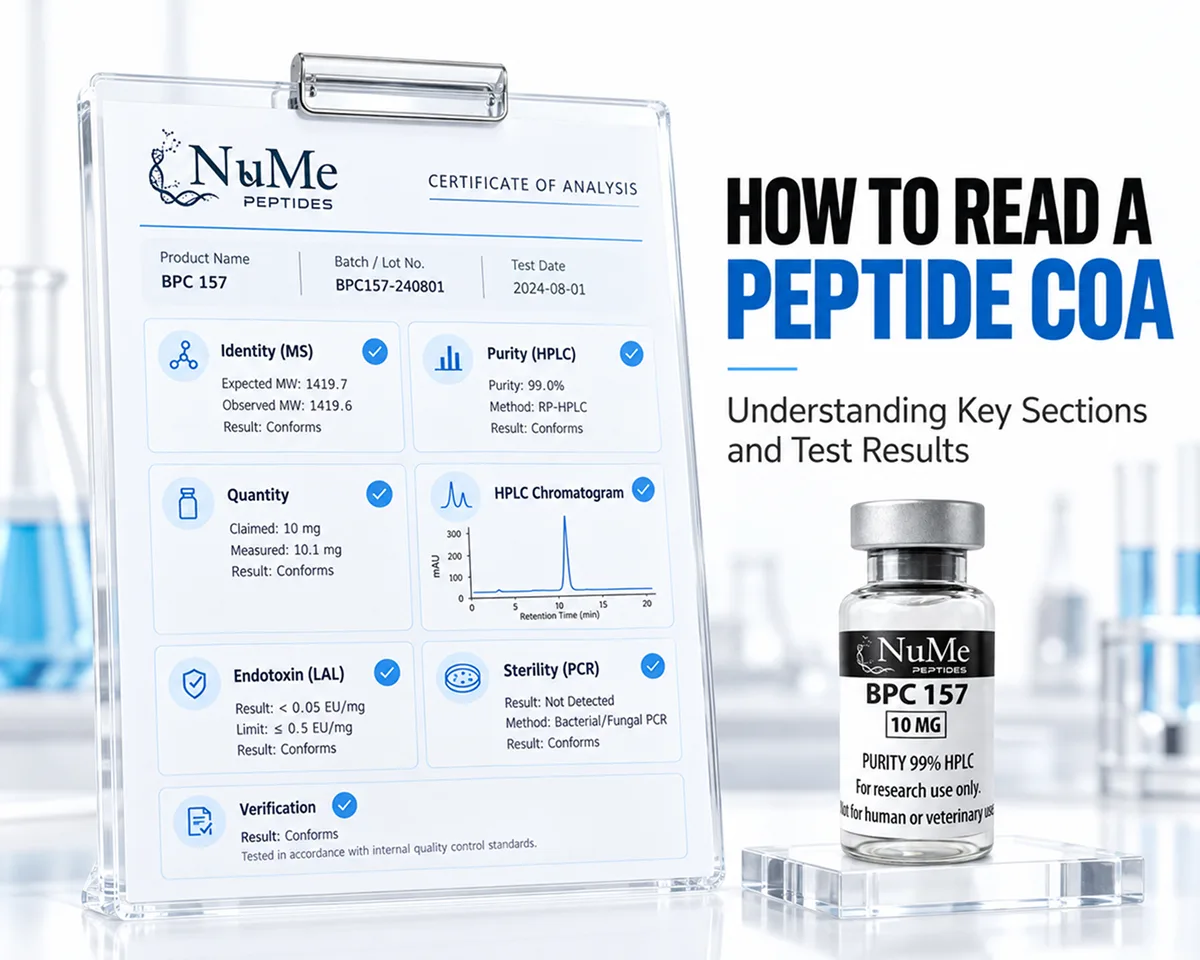
How to Read a Peptide COA: Understanding Key Sections and Test Results


how to read a peptide COA documentation helps researchers move beyond a single headline purity percentage and evaluate what a Certificate of Analysis actually shows. A useful COA should connect a specific research material to a specific production batch, identify the analytical methods used, and report results that researchers can interpret within the limits of those methods.
For peptide research, this distinction matters because purity, molecular identity, peptide content, and stability are separate analytical characteristics. A COA may provide evidence for some of these characteristics without establishing all of them.
For Canadian researchers, Health Canada’s quality framework for regulated active pharmaceutical ingredients provides a useful reference for understanding analytical documentation. It emphasizes batch identification, test procedures, specifications, numerical results, and traceability. These requirements apply to regulated APIs rather than ordinary research-use peptides, but the documentation principles can still help researchers review peptide COAs critically. (Health Canada, 2022)
For researchers looking for peptide materials for laboratory investigation, visit the Nume Peptides to explore the available research peptide collection.
Where Should You Start When Reading a Peptide COA?
When first opening a COA, avoid starting with the largest number on the page.
Instead, first establish whether the document clearly identifies the material being tested and whether the analytical information can be connected to a specific batch.
A practical reading sequence is:
- Identify the peptide.
- Check the batch or lot number.
- Review the testing date.
- Identify the analytical methods.
- Read the purity result.
- Review identity data.
- Check the testing laboratory.
- Compare the COA with the actual research material.
This order reduces the risk of interpreting a 99% purity result before confirming that the certificate even belongs to the correct sample.
Read the COA as a connected record
A strong certificate should create a traceable relationship:
Research material → Batch number → Test method → Analytical result → Testing laboratory
If any part of that chain is unclear, researchers may need additional documentation before drawing conclusions about the sample.
Health Canada’s regulated API guidance similarly requires Certificates of Analysis to identify relevant batches and report testing information in a traceable manner. (Health Canada, 2022)
| COA section | First question to ask |
|---|---|
| Product identification | What material was tested? |
| Lot number | Which production batch does this represent? |
| Test date | When was the sample analyzed? |
| HPLC | What does the chromatographic profile show? |
| Mass spectrometry | Does observed mass support identity? |
| Laboratory details | Who performed the analysis? |
A researcher who follows this sequence can interpret the rest of the certificate with much better context.
For researchers looking for peptide materials for laboratory investigation, browse the Nume Peptides Shop to explore the available research collection.
How Should Product, Batch and Sample Information Be Read?
Before interpreting laboratory results, verify the identification section.
Product name
The peptide name on the COA should correspond with the material being evaluated.
Where available, additional identifiers may include:
- amino-acid sequence;
- molecular formula;
- theoretical molecular weight;
- sample identifier;
- product code;
- nominal quantity.
These fields can provide additional specificity when peptides have similar names or related sequences.
Lot or batch number
The batch number is one of the most important fields on a COA.
Researchers should compare the lot printed on the vial or package with the lot shown on the analytical certificate.
For example:
| Product label | COA | Interpretation |
|---|---|---|
| Lot NP24061 | Lot NP24061 | Direct batch match |
| Lot NP24061 | Lot NP24018 | Different production lots |
| Lot shown | No lot on COA | Traceability incomplete |
| No lot shown | Lot shown | Product-to-COA connection unclear |
A purity result from another production lot may still provide general information about the supplier’s analytical practices, but it does not directly characterize the material currently being studied.
Sample and report identifiers
Independent laboratories may assign their own sample or report numbers.
Therefore, a COA may contain both:
- supplier batch number;
- laboratory sample number.
These numbers do not need to be identical. However, the analytical report should provide enough information to establish that the laboratory sample corresponds to the stated production lot.
Batch traceability is also central to Health Canada’s regulated API framework because records need to connect testing and distribution information to individual production batches. (Health Canada, 2022)
How Can You Interpret Purity and HPLC Results?
HPLC is one of the most common analytical techniques shown on peptide COAs.
However, knowing how to read a peptide COA purity data requires understanding what the percentage actually represents.
Start with the reported purity percentage
A COA might report: HPLC Purity: 99.2%
This usually refers to the relative chromatographic area of the principal detected peak compared with other integrated peaks under the conditions of that HPLC method.
It does not necessarily mean that 99.2% of the entire vial mass consists of target peptide.
The remaining material may include components that are not represented in the same way by the chromatographic measurement, such as:
- water;
- counterions;
- residual salts;
- selected solvents;
- substances with different detector responses.
Scientific recommendations for peptide reference materials specifically distinguish chemical purity from peptide content because these represent different analytical measurements. (Hoofnagle et al., 2016)
Examine the chromatogram when available
A chromatogram provides more context than a percentage alone.
Researchers can look for:
- one dominant principal peak;
- number of secondary peaks;
- relative size of secondary peaks;
- retention time;
- baseline separation;
- unusual unresolved signals.
A simplified example might look like this:
| Chromatographic observation | Possible interpretation |
|---|---|
| One dominant peak | One major chromatographic component |
| Several small peaks | Minor detectable components |
| Large secondary peak | Significant additional chromatographic species |
| Poorly resolved peaks | Separation may be insufficient for clear interpretation |
A secondary peak does not automatically identify an impurity. HPLC can show that another chromatographically distinct component exists, but additional analysis may be necessary to determine what that component is.
Check the analytical context
Two suppliers reporting 99.1% and 99.6% HPLC purity cannot automatically be ranked based on those numbers alone.
Differences in:
- column chemistry;
- mobile phase;
- gradient;
- detector settings;
- wavelength;
- integration parameters;
- sample preparation
can influence chromatographic results.
Therefore, small numerical differences should be interpreted cautiously unless the analytical methods are sufficiently comparable.
For researchers looking for peptide materials for laboratory investigation, browse the Nume Peptides Shop to explore the available research collection.
How Can You Interpret Mass Spectrometry and Identity Results?
Mass spectrometry provides different information from HPLC.
While HPLC primarily evaluates chromatographic composition, mass spectrometry measures ions according to their mass-to-charge ratio and can provide evidence supporting molecular identity.
Compare theoretical and observed mass
A peptide COA may show:
| Measurement | Example |
|---|---|
| Theoretical molecular mass | 1,418.7 Da |
| Observed molecular mass | 1,418.8 Da |
| Difference | 0.1 Da |
A close match between theoretical and experimentally observed mass supports the conclusion that the expected molecular species is present.
Modern mass spectrometry is widely used in synthetic peptide characterization because it can support identity assessment and reveal selected molecular variants or modifications. (Højrup, 2024)
Do not interpret a matching mass as purity
An expected MS result does not mean the sample is chromatographically pure.
A sample could contain:
- the intended peptide;
- truncated peptides;
- oxidation products;
- degradation products;
- other synthesis-related species.
Therefore:
HPLC asks: What chromatographic components are present?
MS asks: What molecular masses are being detected?
These are related but different analytical questions.
Look at additional molecular species
Unexpected MS signals may indicate:
- oxidation;
- sequence truncation;
- adduct formation;
- degradation;
- selected chemical modifications.
However, additional peaks can also result from charge states, isotopes, or common adducts. Researchers should therefore interpret a complete spectrum rather than assuming every additional signal represents contamination.
LC-MS can strengthen interpretation by connecting chromatographic separation with molecular-mass information. This approach is widely used to investigate peptide-related impurities generated during synthesis or storage. (Lian et al., 2021)
For researchers looking for peptide materials for laboratory investigation, browse the Nume Peptides Shop to explore the available research collection.
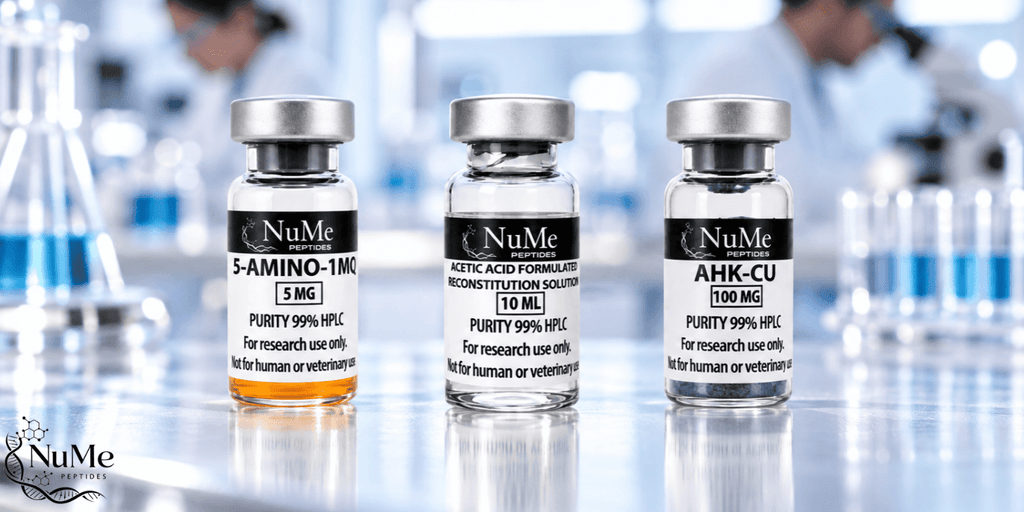
How Can You Check Whether COA Information Matches the Research Peptide?
The final step is to compare the certificate with the physical material and its intended research context.
A COA can contain technically credible analytical data and still be irrelevant if it belongs to another batch.
Perform a direct document-to-product check
Compare the following information:
| Checkpoint | Product | COA | Should match? |
|---|---|---|---|
| Peptide name | Label | Certificate | Yes |
| Lot number | Label | Certificate | Yes |
| Product presentation | Package | Certificate/specification | Ideally |
| Testing date | — | Certificate | Should be present |
| Laboratory | — | Certificate/report | Should be identifiable |
| Purity method | — | Certificate | Should be stated |
| Identity method | — | Certificate | Should be stated when identity is claimed |
Check whether the evidence supports the claim
A useful rule is:
Claim → Method → Result → Batch
For example:
Claim: 99% chromatographic purity
Method: HPLC
Result: 99.3% principal peak area
Batch: NP24061
Or:
Claim: Molecular identity confirmed
Method: Mass spectrometry
Result: Observed molecular mass consistent with theoretical mass
Batch: NP24061
This structure makes analytical claims easier to evaluate.
Look for incomplete documentation
COA information deserves closer review when researchers see:
- missing lot numbers;
- no testing date;
- purity claims without an identified method;
- “MS passed” without molecular-mass data;
- no identifiable laboratory;
- one certificate used for multiple unrelated batches;
- product and COA names that do not correspond;
- headline results without supporting analytical information.
Not every missing field automatically makes a certificate invalid. However, missing information reduces the conclusions researchers can reasonably draw from that document.
For researchers looking for peptide materials supported by batch-specific analytical information, visit NuMe Peptides to explore the available research collection.
Learn how identity, purity, analytical testing, and documentation work together when evaluating peptide materials in our guide: Research Peptide Quality: How to Evaluate Testing, Documentation and Verification
FAQs About Reading a Peptide COA
What Should I Look at First on a Peptide COA?
Start with the peptide name, batch number, testing date, and analytical methods. Confirm that the certificate actually corresponds to the research material before interpreting purity or identity results.
What Does 99% HPLC Purity Mean?
It generally means the principal chromatographic peak accounts for approximately 99% of the integrated detector response under that particular HPLC method.
It does not automatically mean that 99% of the entire vial mass is target peptide.
How Do I Know Whether Mass Spectrometry Confirms Identity?
Compare the theoretical molecular mass with the observed mass. Close agreement supports molecular identity, although mass alone may not establish every structural characteristic.
Should HPLC and Mass Spectrometry Both Appear on a COA?
Not every certificate must contain both methods. However, the two techniques provide complementary information. HPLC can assess chromatographic purity, while MS can provide molecular-mass evidence supporting identity.
Why Does the Batch Number Matter?
The batch number connects analytical results to the actual material. If the product and COA have different lot numbers, the certificate may describe another production run.
Does a COA Prove Complete Peptide Quality?
No. A COA reports the analytical characteristics that were tested. Depending on the research objective, additional information about peptide content, impurities, stability, storage, or other characteristics may also be relevant.
Conclusion
Understanding how to read a peptide COA documentation means interpreting the certificate as a connected analytical record rather than focusing on one purity percentage.
Researchers should review:
- peptide identification;
- batch and lot numbers;
- testing dates;
- HPLC results;
- chromatographic profiles;
- theoretical and observed molecular mass;
- laboratory information;
- consistency between the certificate and physical research material.
Most importantly, HPLC purity and mass-spectrometry identity should remain separate concepts. A strong chromatographic result does not independently prove molecular identity, while a matching molecular mass does not establish complete purity.
For Canadian researchers, Health Canada’s regulated API framework provides a useful quality reference by emphasizing appropriate analytical procedures, numerical results, batch-specific documentation, and traceability. These requirements apply to regulated APIs rather than ordinary research peptides, but the underlying principles remain valuable when reviewing laboratory documentation. (Health Canada, 2022)
For researchers looking for peptide materials for laboratory investigation, visit the Nume Peptides to explore the available research peptide collection.
Disclaimer: This content is provided for educational and scientific research purposes only. Research peptides are intended for laboratory research only and are not intended for human consumption or medical use.

https://web-tool.hashnode.dev