
Peptides for Tissue Repair Research: Biological Pathways and Current Evidence


Research into peptides for tissue repair research examines how peptide-based compounds may influence inflammation, angiogenesis, fibroblast activity, extracellular-matrix remodeling, and other processes involved in tissue recovery. Researchers study these mechanisms through cell cultures, animal injury models, biomaterials, and selected translational investigations.
However, tissue repair is not a single biological event. It requires coordinated responses among immune cells, endothelial cells, fibroblasts, extracellular-matrix proteins, growth factors, and tissue-specific cells. Therefore, evidence from one experimental model cannot automatically predict outcomes in another tissue or in humans.
For Canadian researchers, regulatory context is also important. Health Canada has identified BPC-157, TB-500, and GHK-Cu among unauthorized injectable peptide products and notes that products labelled for research use are not automatically exempt from applicable regulatory requirements. (Health Canada, 2026)
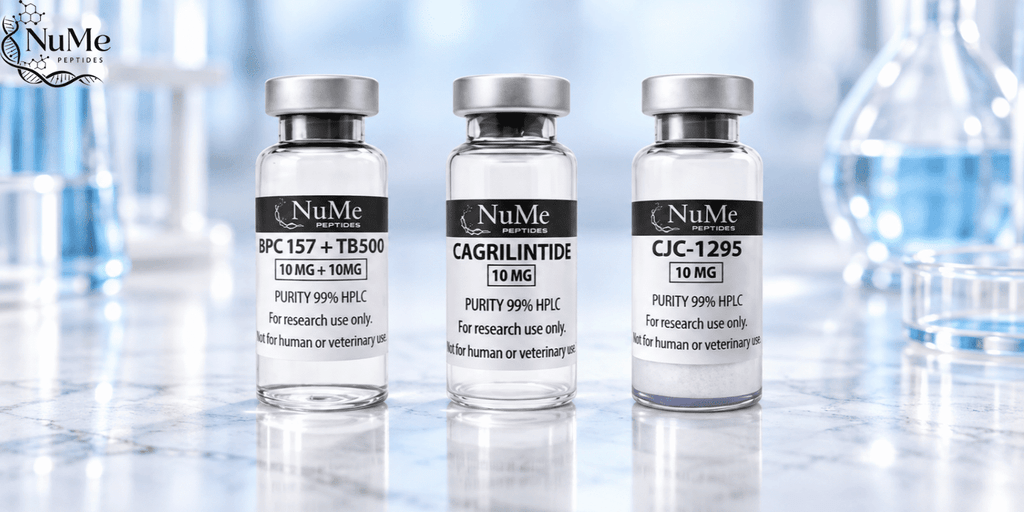
For researchers looking for peptide materials for laboratory investigation, visit the Nume Peptides to explore the available research peptide collection.
What Happens During the Tissue Repair Process?
Tissue repair is generally described through four overlapping phases: hemostasis, inflammation, proliferation, and remodeling. During hemostasis, vascular constriction and clot formation help stabilize damaged tissue. The inflammatory phase then recruits immune cells that remove damaged material and coordinate early repair signals.
During proliferation, fibroblasts, endothelial cells, keratinocytes, and other cells contribute to extracellular-matrix formation, vascular development, and tissue reconstruction. Finally, remodeling reorganizes collagen and other structural components as repaired tissue matures.
Current wound-healing research emphasizes that these phases overlap rather than occurring as completely separate steps. Successful repair depends on coordinated transitions between inflammatory, proliferative, and remodeling responses. (Deng et al., 2025)
| Repair phase | Major biological activities | Common research focus |
|---|---|---|
| Hemostasis | Platelet activation and clot formation | Coagulation signalling |
| Inflammation | Immune-cell recruitment and debris clearance | Cytokines and macrophages |
| Proliferation | Angiogenesis and matrix production | VEGF, fibroblasts and collagen |
| Remodeling | Matrix reorganization | MMPs, collagen turnover and TGF-β |
An important point is that increasing one repair-associated mechanism does not automatically result in complete tissue regeneration. For example, increased angiogenesis alone cannot restore normal tissue architecture if extracellular-matrix organization remains impaired.
For researchers looking for peptide materials for laboratory investigation, browse the Nume Peptides Shop to explore the available research collection.
How Are Peptides Studied in Tissue Repair Research?
Peptides may act as signalling molecules, regulatory fragments, metal-binding complexes, or experimental modulators of cellular pathways.
Researchers commonly investigate them using:
- fibroblast, endothelial, keratinocyte, or immune-cell cultures;
- ex vivo tissue models;
- animal injury models;
- peptide-containing hydrogels or scaffolds;
- biochemical and molecular assays;
- controlled human investigations where sufficient evidence exists.
Research into bioactive peptides has explored potential roles across skin, muscle, tendon, cartilage, bone, cardiovascular tissue, and nervous tissue. Common experimental endpoints include vascular signalling, inflammation, cell migration, extracellular-matrix production, and structural recovery. (Zhang et al., 2024)
Why the research model matters
A cell-culture experiment can demonstrate whether a peptide changes a defined cellular response under controlled conditions.
Animal models provide additional information about interactions among multiple tissues and biological systems. However, results from these models do not automatically establish:
- human effectiveness;
- long-term safety;
- clinically relevant exposure;
- appropriate delivery methods;
- equivalent effects across tissue types.
For that reason, researchers should interpret peptide evidence according to the model in which the observation was made.
Which Biological Pathways Are Involved in Peptide-Mediated Tissue Repair Research?
Several biological pathways repeatedly appear in research involving experimental repair-associated peptides.
Angiogenesis and vascular signalling
Developing tissue requires oxygen and nutrient delivery. Therefore, researchers often examine VEGF-related signalling, endothelial migration, capillary formation, and microvascular responses.
Angiogenesis may support tissue reconstruction, but vascular growth represents only one part of the repair process.
Fibroblast activity and extracellular-matrix remodeling
Fibroblasts contribute collagen and other extracellular-matrix components that provide structural support.
Peptide research may evaluate:
- fibroblast migration;
- fibroblast proliferation;
- collagen synthesis;
- matrix metalloproteinases;
- extracellular-matrix organization.
Both insufficient and excessive matrix activity can be problematic, which is why researchers often examine the balance between matrix synthesis and degradation.
Inflammatory signalling
Inflammation is essential during early repair, but prolonged inflammatory activity can interfere with normal tissue recovery.
Experimental peptide studies may therefore examine:
- inflammatory cytokines;
- macrophage behaviour;
- oxidative stress;
- inflammatory-resolution pathways.
Cell migration and cytoskeletal regulation
Cell migration contributes to re-epithelialization, angiogenesis, and tissue reconstruction.
Thymosin β4 is especially relevant because it interacts with G-actin and has been investigated in relation to cytoskeletal regulation, migration, angiogenesis, and repair-associated processes. (Ying et al., 2023)
These pathways interact continuously. Therefore, researchers should avoid describing a compound as supporting complete tissue repair merely because it affects one isolated signalling pathway.
For researchers looking for peptide materials for laboratory investigation, browse the Nume Peptides Shop to explore the available research collection.
Which Peptides Are Being Investigated for Tissue Repair?
Several compounds appear frequently in peptides for tissue repair research, although the strength and type of evidence differ between them.
BPC-157
BPC-157 is a synthetic pentadecapeptide widely studied in preclinical models involving tendon, ligament, muscle, bone, gastrointestinal tissue, angiogenesis, and inflammatory signalling.
A 2025 systematic review of musculoskeletal BPC-157 research identified 36 eligible studies. Of these, 35 were preclinical and only one involved human subjects. Reported experimental mechanisms included angiogenesis, inflammatory regulation, growth-related signalling, and structural or biomechanical outcomes. (Vasireddi et al., 2025)
This evidence profile is important because it shows considerable experimental interest while also highlighting the limited amount of human data.
TB-500 and thymosin β4
TB-500 is commonly discussed in connection with thymosin β4, or Tβ4. However, researchers should distinguish commercial TB-500 terminology from specific compounds characterized in peer-reviewed studies.
Thymosin β4 is a 43-amino-acid peptide that interacts with G-actin. Research has investigated its relationship with:
- cell migration;
- cytoskeletal organization;
- angiogenesis;
- inflammatory modulation;
- dermal repair;
- vascular responses.
Studies have also examined functional fragments derived from thymosin β4 in relation to angiogenesis and cell migration. (Philp et al., 2010)
Therefore, researchers should verify the molecular identity of experimental material before assuming that findings from full-length Tβ4 apply directly to every product described as TB-500.
GHK-Cu
GHK-Cu is a copper complex formed from the tripeptide glycyl-L-histidyl-L-lysine.
Research has explored GHK-Cu in relation to:
- fibroblast activity;
- collagen production;
- extracellular-matrix remodeling;
- angiogenesis;
- skin biology;
- inflammatory regulation.
Earlier research described GHK-Cu as influencing repair-cell recruitment, collagen production, elastin-related activity, fibroblast behaviour, and vascular signalling. (Pickart, 2008)
| Research compound | Major areas investigated | Main evidence limitation |
|---|---|---|
| BPC-157 | Tendon, ligament, muscle, bone and angiogenesis | Evidence remains predominantly preclinical |
| Tβ4 / TB-500-related research | Cell migration, actin and angiogenesis | TB-500 terminology may not always represent full-length Tβ4 |
| GHK-Cu | Fibroblasts, collagen, ECM and skin biology | Formulation and clinical evidence vary |
For laboratory research, analytical identity remains important. HPLC, mass spectrometry, batch documentation, and clear molecular specifications can help determine whether experimental material corresponds to the compound described in scientific literature.
What Does Current Research Show About Peptides and Tissue Repair?
Current research shows that several peptides can influence biological processes associated with tissue repair. However, biological activity should not be confused with demonstrated clinical effectiveness.
BPC-157 evidence
BPC-157 has been studied in multiple animal models involving musculoskeletal injury and repair-associated pathways.
However, the available literature remains heavily weighted toward preclinical studies. The 2025 systematic review identified only one human study among 36 included publications. (Vasireddi et al., 2025)
Consequently, findings from tendon, muscle, ligament, or bone models should be interpreted as experimental evidence.
Thymosin β4 evidence
Thymosin β4 has a broader mechanistic literature involving actin regulation, endothelial migration, angiogenesis, inflammation, and tissue repair.
Research has demonstrated that Tβ4 can influence endothelial-cell migration and vascular development in experimental systems. (Philp et al., 2003)
However, results obtained using specifically characterized Tβ4 should not automatically be transferred to every compound sold under the TB-500 name.
GHK-Cu evidence
GHK-Cu has been examined in cellular, animal, skin, biomaterial, and extracellular-matrix research.
Its literature includes studies of fibroblast behaviour, collagen-related signalling, angiogenesis, and tissue remodeling. Nevertheless, experimental outcomes can depend on concentration, delivery system, formulation, copper coordination, and the research model.
Understanding the evidence hierarchy
| Evidence level | What it can help investigate | Main limitation |
|---|---|---|
| Cell studies | Molecular and cellular mechanisms | Limited tissue complexity |
| Animal studies | Integrated biological response | Human translation uncertain |
| Human observational research | Early human signals | Limited causal certainty |
| Controlled clinical trials | Comparative clinical evidence | Limited for many experimental peptides |
This hierarchy helps distinguish a promising mechanistic finding from an established clinical conclusion.
Canadian context
Health Canada has specifically warned about unauthorized injectable peptide products containing BPC-157, TB-500, GHK-Cu, and other compounds. The agency states that unauthorized products have not been assessed for safety, efficacy, and quality. (Health Canada, 2026)
For laboratory researchers, four separate questions should therefore remain distinct:
- Does the peptide demonstrate biological activity?
- Does a specific experimental model show repair-associated effects?
- Is the research material analytically characterized?
- Has the compound been clinically evaluated and authorized?
Keeping these questions separate allows peptides for tissue repair research to be interpreted more accurately.
For researchers looking for peptide materials for laboratory investigation, browse the Nume Peptides Shop to explore the available research collection.
FAQs About Peptides for Tissue Repair Research
What Are Peptides for Tissue Repair Research?
They are peptide compounds investigated for their effects on processes associated with tissue repair, including angiogenesis, inflammation, fibroblast activity, cell migration, collagen production, and extracellular-matrix remodeling.
Is BPC-157 Supported by Human Tissue-Repair Research?
Human evidence remains limited. Most available evidence comes from cell and animal studies rather than controlled human trials. (Vasireddi et al., 2025)
Is TB-500 the Same as Thymosin β4?
The terms are often associated commercially, but they should not automatically be considered analytically identical. Researchers should verify sequence and molecular identity before applying findings from Tβ4 studies to a TB-500-labelled material.
Why Is GHK-Cu Studied in Tissue Repair?
Researchers have investigated GHK-Cu because of its relationships with fibroblast activity, collagen production, angiogenesis, inflammatory signalling, and extracellular-matrix remodeling.
Does Angiogenesis Alone Prove Tissue Repair?
No. Tissue repair also requires coordinated inflammation, cellular migration, matrix formation, structural remodeling, and tissue-specific responses.
Are These Peptides Approved Tissue-Repair Treatments in Canada?
Health Canada has identified unauthorized injectable peptide products containing BPC-157, TB-500, and GHK-Cu. Experimental findings should therefore not be interpreted as regulatory authorization or established therapeutic use. (Health Canada, 2026)
Conclusion
Research into peptides for tissue repair research provides scientists with tools for studying angiogenesis, inflammation, fibroblast behaviour, cell migration, extracellular-matrix remodeling, and other components of biological repair.
However, the evidence differs substantially between compounds. BPC-157 remains supported mainly by preclinical research. Thymosin β4 has a substantial mechanistic literature involving cytoskeletal dynamics, angiogenesis, and cell migration, although these findings should not automatically be attributed to every TB-500-labelled material. GHK-Cu has been studied extensively in skin biology, fibroblast activity, and matrix-remodeling research, but experimental context remains important.
The most accurate approach is therefore to separate biological mechanism from clinical outcome, preclinical findings from human evidence, and laboratory investigation from regulatory authorization.
For researchers looking for peptide materials for laboratory investigation, visit the Nume Peptides to explore the available research peptide collection.
Disclaimer: This content is provided for educational and scientific research purposes only. Research peptides are intended for laboratory research only and are not intended for human consumption or medical use.

Krautersalz ist eine wunderbare Wurze, die jedem Gericht eine besondere Note verleiht.
Sie mochten Krautersalz mit Bio-Krautern selbst herstellen, um ein aromatisches und naturbelassenes Krautersalz zu erhalten.
Mit selbstgemachtem Krautersalz hat man die Kontrolle uber die verwendeten Krauter und deren Qualitat.Das Vermengen von Krautern und Salz ist der Schlussel zu einem gelungenen Krautersalz.