
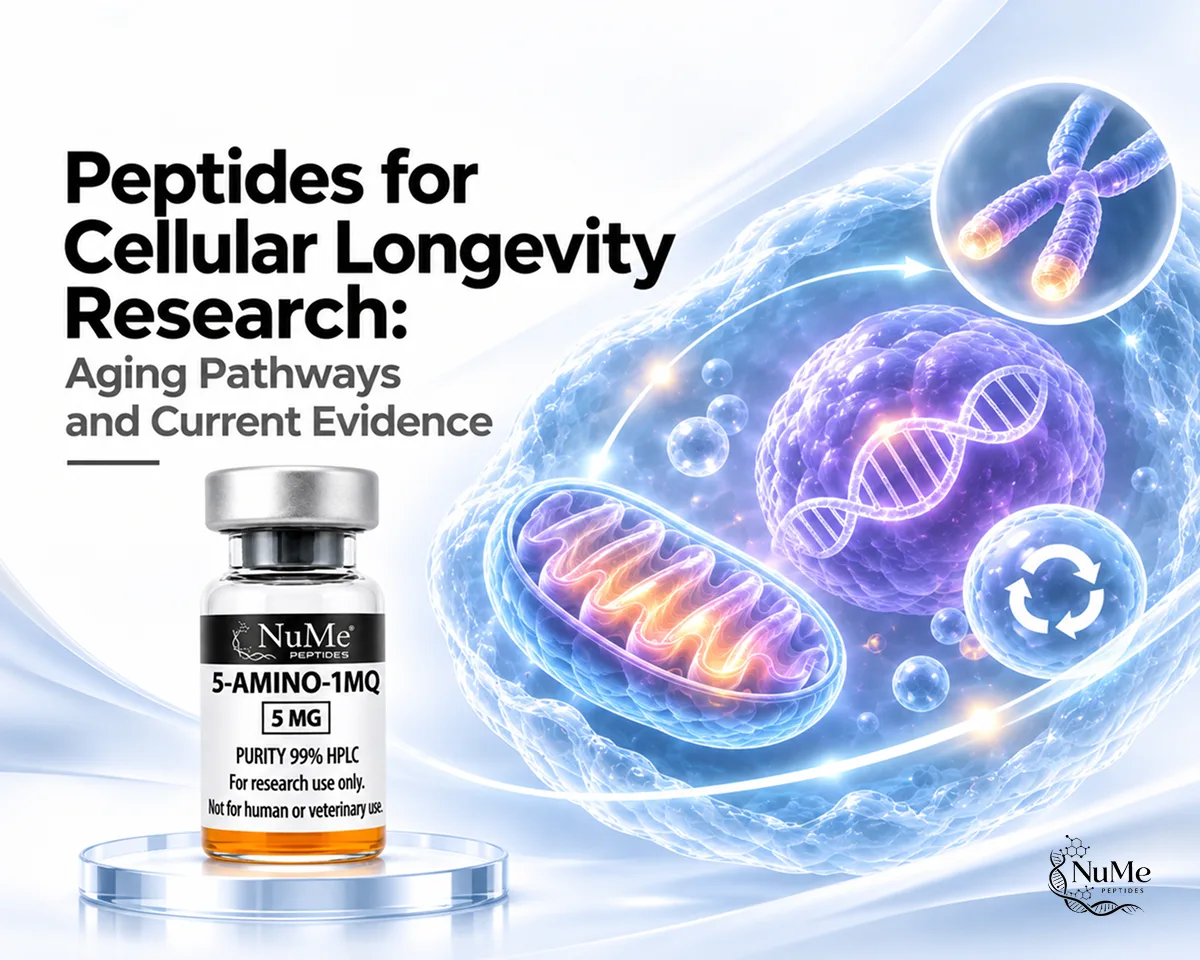
Peptides for Cellular Longevity Research: Aging Pathways and Current Evidence


Peptides for Cellular Longevity Research are investigated to understand the biological processes that determine how cells maintain function, respond to stress, repair damage, and eventually enter senescence or lose physiological capacity. Longevity research is therefore broader than simply extending lifespan. It examines cellular resilience, mitochondrial integrity, genomic stability, telomere maintenance, proteostasis, metabolic signalling, and the ability of cells to adapt to age-related stress.
Epithalon, MOTS-C, SS-31, and NAD+ represent different experimental approaches to these questions. Epithalon has been studied in relation to telomerase and telomere biology, MOTS-C is a mitochondria-derived peptide associated with metabolic stress adaptation, SS-31 targets mitochondrial membrane and redox function, while NAD+ is an essential metabolic coenzyme involved in energy metabolism, DNA repair, and stress-responsive enzymes.
For researchers looking for peptide materials for laboratory investigation, visit the Nume Peptides to explore the available research peptide collection.
What Is Cellular Longevity Research?
Cellular longevity research examines why cells progressively lose function with age and which biological systems contribute to resilience or decline. A long-lived cell is not simply one that continues dividing indefinitely. Researchers also consider whether cells preserve genomic integrity, mitochondrial function, protein quality, metabolic flexibility, and appropriate stress responses.
Several processes are commonly studied in cellular aging:
- telomere shortening and telomerase regulation;
- mitochondrial dysfunction;
- cellular senescence;
- genomic instability;
- altered nutrient sensing;
- loss of proteostasis;
- oxidative and redox imbalance;
- impaired autophagy and mitophagy;
- changes in intercellular signalling.
These mechanisms are interconnected. Mitochondrial dysfunction can increase redox stress, while DNA damage can promote senescence. Reduced proteostasis can increase damaged protein accumulation, and altered nutrient sensing can influence mitochondrial activity and autophagy.
| Aging-related process | Research significance |
|---|---|
| Telomere shortening | Associated with replicative limits in many somatic cells |
| Cellular senescence | Produces persistent cell-cycle arrest and altered signalling |
| Mitochondrial dysfunction | Can reduce bioenergetic and metabolic resilience |
| NAD+ decline | May affect metabolism and NAD-dependent enzymes |
| Oxidative stress | Can modify proteins, lipids, and nucleic acids |
| Loss of proteostasis | Increases accumulation of damaged proteins |
| Impaired mitophagy | Reduces mitochondrial quality control |
This broader framework is important because no single biomarker can establish “cellular longevity.” Changes in telomeres, mitochondrial respiration, or NAD+ should be interpreted as individual research endpoints rather than direct measurements of lifespan.
Explore laboratory research into cellular energy metabolism, redox balance, and aging-related pathways with NAD+ (500 mg).

Which Biological Pathways Are Associated With Cellular Aging?
Age-related cellular decline involves several overlapping pathways. The compounds discussed here intersect with different parts of this network rather than acting through one universal longevity mechanism.
Telomeres and replicative aging
Telomeres are repetitive DNA structures located at chromosome ends. In many somatic cells, telomeres progressively shorten during repeated cell division. When telomere integrity becomes insufficient, cells may activate DNA-damage responses that contribute to senescence or replicative arrest.
Epithalon has been investigated within this area. A 2003 cell-culture study reported that Epithalon increased expression of the telomerase catalytic subunit, induced telomerase activity, and was associated with telomere elongation in telomerase-negative human fetal fibroblasts. (Khavinson et al., 2003)
A subsequent study from the same research group reported additional cell divisions in Epithalon-treated fibroblast cultures. However, these experiments were performed in cultured cells and do not establish that Epithalon extends human lifespan or prevents age-related disease. (Khavinson et al., 2004)
Mitochondrial stress and mitonuclear signalling
Mitochondrial dysfunction is another major feature of cellular aging. Mitochondria influence ATP production, redox state, reactive oxygen species signalling, and stress adaptation.
MOTS-C provides a model for mitochondria-to-nucleus communication. Research indicates that this mitochondria-encoded peptide can respond to metabolic stress, translocate toward the nucleus, and influence genes associated with stress adaptation. Its activity has been linked particularly with the folate-AICAR-AMPK pathway. (Wan et al., 2023)
Mitochondrial redox integrity
Age-related mitochondrial dysfunction can also involve increased oxidant production, altered protein redox state, and reduced oxidative phosphorylation efficiency.
SS-31 has been studied as a mitochondria-targeted peptide in this context. In aged mice, SS-31 improved mitochondrial energetics, redox homeostasis, and skeletal-muscle endurance without requiring increased mitochondrial content. (Campbell et al., 2019)
NAD+-dependent regulation
NAD+ participates in mitochondrial redox reactions and also serves as a substrate for enzymes involved in DNA repair, stress signalling, and metabolic regulation. NAD+ levels can decline with aging in some tissues and models, which has made NAD+ metabolism a major area of longevity research. (Lautrup et al., 2024)
How Are Peptides Studied in Longevity Research?
Longevity research requires multiple experimental levels because cellular changes do not automatically predict organism-level lifespan or healthspan.
Cell-based studies may measure:
- telomerase activity;
- telomere length;
- senescence-associated markers;
- mitochondrial membrane potential;
- ATP production;
- oxidative stress;
- DNA-damage responses;
- autophagy and mitophagy;
- stress-responsive gene expression.
Animal models allow researchers to examine whether molecular changes translate into preserved physical function, tissue integrity, metabolic performance, or resistance to age-related decline.
MOTS-C research illustrates this approach. In mice, MOTS-C influenced genes associated with metabolism and proteostasis and improved physical performance across young, middle-aged, and old groups. Late-life administration also increased physical capacity in older mice. (Reynolds et al., 2021)
SS-31 has also been tested across several aging models. Researchers have examined skeletal muscle, cardiovascular tissue, renal architecture, neurovascular function, and mitochondrial redox state. These studies help identify mechanisms, but results from aged mice cannot be interpreted as proof of human lifespan extension.
A useful longevity research hierarchy is:
Molecular pathway → Cellular response → Tissue function → Organism healthspan → Clinical outcome
Evidence at an earlier stage does not automatically prove effects at later stages.
Explore laboratory research into telomerase activity, telomere-related pathways, and cellular longevity with Epithalon (10 mg).

Which Peptides and Compounds Are Investigated in Cellular Longevity Research?
The four compounds discussed here represent different areas of aging biology.
| Compound | Molecular class | Main longevity-related research area | Evidence profile |
|---|---|---|---|
| Epithalon | Synthetic tetrapeptide | Telomerase and telomere biology | Primarily cell/preclinical evidence |
| MOTS-C | Mitochondria-derived peptide | Stress adaptation and metabolic resilience | Mainly preclinical |
| SS-31 | Mitochondria-targeted tetrapeptide | Mitochondrial redox and bioenergetics | Preclinical + human research |
| NAD+ | Endogenous coenzyme | Metabolism, DNA repair and stress signalling | Extensive biology; intervention results mixed |
Epithalon
Epithalon, also called Epitalon in some literature, is the tetrapeptide Ala-Glu-Asp-Gly. It has attracted longevity-related interest largely because of laboratory research involving telomerase and cultured fibroblasts.
The most frequently cited studies reported telomerase activation, telomere elongation, and additional cellular divisions in treated human fibroblast cultures. (Khavinson et al., 2003) (Khavinson et al., 2004)
However, the evidence base is narrow and largely originates from early laboratory studies. Telomerase activation in cultured cells should not be interpreted as direct evidence of increased human longevity. Telomere biology is also complex because excessive or inappropriate telomerase activity can be relevant to uncontrolled cellular proliferation.
MOTS-C
MOTS-C is a mitochondrial-derived peptide involved in metabolic and stress-related signalling. Rather than targeting telomeres directly, MOTS-C research focuses on metabolic resilience, AMPK-related signalling, proteostasis, and adaptation to physiological stress.
A 2021 study found that MOTS-C improved physical capacity and influenced skeletal-muscle metabolism in aged mice. (Reynolds et al., 2021)
Current reviews describe MOTS-C as relevant to aging research, but controlled human intervention evidence remains limited. (Wan et al., 2023)
SS-31
SS-31, or elamipretide, is a synthetic mitochondria-targeted tetrapeptide. Its longevity relevance comes primarily from research into mitochondrial decline rather than direct effects on lifespan.
In aged mice, SS-31 rapidly improved skeletal-muscle mitochondrial energetics and exercise capacity. Longer experimental exposure also improved redox homeostasis and mitochondrial function. (Siegel et al., 2013) (Campbell et al., 2019)
Other aging models have reported improvements in cardiac mitochondrial oxidative stress and kidney mitochondrial morphology, illustrating that SS-31 is being investigated across several age-sensitive tissues. (Chiao et al., 2020) (Sweetwyne et al., 2017)
NAD+
NAD+ is not a peptide. It is a metabolic coenzyme required for redox reactions and also supports enzymes involved in DNA repair, mitophagy, inflammation, and metabolic regulation.
The biology connecting NAD+ with aging is extensive, but intervention evidence requires more careful interpretation. A 2026 systematic review found that oral NAD+ precursors such as NR and NMN reliably increased NAD-related biomarkers in human studies, while functional, metabolic, vascular, and other healthspan outcomes were inconsistent or endpoint-specific. The review found no eligible clinical outcomes trials establishing intravenous or intramuscular NAD+ itself as an anti-aging intervention. (Gallagher & Emmanuel, 2026)
What Does Current Evidence Show About Peptides and Aging-Related Pathways?
Current evidence suggests that several biological systems associated with aging can be modified experimentally, but this should not be confused with proof that a compound extends human lifespan.
The major findings can be summarized as follows:
- Epithalon has preliminary telomere-related evidence. Cultured human fibroblast studies reported telomerase activation and telomere elongation, but robust independent human longevity evidence is lacking.
- MOTS-C is linked to metabolic resilience. Preclinical studies connect it with AMPK, proteostasis, stress adaptation, and physical capacity in aging models.
- SS-31 targets age-related mitochondrial dysfunction. Aged-animal studies support effects on mitochondrial energetics, redox state, and tissue function, but these outcomes do not establish lifespan extension.
- NAD+ metabolism is strongly associated with aging biology. Human NAD+-precursor studies demonstrate biochemical target engagement, while evidence for meaningful anti-aging or healthspan outcomes remains heterogeneous.
The strongest interpretation is therefore that these compounds investigate different components of cellular aging, not that they represent proven longevity interventions.
Canadian research context
Health Canada lists Epitalon, MOTS-C, and SS-31 among synthetic peptide ingredients found in unauthorized products promoted for human use in Canada. Health Canada has also warned about unauthorized NAD+ injectable products, including a November 6, 2026 advisory involving contaminated unauthorized injectable peptide and non-peptide products. A “Research Use Only” label does not automatically authorize a product for human use in Canada.
This regulatory context is separate from legitimate laboratory investigation of cellular-aging pathways.
Explore research compounds for metabolic signaling, energy regulation, and longevity pathways in the Metabolic & Longevity collection.

FAQs About Peptides for Cellular Longevity Research
What Is Cellular Longevity Research?
Cellular longevity research examines mechanisms that influence how cells maintain function during aging, including telomere biology, mitochondrial quality, genomic stability, proteostasis, nutrient sensing, and stress responses.
Does Epithalon Increase Telomere Length?
Older cell-culture studies reported telomerase activation and telomere elongation after Epithalon exposure. These findings remain laboratory evidence and do not establish increased human lifespan.
How Is MOTS-C Connected to Aging?
MOTS-C is studied for its relationship with mitochondrial stress signalling, AMPK, metabolism, proteostasis, and physical adaptation in aging models.
Why Is SS-31 Studied in Longevity Research?
SS-31 targets mitochondrial biology. Preclinical aging studies have examined whether improving mitochondrial energetics and redox balance can preserve tissue function during aging.
Is NAD+ a Longevity Peptide?
No. NAD+ is an endogenous metabolic coenzyme. It is relevant to longevity research because it participates in energy metabolism, DNA repair, mitophagy, and NAD-dependent signalling pathways.
Do These Compounds Extend Human Lifespan?
Current evidence does not establish that Epithalon, MOTS-C, SS-31, or NAD+ interventions extend human lifespan. Their research value lies in investigating specific biological processes associated with aging.
Conclusion
Peptides for Cellular Longevity Research provide several distinct models for studying how cells respond to aging. Epithalon focuses attention on telomerase and telomere biology, MOTS-C on mitochondrial stress adaptation and metabolic resilience, and SS-31 on mitochondrial redox and bioenergetic function. NAD+ adds another layer by connecting cellular metabolism with DNA repair, mitophagy, and stress-responsive signalling.
The current evidence supports investigation of these aging-related pathways but does not justify treating changes in telomeres, mitochondrial function, or NAD+ as direct proof of lifespan extension. Separating mechanistic evidence from demonstrated healthspan or lifespan outcomes remains essential.
For researchers looking for peptide materials for laboratory investigation, visit the Nume Peptides to explore the available research peptide collection.
Disclaimer: This content is provided for educational and scientific research purposes only. Research peptides are intended for laboratory research only and are not intended for human consumption or medical use.