
Peptides for Skin Repair Research: Biological Mechanisms and Current Evidence


Research into peptides for skin repair research examines how experimental peptide compounds may influence re-epithelialization, fibroblast activity, collagen production, extracellular-matrix remodeling, angiogenesis, and other processes involved in restoring damaged skin.
Skin repair is not a single biological event. It requires coordinated activity among keratinocytes, fibroblasts, endothelial cells, immune cells, extracellular-matrix proteins, and signalling molecules. Recent research increasingly emphasizes that successful repair depends not only on closing a wound but also on restoring tissue architecture while limiting excessive fibrosis and scar formation. (Su et al., 2026)
GHK-Cu, AHK-Cu, and BPC-157 are among the experimental compounds discussed in this field, although the strength and relevance of their evidence differ substantially.
For researchers looking for peptide materials for laboratory investigation, visit the Nume Peptides to explore the available research peptide collection.
How Does the Skin Repair Process Work?
Skin repair is commonly described as four overlapping phases: hemostasis, inflammation, proliferation, and remodeling. These stages do not function as completely separate steps. Instead, cells and signalling molecules transition between them as the wound environment changes. (Jin et al., 2025)
Hemostasis and early inflammatory signalling
Immediately after skin injury, damaged blood vessels constrict and platelets contribute to clot formation. The clot limits blood loss while creating a temporary matrix that provides structural support for migrating cells.
Inflammatory cells then enter the damaged area. Neutrophils and macrophages participate in debris removal, immune signalling, and regulation of later repair responses.
Proliferation and re-epithelialization
During the proliferative phase, several processes occur simultaneously:
- keratinocytes migrate across the wound surface;
- fibroblasts proliferate within the dermis;
- extracellular-matrix components are deposited;
- endothelial cells contribute to new blood-vessel formation;
- granulation tissue develops;
- wound contraction may begin.
Keratinocytes are particularly important because restoration of the epidermal barrier requires them to migrate, proliferate, and differentiate appropriately.
Remodeling and maturation
Repair continues after the wound has closed. Collagen fibres are reorganized, immature matrix is replaced, and the tissue gradually develops greater structural stability.
| Repair phase | Major events | Important research endpoints |
|---|---|---|
| Hemostasis | Clot formation and vessel constriction | Platelet activity, fibrin matrix |
| Inflammation | Immune-cell recruitment and signalling | Cytokines, macrophages, neutrophils |
| Proliferation | Re-epithelialization and granulation tissue | Keratinocytes, fibroblasts, angiogenesis |
| Remodeling | ECM reorganization and scar maturation | Collagen alignment, MMPs, TIMPs |
This process explains why experimental skin repair studies should evaluate more than wound closure alone.
Explore research compounds studied for tissue repair, recovery, collagen support, and regenerative science in the Healing & Recovery collection.
What Roles Do Fibroblasts, Collagen and the Extracellular Matrix Play in Skin Repair?
Fibroblasts are central regulators of dermal repair. After injury, they can migrate into damaged tissue, proliferate, synthesize matrix proteins, and contribute to wound contraction.
The extracellular matrix, or ECM, provides both structural support and biological signals. Collagen is one of its major components, but proteoglycans, glycosaminoglycans, fibronectin, and other proteins are also important.
A review of ECM biology in wound healing describes the matrix as an active component throughout hemostasis, inflammation, proliferation, and remodeling rather than simply a final structural product. (Diller & Tabor, 2022)
Why collagen production alone is not enough
During early repair, fibroblasts produce new collagen and other matrix components. However, mature skin structure requires continuous remodeling.
Researchers may therefore measure:
- COL1A1 and COL3A1 expression;
- procollagen production;
- deposited collagen;
- glycosaminoglycans;
- matrix metalloproteinases;
- tissue inhibitors of metalloproteinases;
- collagen organization;
- tensile properties.
Excessive collagen deposition can contribute to fibrotic scarring, while inadequate matrix formation can impair tissue stability. Recent research therefore increasingly focuses on the balance between regeneration and scar formation. (Su et al., 2026)
How Are Peptides Investigated in Experimental Skin Repair Models?
Researchers use several complementary models to determine whether a peptide influences specific stages of skin repair.
Cell-based models
Human dermal fibroblasts, keratinocytes, and endothelial cells can be studied independently under controlled laboratory conditions.
Typical endpoints include:
- cell proliferation and viability;
- cell migration;
- collagen synthesis;
- ECM-related gene expression;
- VEGF signalling;
- MMP and TIMP activity.
These models help identify mechanisms but cannot reproduce the complete complexity of intact skin.
Reconstructed and ex vivo skin models
Three-dimensional skin equivalents and ex vivo tissue preserve more structural organization than isolated cell cultures. They can help researchers investigate the epidermis, basement membrane, dermal-epidermal junction, and extracellular matrix together.
For example, a 2023 study evaluated GHK-Cu with hyaluronic acid in human dermal fibroblasts and an ex vivo skin model. Changes in collagen I, IV, and VII were measured, including increased collagen IV under the experimental conditions. (Jiang et al., 2023)
Animal wound models
Animal experiments allow researchers to examine wound closure together with angiogenesis, granulation tissue, re-epithelialization, collagen deposition, inflammation, and mechanical properties.
Important experimental outcomes can include:
- wound area and closure rate;
- epidermal regeneration;
- granulation-tissue formation;
- new blood-vessel density;
- collagen deposition;
- ECM organization;
- scar characteristics.
Animal findings, however, should not be interpreted automatically as human clinical effects.
Which Peptides Are Being Studied in Skin Repair Research?
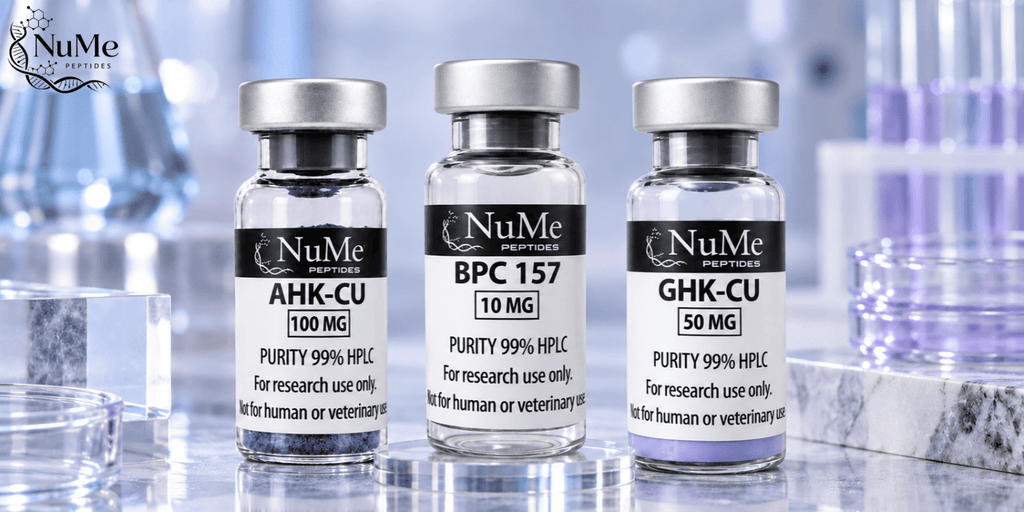
GHK-Cu, AHK-Cu, and BPC-157 represent substantially different areas of skin-related peptide research.
GHK-Cu
GHK-Cu is the copper complex of glycyl-L-histidyl-L-lysine. Among the three compounds discussed here, it has the strongest direct experimental history involving fibroblasts and extracellular-matrix biology. A classic study demonstrated that GHK-Cu stimulated collagen synthesis in cultured fibroblasts without simply increasing cell number. (Maquart et al., 1988)
Additional research found that GHK-Cu increased glycosaminoglycan synthesis in human fibroblast cultures. (Maquart et al., 1992) In a rat experimental wound model, GHK-Cu increased the accumulation of collagen, total proteins, DNA, and glycosaminoglycans within wound chambers. (Maquart et al., 1993)
GHK-Cu has also been investigated for ECM remodeling. Cultured fibroblasts exposed to the compound showed increased MMP-2 expression together with increased secretion of TIMP-1 and TIMP-2. (Siméon et al., 2000) These findings suggest that GHK-Cu research involves both matrix production and matrix turnover.
AHK-Cu
AHK-Cu is the copper complex of alanyl-histidyl-lysine. Its direct evidence for skin wound repair is much more limited than that for GHK-Cu.
One frequently cited study investigated AHK-Cu using human hair follicles and cultured dermal papilla cells. AHK-Cu increased hair-follicle elongation and dermal papilla-cell proliferation under the tested conditions. (Pyo et al., 2007)
Dermal papilla cells are specialized mesenchymal cells, so this study provides evidence of biological activity in a skin-associated system. However, it did not directly establish accelerated wound closure, re-epithelialization, or increased dermal collagen production. AHK-Cu should therefore not be assigned the same skin-repair evidence as GHK-Cu merely because both are copper tripeptides.
BPC-157
BPC-157 is a synthetic pentadecapeptide investigated predominantly in animal models. One early rat study evaluated skin incisional wounds and reported changes involving granulation tissue, collagen, angiogenesis, and tensile strength. (Mikus et al., 1997)
A later study used an alkali-burn skin model in rats. BPC-157 was associated with faster wound closure, greater re-epithelialization, granulation-tissue formation, collagen deposition, and increased VEGF-related angiogenic signalling. Experiments also identified changes involving ERK1/2 signalling in endothelial cells. (Huang et al., 2015)
| Compound | Skin-related research focus | Key limitation |
|---|---|---|
| GHK-Cu | Fibroblasts, collagen, ECM and remodeling | Much evidence remains experimental |
| AHK-Cu | Dermal papilla and hair-follicle biology | Direct wound-repair evidence is limited |
| BPC-157 | Wounds, angiogenesis and tissue repair | Evidence is predominantly preclinical |
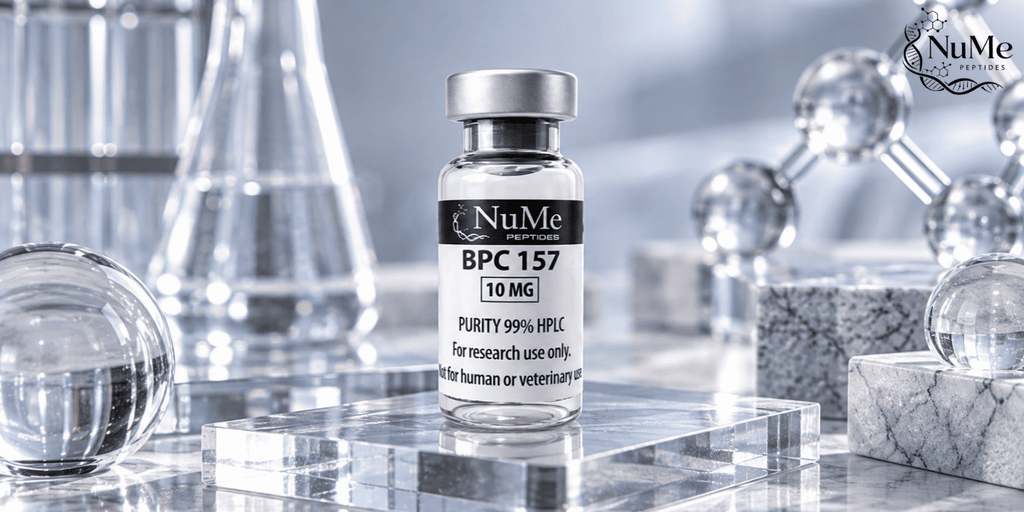
Explore batch-specific testing, analytical documentation, and research-use details for BPC-157 (10 mg).
What Does Current Evidence Show About Peptides and Skin Repair?
Current research does not support treating all experimental skin-repair peptides as equivalent.
GHK-Cu has direct evidence involving collagen synthesis, glycosaminoglycan production, fibroblast activity, and ECM remodeling. More recent ex vivo work also supports continued investigation of collagen-related responses in structured skin models. (Jiang et al., 2023)
AHK-Cu has a narrower evidence base. Its demonstrated effects on dermal papilla cells are scientifically interesting but do not establish general skin regeneration.
BPC-157 has several preclinical wound-healing studies, including skin injury models. However, the human evidence remains extremely limited. A 2026 systematic review identified only three small human studies involving 30 participants across regenerative and orthopaedic indications, and rated the overall certainty of evidence as very low. None provides strong clinical evidence for routine human skin-repair use. (Poolton et al., 2026)
Researchers should therefore distinguish among:
- molecular signalling;
- cellular responses;
- collagen and ECM changes;
- wound closure in animals;
- histological repair;
- demonstrated human outcomes.
Evidence at one level does not automatically establish the next.
Canadian research context
Health Canada currently identifies both BPC-157 and GHK-Cu among examples of unauthorized injectable peptide products encountered in Canada. Health Canada has also reported a 2026 recall involving unauthorized GHK-Cu and BPC-157 active pharmaceutical ingredients. (Health Canada, 2026)
This regulatory information should remain separate from laboratory research findings. Experimental evidence does not establish therapeutic authorization.
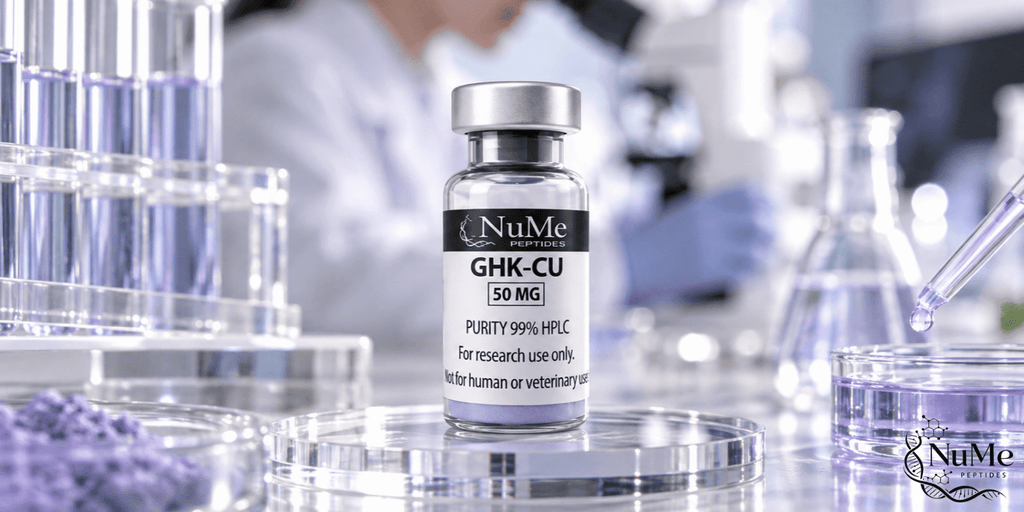
Explore research-use specifications, analytical documentation, and batch details for GHK-Cu (50 mg).
FAQs About Peptides for Skin Repair Research
What Are Peptides for Skin Repair Research?
They are peptide compounds investigated for potential effects on processes such as fibroblast activity, keratinocyte behaviour, collagen synthesis, angiogenesis, and extracellular-matrix remodeling.
Which Peptide Has the Strongest Direct Fibroblast Evidence?
GHK-Cuhas substantial direct laboratory evidence involving fibroblast collagen synthesis and ECM regulation.
Is AHK-Cu Proven to Repair Skin?
No. Published AHK-Cu research demonstrates activity in human hair follicles and dermal papilla cells, but direct evidence for wound repair remains limited.
Has BPC-157 Been Studied in Skin Wounds?
Yes. BPC-157 has been investigated in several animal skin-injury models, including incisional wounds and chemical burns. Human evidence remains insufficient to establish clinical skin-repair effects.
Why Is Angiogenesis Important in Skin Repair?
New blood vessels help provide oxygen and nutrients to developing tissue during the proliferative phase. However, angiogenesis is only one part of successful repair.
Does Increased Collagen Always Mean Better Skin Repair?
No. Collagen must also be appropriately organized and remodeled. Excessive matrix deposition may contribute to scar formation rather than true tissue regeneration.
Conclusion
Research into peptides for skin repair research focuses on a coordinated network involving keratinocytes, fibroblasts, endothelial cells, collagen, extracellular-matrix remodeling, angiogenesis, and inflammatory signalling.
GHK-Cu currently has the strongest direct evidence among the compounds discussed for fibroblast and ECM-related mechanisms. AHK-Cu shows biological activity in specialized dermal papilla models, but direct wound-repair evidence remains limited. BPC-157 has generated substantial preclinical interest in skin-wound models, yet robust human evidence is still lacking.
For researchers, the most useful approach is to distinguish molecular activity from actual tissue regeneration and preclinical findings from human outcomes.
For researchers looking for peptide materials for laboratory investigation, visit the Nume Peptides to explore the available research peptide collection.
Disclaimer: This content is provided for educational and scientific research purposes only. Research peptides are intended for laboratory research only and are not intended for human consumption or medical use.