

Peptides for Collagen Synthesis Research: Fibroblasts, Extracellular Matrix and Current Evidence


Research into peptides for collagen synthesis research examines how peptide-based compounds may influence fibroblast behaviour, collagen production, extracellular-matrix organization, and the balance between matrix synthesis and degradation. These processes are relevant to experimental models involving skin biology, connective tissue, wound repair, and matrix remodeling.
Collagen biology is more complex than simply increasing one structural protein. Fibroblasts synthesize collagen precursors, modify and secrete them, while extracellular enzymes help organize collagen molecules into fibrils. At the same time, existing matrix is continuously degraded and rebuilt. Researchers therefore need to distinguish among collagen gene expression, actual protein synthesis, extracellular deposition, matrix organization, and functional tissue properties.
For researchers looking for peptide materials for laboratory investigation, visit the Nume Peptides to explore the available research peptide collection.
How Is Collagen Synthesized and Remodeled?
Collagens are major structural proteins within the extracellular matrix. Different collagen types contribute to the properties of skin, tendon, bone, cartilage, blood vessels, and other connective tissues.
Collagen production involves several coordinated intracellular and extracellular steps:
- transcription of collagen-related genes;
- translation of collagen polypeptide chains;
- hydroxylation of selected proline and lysine residues;
- glycosylation of specific residues;
- assembly of three chains into procollagen;
- secretion into the extracellular space;
- removal of terminal propeptides;
- fibril assembly and cross-linking.
These steps illustrate why increased collagen gene expression alone cannot establish that mature collagen fibres have increased.
Collagen metabolism also requires substantial cellular resources. Fibroblasts must provide amino acids, energy, and cofactors necessary for producing and modifying extracellular-matrix proteins. (Schwörer et al., 2024)
Extracellular remodeling
After secretion, collagen becomes part of a constantly changing extracellular environment. Matrix metalloproteinases, commonly called MMPs, participate in collagen and matrix degradation, while tissue inhibitors of metalloproteinases help regulate their activity.
Researchers may therefore examine both formation and degradation when evaluating collagen-related compounds.
| Collagen process | Main biological event | Research relevance |
|---|---|---|
| Gene expression | Collagen genes are transcribed | Indicates an early molecular response |
| Procollagen synthesis | Precursor proteins are produced | Reflects intracellular synthesis |
| Secretion | Procollagen reaches the ECM | Supports matrix formation |
| Fibril assembly | Collagen molecules organize | Influences tissue architecture |
| Cross-linking | Fibres become stabilized | Contributes to mechanical properties |
| Remodeling | Existing matrix is degraded and rebuilt | Maintains ECM balance |
Explore research compounds studied for tissue repair, recovery, collagen support, and regenerative science in the Healing & Recovery collection.
What Role Do Fibroblasts Play in Collagen Research?
Fibroblasts are major producers and regulators of extracellular matrix in many connective tissues. In addition to collagen, they can produce proteoglycans, glycoproteins, growth factors, and enzymes involved in matrix turnover.
Fibroblasts are also highly responsive cells. Their behaviour can change according to tissue location, mechanical stress, inflammation, aging, injury, and experimental conditions.
Researchers studying fibroblast responses may evaluate:
- cell proliferation;
- cellular migration;
- COL1A1 and COL3A1 gene expression;
- procollagen production;
- extracellular collagen deposition;
- MMP activity;
- TIMP expression;
- growth-factor signalling.
These measurements should not be treated as interchangeable. Increased fibroblast proliferation does not necessarily mean that each cell is producing more collagen, while increased collagen synthesis does not establish that the resulting fibres are organized normally.
Why balance matters
Collagen accumulation is useful only when synthesis and degradation remain appropriately coordinated. Excessive matrix deposition can contribute to fibrosis, while insufficient collagen production can impair tissue structure.
For this reason, peptides for collagen synthesis research are often studied across several endpoints rather than by measuring collagen quantity alone.
A more complete experimental evaluation may consider:
- fibroblast activity;
- collagen gene expression;
- protein production;
- extracellular deposition;
- collagen organization;
- matrix degradation.
How Are Peptides Studied in Collagen Synthesis and Remodeling?
Experimental peptide research uses several models because collagen biology operates at molecular, cellular, tissue, and functional levels.
Fibroblast cultures
Human dermal fibroblasts and other fibroblast populations are commonly used to investigate direct cellular responses.
Researchers may measure:
- collagen synthesis;
- procollagen secretion;
- collagen-related gene expression;
- fibroblast proliferation;
- MMP activity;
- TIMP production;
- extracellular-matrix proteins.
A classic laboratory study reported that GHK-Cu increased collagen synthesis in cultured fibroblasts and that this effect occurred independently of changes in cell number. (Maquart et al., 1988)
Fibroblast cultures are useful for investigating mechanisms but cannot reproduce the complete immune, vascular, structural, and mechanical environment of intact tissue.
Ex vivo tissue models
Ex vivo models preserve more natural extracellular-matrix architecture than isolated cell systems.
They can help researchers examine:
- collagen localization;
- tissue-specific matrix responses;
- interactions between cells and existing ECM;
- changes in collagen-associated proteins.
These models provide an intermediate level of biological complexity between cell culture and whole-animal experiments.
Animal models
Animal studies allow researchers to examine collagen biology alongside inflammation, angiogenesis, wound repair, and mechanical loading.
Common outcomes include:
- collagen accumulation;
- collagen I and III distribution;
- histological matrix organization;
- wound architecture;
- fibrosis;
- biomechanical properties.
Results from animal models can provide useful tissue-level evidence, but they should not automatically be treated as established human outcomes.
Which Peptides Are Being Investigated in Collagen Research?
Among copper-containing peptides, GHK-Cu has a considerably stronger direct research history involving collagen and extracellular-matrix biology than AHK-Cu.
Although both compounds are copper tripeptides, their published evidence should be evaluated separately.
GHK-Cu
GHK-Cu is the copper complex of glycyl-L-histidyl-L-lysine. It has been investigated for decades in fibroblast and extracellular-matrix research.
A 1988 experiment reported that GHK-Cu stimulated collagen synthesis in cultured fibroblasts without a corresponding increase in cell number. This suggested that the observed response involved changes in collagen-producing activity rather than simply greater fibroblast proliferation. (Maquart et al., 1988)
Subsequent studies broadened the research focus beyond collagen production alone. GHK-Cu has been investigated in relation to:
- collagen synthesis;
- fibroblast activity;
- glycosaminoglycan production;
- extracellular-matrix turnover;
- MMP regulation;
- TIMP secretion;
- wound-associated signalling.
One fibroblast study reported increased MMP-2 expression together with increased TIMP-1 and TIMP-2 secretion following GHK-Cu exposure. This is relevant because it suggests involvement in matrix remodeling as well as matrix formation. (Siméon et al., 2000)
AHK-Cu
AHK-Cu is the copper complex of alanyl-histidyl-lysine. It is structurally related to GHK-Cu, but the available direct research literature is substantially smaller.
A 2007 study evaluated AHK-Cu using human hair follicles maintained ex vivo and cultured dermal papilla cells. Researchers reported increased follicle elongation and dermal papilla-cell proliferation under the experimental conditions. (Pyo et al., 2007)
However, the study was not designed to demonstrate direct collagen synthesis.
Researchers should therefore avoid assuming that findings from GHK-Cu can automatically be transferred to AHK-Cu.
| Compound | Main research areas | Collagen evidence |
|---|---|---|
| GHK-Cu | Fibroblasts, collagen, MMPs, TIMPs and ECM | Direct experimental evidence |
| AHK-Cu | Dermal papilla cells and hair-follicle models | Direct collagen evidence remains limited |
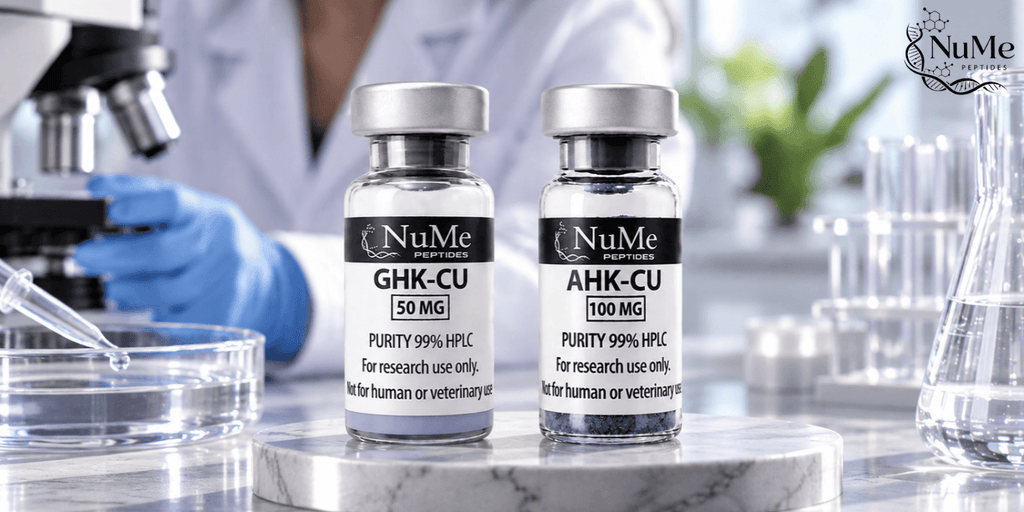
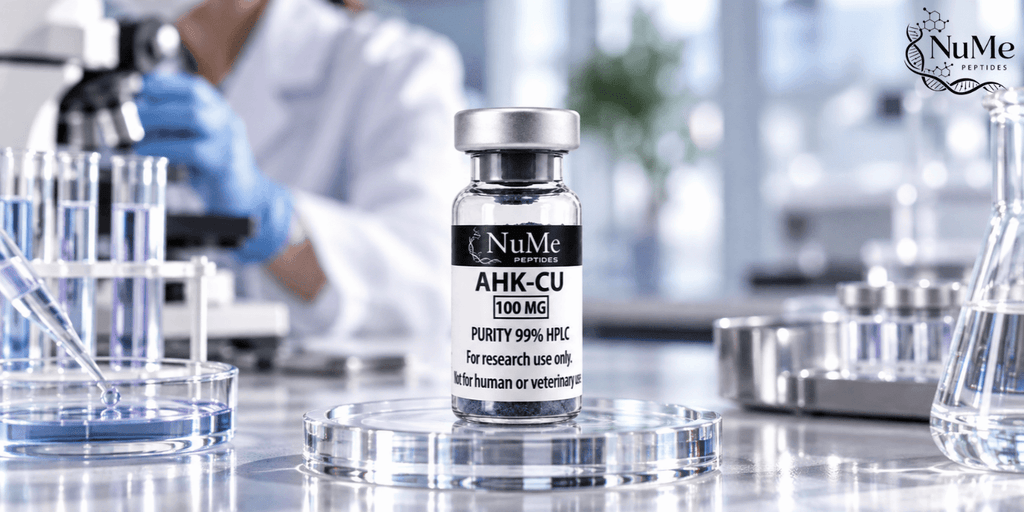
Explore research-use specifications, analytical documentation, and batch details for AHK-Cu (100 mg).
What Does Current Evidence Show About Peptides and Collagen Synthesis?
Current evidence provides the clearest direct support for GHK-Cu as an experimental regulator of collagen-related and extracellular-matrix processes.
GHK-Cu has direct collagen evidence
Laboratory studies have reported increased collagen synthesis in fibroblasts exposed to GHK-Cu. Other studies have examined changes in matrix-remodeling pathways involving MMPs and TIMPs. (Maquart et al., 1988) (Siméon et al., 2000)
These findings suggest that GHK-Cu research should not be reduced to a single “collagen boosting” concept. Experimental outcomes may involve both matrix production and matrix turnover.
Researchers may therefore examine several evidence levels:
- collagen-related gene expression;
- procollagen synthesis;
- extracellular collagen deposition;
- changes in MMPs;
- changes in TIMPs;
- collagen fibre organization;
- tissue-level mechanical properties.
| Experimental finding | What it may indicate |
|---|---|
| Higher collagen gene expression | Increased transcriptional activity |
| Increased procollagen | Increased precursor production |
| Increased collagen deposition | More extracellular collagen |
| Changed MMP activity | Altered matrix degradation |
| Changed TIMP levels | Altered regulation of MMP activity |
| Improved fibre organization | Structural matrix changes |
| Better mechanical properties | Functional tissue-level change |
A compound may influence one level without producing equivalent effects across all of them.
AHK-Cu evidence remains narrower
AHK-Cu requires a more conservative interpretation because direct collagen-focused research remains limited.
The published study involving AHK-Cu demonstrated biological activity in hair-follicle and dermal papilla-cell models, but it did not establish increased collagen production. (Pyo et al., 2007)
More direct research measuring collagen synthesis, extracellular deposition, matrix-remodeling enzymes, and tissue architecture would be needed before AHK-Cu could be discussed with the same collagen-focused evidence base as GHK-Cu.
Canadian research context
Canadian researchers should also separate experimental findings from regulatory authorization. Health Canada has identified GHK-Cu among unauthorized peptide products encountered in Canada. This regulatory status does not invalidate laboratory studies of collagen biology, but mechanistic research should not be interpreted as therapeutic approval. (Health Canada, 2026)
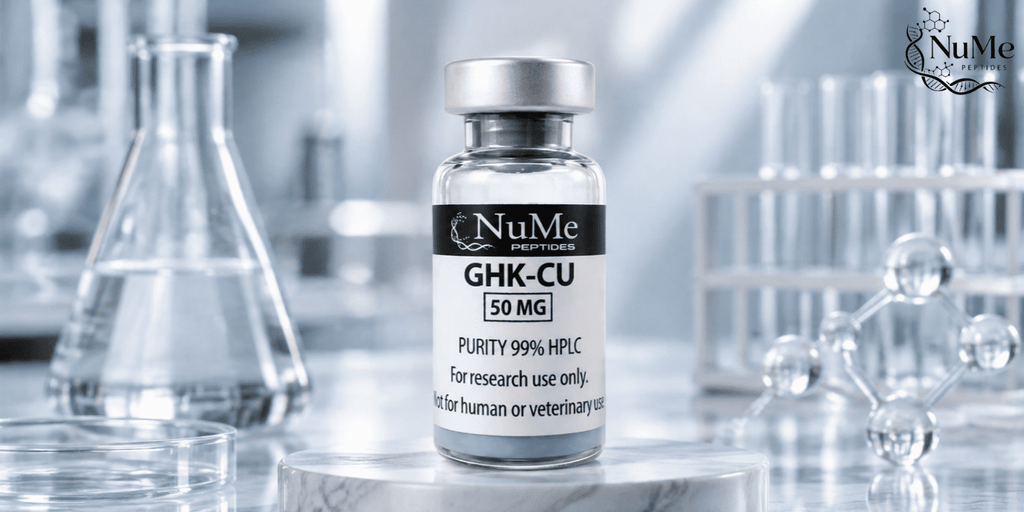
Explore research-use specifications, analytical documentation, and batch details for GHK-Cu (50 mg).
FAQs About Peptides for Collagen Synthesis Research
What Are Peptides for Collagen Synthesis Research?
They are peptide compounds investigated for potential effects on fibroblast activity, collagen production, extracellular-matrix signalling, and matrix remodeling.
Does GHK-Cu Increase Collagen Synthesis?
Laboratory studies have reported increased collagen synthesis in cultured fibroblasts exposed to GHK-Cu. These findings represent controlled experimental evidence rather than proof of clinical outcomes. (Maquart et al., 1988)
Does More Collagen Always Mean Better Tissue Quality?
No. Researchers must also consider:
- collagen type;
- fibre alignment;
- matrix organization;
- cross-linking;
- degradation;
- mechanical properties.
Excessive or poorly organized collagen can contribute to abnormal matrix formation.
Does AHK-Cu Have the Same Collagen Evidence as GHK-Cu?
No. The two compounds are distinct copper tripeptides, and GHK-Cu currently has much more direct experimental evidence involving collagen synthesis and extracellular-matrix remodeling.
Why Are MMPs Important in Collagen Research?
MMPs participate in extracellular-matrix degradation and turnover. Their activity helps determine whether existing collagen is being broken down and reorganized while new matrix is being produced.
Why Are Fibroblasts Used in Collagen Studies?
Fibroblasts are major producers of collagen and other extracellular-matrix components. Their responses provide researchers with a useful model for examining collagen synthesis, matrix regulation, and remodeling.
Conclusion
Research into peptides for collagen synthesis research extends far beyond measuring whether a peptide increases collagen production. Fibroblast behaviour, procollagen processing, extracellular deposition, MMP activity, collagen degradation, fibril organization, and tissue mechanics all contribute to extracellular-matrix biology.
GHK-Cu currently has the stronger direct evidence base. Experimental studies have reported increased collagen synthesis and changes in matrix-remodeling systems involving MMPs and TIMPs. AHK-Cu is structurally related but has a substantially smaller direct literature, so findings from GHK-Cu should not automatically be attributed to AHK-Cu.
When evaluating collagen research, researchers should distinguish among:
- gene expression;
- collagen production;
- extracellular deposition;
- matrix remodeling;
- fibre organization;
- functional tissue outcomes.
This approach provides a more accurate interpretation than relying on a single collagen measurement.
For researchers looking for peptide materials for laboratory investigation, visit the Nume Peptides to explore the available research peptide collection.
Disclaimer: This content is provided for educational and scientific research purposes only. Research peptides are intended for laboratory research only and are not intended for human consumption or medical use.


https://web-tool.hashnode.dev/how-youtube-shorts-downloading-works-video-formats-streams-and-technical-challenges
https://medium.com/@webdev1501/how-to-download-an-entire-facebook-photo-album-as-a-zip-file-without-saving-photos-one-by-one-36179b7c4364