
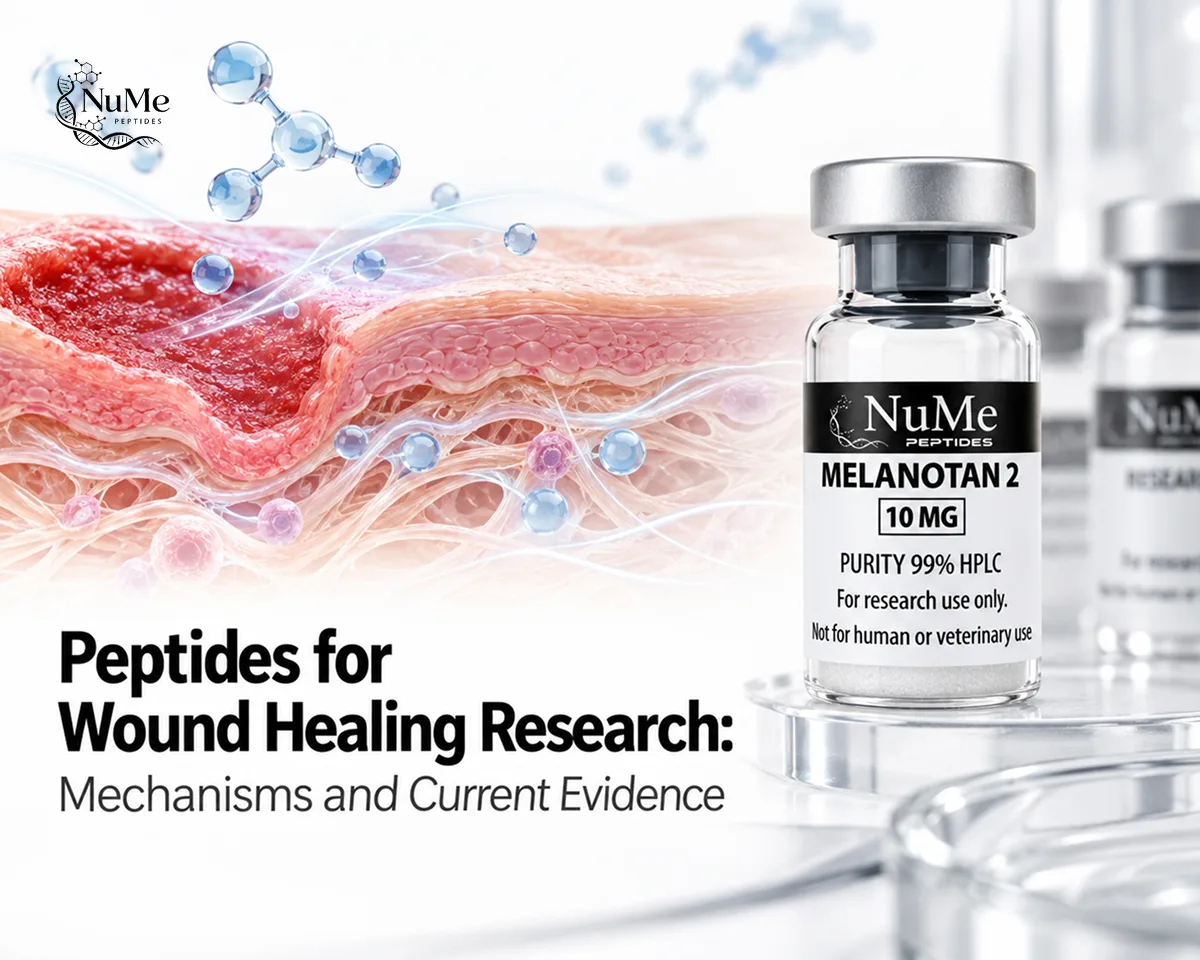
Peptides for Wound Healing Research: Mechanisms and Current Evidence


Research into peptides for wound healing research examines how peptide-based compounds may influence inflammation, vascular development, fibroblast behaviour, extracellular-matrix formation, and tissue remodeling. These processes are central to experimental wound-healing models because successful repair requires multiple cell types and signalling pathways to work in sequence.
However, evidence should be interpreted carefully. A peptide that changes fibroblast migration or angiogenic signalling in a laboratory model has not necessarily been shown to improve wound healing in humans. Study design, tissue type, peptide identity, concentration, delivery system, and experimental endpoint can all influence results.
Canadian regulatory context is also relevant. Health Canada has identified BPC-157, TB-500, and GHK-Cu among unauthorized injectable peptide products and notes that research-use labelling does not automatically remove applicable regulatory requirements. Accordingly, these compounds should be discussed separately from approved wound-care therapies. (Health Canada, 2026)
For researchers looking for peptide materials for laboratory investigation, visit the Nume Peptides to explore the available research peptide collection.
What Are the Main Stages of Wound Healing?
Wound healing is usually described as a coordinated process involving hemostasis, inflammation, proliferation, and remodeling. These stages overlap rather than occurring as completely independent events.
Hemostasis
Immediately after tissue damage, blood vessels constrict while platelets and coagulation pathways contribute to clot formation.
The temporary fibrin-rich matrix helps limit blood loss while providing an early structural environment for inflammatory and repair-associated cells.
Inflammation
Neutrophils and macrophages are recruited to damaged tissue. They participate in debris clearance and release signalling molecules that influence later repair.
Inflammation is necessary, but prolonged inflammatory signalling may interfere with normal progression toward tissue reconstruction.
Proliferation
During this phase, several processes occur simultaneously:
- fibroblast migration and proliferation;
- collagen and extracellular-matrix deposition;
- keratinocyte migration;
- angiogenesis;
- granulation-tissue formation;
- re-epithelialization.
This stage is especially relevant to peptide research because many experimental compounds are studied for their potential effects on fibroblasts, endothelial cells, and matrix-associated signalling.
Remodeling
The newly formed matrix is gradually reorganized. Collagen composition, fiber alignment, matrix turnover, and tissue mechanical properties continue to change over time.
Modern wound-healing research emphasizes that disruption at any stage can influence subsequent repair and final tissue structure. (Deng et al., 2025)
| Wound-healing phase | Major processes | Common research endpoints |
|---|---|---|
| Hemostasis | Clot formation and platelet activity | Coagulation and platelet signalling |
| Inflammation | Immune-cell recruitment | Cytokines and macrophage activity |
| Proliferation | Fibroblasts, angiogenesis and re-epithelialization | VEGF, collagen and cell migration |
| Remodeling | Matrix reorganization | Collagen turnover and MMP activity |
For researchers looking for peptide materials for laboratory investigation, browse the Nume Peptides Shop to explore the available research collection.
How Are Peptides Studied in Experimental Wound-Healing Models?
Researchers use several experimental systems to investigate peptides for wound healing research.
Cell-culture models can isolate specific processes, while animal wound models provide a more integrated view of inflammation, vascular responses, extracellular-matrix formation, and tissue closure.
Common experimental approaches include:
- fibroblast cultures;
- keratinocyte cultures;
- endothelial-cell assays;
- cell-migration assays;
- collagen-production measurements;
- scratch-wound models;
- animal excisional or incisional wound models;
- peptide-loaded hydrogels and scaffolds;
- histological examination of repaired tissue.
Cell models answer focused questions
A fibroblast culture, for example, can help researchers determine whether a peptide changes migration, proliferation, collagen-related signalling, or matrix production.
Endothelial-cell experiments may instead focus on migration, tube formation, or angiogenic pathways.
These models are valuable for mechanisms, but they do not reproduce the entire biological complexity of a wound.
Animal models examine integrated repair
Animal studies can measure endpoints such as wound closure, vascular density, inflammatory-cell infiltration, collagen organization, tensile properties, or histological appearance.
Nevertheless, differences in anatomy, metabolism, immune responses, and experimental conditions limit direct translation to humans.
Research reviews of bioactive peptides in tissue regeneration therefore emphasize both their mechanistic potential and the need for better translation between experimental systems and clinical evidence. (Zhang et al., 2024)
How Do Peptides Relate to Fibroblast Activity and Tissue Remodeling?
Fibroblasts are central to wound repair because they contribute to granulation tissue and extracellular-matrix formation.
During proliferation, fibroblasts migrate into the wound environment and produce structural molecules such as collagen. Some cells can also adopt myofibroblast-like characteristics involved in tissue contraction.
Collagen production and organization
Peptide studies may examine changes in:
- collagen synthesis;
- fibroblast proliferation;
- fibroblast migration;
- extracellular-matrix deposition;
- matrix metalloproteinase activity;
- collagen organization.
However, more collagen is not automatically better. Effective wound repair requires an appropriate balance between matrix deposition and matrix degradation.
Excessive collagen accumulation may contribute to abnormal scarring or fibrosis, while insufficient matrix formation may weaken repaired tissue.
Angiogenesis and fibroblast interactions
Fibroblasts and endothelial cells also communicate through growth factors and matrix-derived signals.
New vessels can support developing tissue by improving oxygen and nutrient delivery, while fibroblast-generated extracellular matrix creates a structural environment through which cells migrate.
This explains why peptide experiments often measure both fibroblast activity and vascular signalling rather than treating them as separate processes.
Remodeling is a long-term process
Early wound closure does not necessarily indicate complete repair. The newly formed matrix must continue to reorganize after visible closure occurs.
Consequently, research endpoints such as collagen architecture, tissue strength, inflammatory status, and matrix turnover may provide information that simple wound-area measurements cannot.
Which Peptides Are Being Investigated in Wound-Healing Research?
BPC-157, GHK-Cu, and thymosin β4-related compounds are frequently discussed in experimental wound-repair literature, although their evidence bases are different.
BPC-157
BPC-157 is a synthetic 15-amino-acid peptide investigated mainly in preclinical studies.
Experimental research has examined BPC-157 in gastrointestinal, skin, tendon, ligament, muscle, and other injury models. Proposed areas of investigation include angiogenic signalling, inflammatory pathways, cellular migration, and tissue organization.
A 2025 systematic review of BPC-157 in musculoskeletal research identified 36 eligible studies, of which 35 were preclinical and only one involved humans. The authors therefore highlighted the substantial difference between experimental findings and available clinical evidence. (Vasireddi et al., 2025)
For wound-healing research, this means BPC-157 should primarily be understood as a preclinical research compound rather than an established human wound-healing intervention.
GHK-Cu
GHK-Cu is a copper complex of the tripeptide glycyl-L-histidyl-L-lysine.
It has been investigated extensively in skin and extracellular-matrix research. Experimental studies have examined its relationship with:
- fibroblast activity;
- collagen synthesis;
- elastin-associated processes;
- angiogenesis;
- matrix remodeling;
- inflammatory signalling.
Research reviews have described GHK-Cu as influencing several pathways associated with tissue reconstruction and skin biology. (Pickart, 2008)
Its interpretation still depends on experimental conditions. Copper coordination, formulation, concentration, delivery systems, and tissue model can all affect observed outcomes.
TB-500 and thymosin β4
TB-500 is commonly associated with thymosin β4, but the terminology requires caution.
Thymosin β4 is a naturally occurring 43-amino-acid peptide known for its interaction with G-actin. Research has examined Tβ4 in relation to:
- cytoskeletal regulation;
- cell migration;
- endothelial behaviour;
- angiogenesis;
- inflammatory responses;
- wound-associated repair.
Experimental studies have also investigated shorter sequences derived from Tβ4 that retain selected biological activities. (Philp et al., 2010)
Therefore, findings from full-length thymosin β4 should not automatically be attributed to every material marketed as TB-500. Molecular identity should be confirmed before making research comparisons.
| Compound | Major wound-research areas | Important limitation |
|---|---|---|
| BPC-157 | Angiogenesis, inflammation and tissue repair models | Evidence remains predominantly preclinical |
| GHK-Cu | Fibroblasts, collagen and skin remodeling | Outcomes depend on formulation and model |
| Tβ4 / TB-500-related research | Migration, actin regulation and angiogenesis | TB-500 terminology may not equal full-length Tβ4 |
What Does Current Evidence Show About Peptides and Wound Healing?
Current evidence suggests that several peptide systems can influence biological pathways involved in wound repair. However, the evidence is much stronger for mechanisms and experimental models than for established clinical outcomes.
Evidence for BPC-157 remains mainly preclinical
BPC-157 research includes many animal studies reporting repair-associated biological effects.
Nevertheless, the limited human evidence remains a major constraint. Even when animal models demonstrate changes in vascular signalling, inflammation, or tissue organization, these findings cannot establish comparable human effectiveness or safety. (Vasireddi et al., 2025)
GHK-Cu has a broader skin-research history
GHK-Cu has been examined for decades in relation to fibroblast activity, collagen, extracellular-matrix biology, and skin-associated repair mechanisms.
This gives it a broader mechanistic foundation in skin research than some newer experimental peptides. However, different formulations and research systems make direct comparison across studies difficult.
Thymosin β4 has mechanistic wound-healing evidence
Thymosin β4 research includes studies of cell migration, angiogenesis, actin dynamics, and dermal wound responses.
Experimental work has reported enhanced endothelial-cell migration and vascular-associated responses, supporting continued investigation of Tβ4-related pathways in repair biology. (Philp et al., 2003)
However, evidence involving a defined Tβ4 molecule does not automatically characterize commercial TB-500 materials.
Evidence quality should guide interpretation
| Evidence type | What it can support | What it cannot establish alone |
|---|---|---|
| Cell culture | Cellular mechanism | Whole-organism effectiveness |
| Animal model | Integrated repair response | Human clinical outcome |
| Human observational study | Early human association | Strong causal evidence |
| Controlled clinical trial | Comparative clinical evidence | Broader use beyond studied conditions |
Researchers should therefore distinguish between a compound affecting a wound-associated pathway and a compound being established as a wound-healing therapy.
Health Canada’s position reinforces this distinction. Unauthorized peptide products have not undergone the regulatory assessment required to establish their safety, effectiveness, and quality as therapeutic products in Canada. (Health Canada, 2026)
For researchers looking for peptide materials for laboratory investigation, browse the Nume Peptides Shop to explore the available research collection.
FAQs About Peptides for Wound Healing Research
What Are Peptides for Wound Healing Research?
They are peptide compounds investigated for effects on biological processes involved in wound repair, including inflammation, angiogenesis, fibroblast activity, cell migration, collagen production, and extracellular-matrix remodeling.
How Are Peptides Tested in Wound-Healing Studies?
Researchers may use cell cultures, migration assays, animal wounds, histological analysis, biomaterials, and molecular assays.
Different models answer different questions, so results should be interpreted within their experimental context.
Is BPC-157 Proven to Heal Wounds in Humans?
No established conclusion can currently be drawn from the available evidence.
Most published BPC-157 research remains preclinical, and robust human evidence is limited. (Vasireddi et al., 2025)
Why Is GHK-Cu Studied in Wound Research?
GHK-Cu is investigated because experimental research has linked it with fibroblast activity, collagen-related processes, angiogenesis, extracellular-matrix remodeling, and skin biology.
Is TB-500 the Same as Thymosin β4?
The terms are frequently associated, but researchers should not assume that every TB-500-labelled material is molecularly identical to full-length thymosin β4.
Analytical identity should be confirmed before applying findings from Tβ4 studies.
Does Faster Wound Closure Mean Better Tissue Repair?
Not necessarily.
Researchers may also need to evaluate inflammation, collagen organization, vascular development, tissue strength, and long-term remodeling. Visible closure represents only one possible endpoint.
Conclusion
Research into peptides for wound healing research focuses on a network of biological processes rather than a single mechanism.
BPC-157 is being investigated primarily through preclinical wound and tissue-repair models. GHK-Cu has a longer history of research involving fibroblasts, collagen, skin biology, and extracellular-matrix remodeling. Thymosin β4 has mechanistic evidence involving actin regulation, cell migration, and angiogenesis, although researchers should distinguish defined Tβ4 research from broader TB-500 terminology.
Across all three compounds, the strongest interpretation separates mechanistic evidence from clinical evidence. Changes in angiogenesis, fibroblast behaviour, or collagen signalling may provide valuable experimental information, but they do not independently demonstrate an approved or established wound-healing treatment.
For researchers looking for peptide materials for laboratory investigation, visit the Nume Peptides to explore the available research peptide collection.
Disclaimer: This content is provided for educational and scientific research purposes only. Research peptides are intended for laboratory research only and are not intended for human consumption or medical use.