
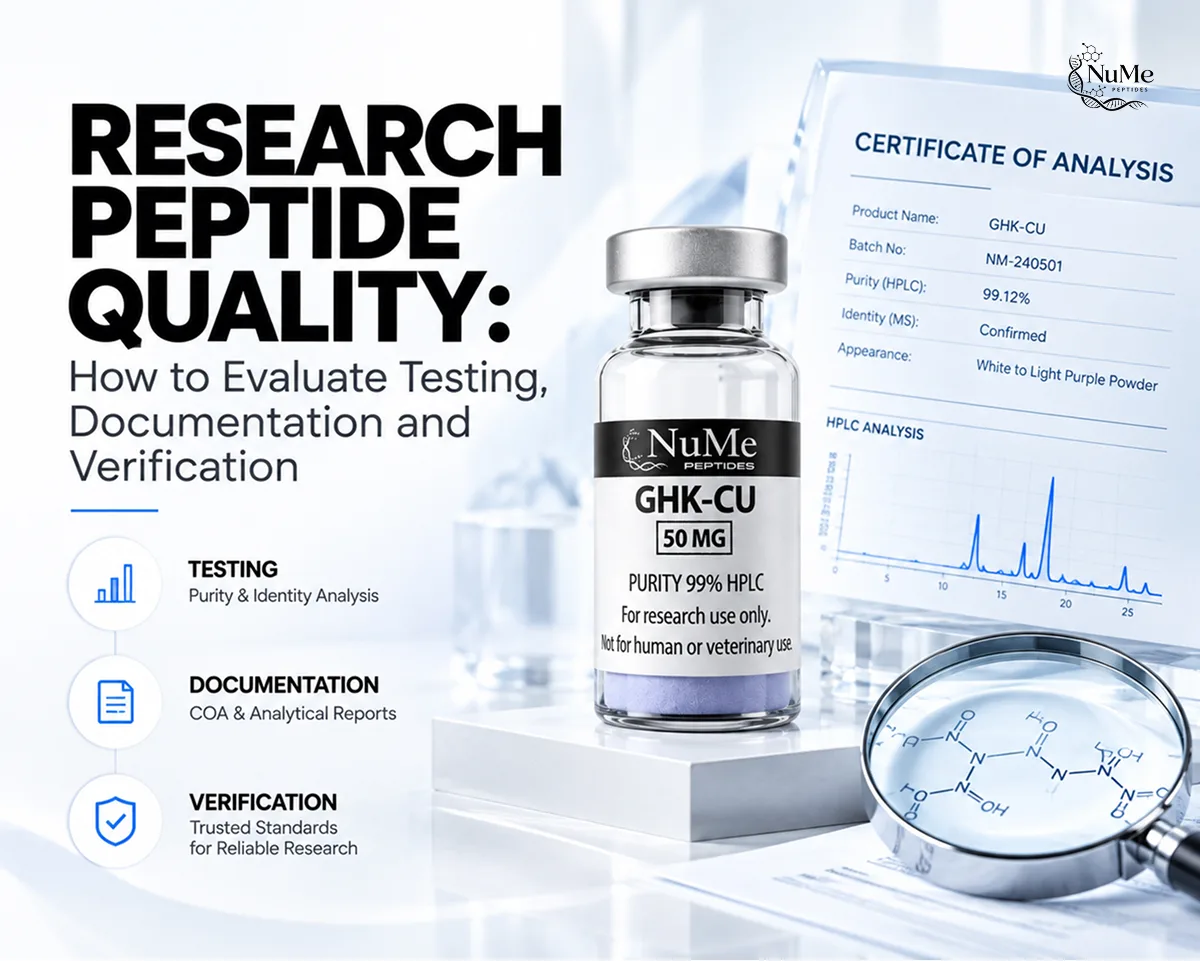
Research Peptide Quality: How to Evaluate Testing, Documentation and Verification


Research peptide quality cannot be judged reliably from a purity percentage alone. A sample may report high chromatographic purity while leaving other important questions unanswered. Was molecular identity confirmed? Does the Certificate of Analysis correspond to the supplied batch? Were the analytical methods suitable? Could storage or handling have changed the material after testing?
For researchers, a stronger assessment combines several independent quality indicators. Identity, purity, peptide content, impurity profile, analytical methodology, batch traceability, documentation, and stability each answer a different question.
In Canada, there is no single universal definition that makes a research peptide “high quality.” However, Health Canada’s framework for regulated active pharmaceutical ingredients illustrates an important quality principle: reliable assessment depends on specifications, appropriate analytical procedures, documented results, and traceability rather than a marketing claim alone. (Health Canada, 2022)
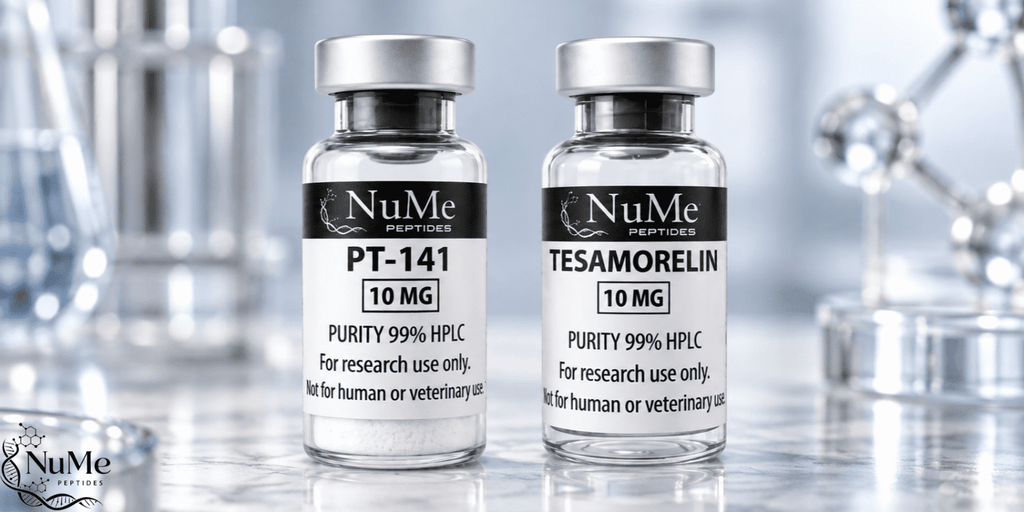
NuMe Peptides states that its Canadian research products undergo HPLC and mass-spectrometry testing and are supported by batch-specific Certificates of Analysis.
For researchers looking for peptide materials for laboratory investigation, visit the Nume Peptides to explore the available research peptide collection.
What Defines Research Peptide Quality?
Research peptide quality is best understood as a combination of measurable characteristics rather than one score or label.
A useful quality assessment should answer questions such as:
- Is the material consistent with the intended peptide?
- How was molecular identity evaluated?
- What analytical method produced the purity result?
- Are relevant peptide-related impurities detectable?
- Does the documentation correspond to the supplied lot?
- When was the material tested?
- Has storage or handling potentially affected the sample?
This approach reflects the broader concept of specifications used in analytical quality control.
Health Canada’s implementation of ICH Q6A describes a specification as a combination of tests, analytical procedures, and acceptance criteria. Importantly, specifications represent only one part of an overall quality strategy. (Health Canada, ICH Q6A)
The same principle is useful for research materials. A purity percentage becomes more meaningful when researchers also know what was tested, how the measurement was performed, and which batch the result represents.
For researchers looking for peptide materials for laboratory investigation, browse the Nume Peptides Shop to explore the available research collection.
Which Quality Factors Should Researchers Evaluate?
Several quality attributes should be examined separately before they are combined into an overall assessment.
Molecular identity
Identity asks whether the material is consistent with the intended peptide.
Mass spectrometry is commonly used because it can measure molecular mass and determine whether the observed species is consistent with the expected molecule.
However, an expected molecular mass does not automatically establish purity. A sample can contain the correct peptide together with several additional compounds.
Therefore, identity testing and purity testing should be treated as complementary rather than interchangeable.
Chromatographic purity
Reverse-phase HPLC is widely used to evaluate synthetic peptide preparations.
A chromatogram may provide information about:
- the primary peptide peak;
- additional detectable peaks;
- relative peak areas;
- retention behaviour;
- differences between lots;
- potential degradation-related species.
However, an HPLC purity value should not automatically be interpreted as total peptide content.
For example, a result of 99% chromatographic purity generally refers to the relative detector response associated with the principal peak under the selected analytical conditions. It does not necessarily mean that 99% of the total dry material consists of the target peptide.
Peptide content
Peptide content addresses the amount of peptide actually present in the sample.
A synthetic peptide preparation may also contain:
- residual moisture;
- counterions;
- salts;
- residual solvents;
- non-peptide components.
Therefore, chromatographic purity and actual peptide content can differ.
Recommendations developed for peptide standards used in quantitative mass-spectrometry assays specifically distinguish chemical purity from net peptide content and emphasize accurate characterization when quantitative reliability matters. (Hoofnagle et al., 2016)
Impurity profile
Synthetic peptides may contain closely related molecular species generated during synthesis, purification, processing, or storage.
Potential impurities include:
- truncated sequences;
- deletion sequences;
- incomplete coupling products;
- amino-acid misincorporations;
- oxidation products;
- deamidated species;
- epimers;
- degradation products.
LC-MS can be particularly useful because it combines chromatographic separation with molecular-mass information. Research reviewing synthetic peptide characterization describes LC-MS as an important method for investigating peptide-related impurities arising from manufacturing and storage. (Lian et al., 2021)
| Quality indicator | Main question | Common analytical evidence |
|---|---|---|
| Identity | Is this the intended peptide? | MS or LC-MS |
| Chromatographic purity | What other detectable species are present? | HPLC or UPLC |
| Peptide content | How much peptide is actually present? | Quantitative analysis |
| Impurity profile | Which related compounds are present? | HPLC, LC-MS |
| Stability | Has the material changed over time? | Repeat testing |
| Traceability | Does testing apply to this lot? | Batch-specific COA |
SEE MORE:
- What Is a Peptide COA? Understanding Certificates of Analysis for Research Peptides
- What Is HPLC Peptide Testing? Understanding HPLC Analysis in Peptide Research
- What Is Mass Spectrometry Peptide Testing? A Guide to Peptide Identity Analysis
- HPLC vs Mass Spectrometry for Peptides: What’s the Difference?
How Do Analytical Testing Methods Support Quality Assessment?
Analytical testing only provides useful evidence when the selected method is appropriate for the question researchers are trying to answer.
HPLC
HPLC separates components according to their interactions with the chromatographic system.
When evaluating HPLC data, researchers should consider more than the reported percentage. Useful information may include:
- chromatogram quality;
- number of detectable peaks;
- peak separation;
- retention time;
- detector type;
- integration method;
- analytical conditions.
Poor chromatographic resolution can allow multiple species to overlap. As a result, an apparently strong purity value may provide less information if impurities co-elute with the main peak.
Recommendations for peptide standards used in mass-spectrometry assays emphasize the importance of detailed chromatographic characterization because inadequate separation may obscure synthesis-related contaminants. (Hoofnagle et al., 2016)
Mass spectrometry
Mass spectrometry answers a different analytical question.
It may help researchers:
- confirm expected molecular mass;
- detect mass-shifted variants;
- investigate degradation products;
- characterize individual chromatographic peaks.
An MS result that matches the expected peptide mass supports identity, but it does not automatically establish overall chromatographic purity.
LC-MS
LC-MS combines chromatographic separation with mass detection.
This can be especially useful when researchers need to characterize individual impurity peaks rather than simply observe that additional peaks exist.
Reviews of synthetic peptide impurity analysis identify LC-MS as a major tool for distinguishing and investigating structurally related peptide impurities. (Lian et al., 2021)
Orthogonal testing
Confidence increases when different analytical methods provide consistent results.
For example:
- HPLC shows one dominant chromatographic component.
- MS detects a molecular mass consistent with the intended peptide.
- The COA connects both results to the same batch.
Each test provides different information, but together they form a stronger quality assessment.
For researchers looking for peptide materials for laboratory investigation, browse the Nume Peptides Shop to explore the available research collection.
Why Are Identity, Purity and Documentation Different Quality Indicators?
Identity, purity, and documentation are closely related, but they should not be treated as the same measurement.
Identity asks: “What is it?”
Mass spectrometry can help establish that a detected species has a molecular mass consistent with the expected peptide.
However, the sample may still contain other compounds.
Purity asks: “What else is present?”
Chromatographic analysis examines the relative abundance of the principal component compared with other detectable species.
However, a clean chromatogram does not necessarily establish molecular identity without supporting evidence.
Documentation asks: “Can the result be traced?”
Documentation connects analytical findings to the material used in the experiment.
Useful records may include:
- product or peptide name;
- lot or batch number;
- test date;
- analytical methods;
- HPLC result;
- MS result;
- testing laboratory;
- applicable specifications.
Health Canada’s GMP guidance for regulated APIs requires Certificates of Analysis to connect analytical results to a specific batch and applicable specifications. Research-use peptides do not automatically fall under the same regulatory requirements, but this traceability principle remains useful when evaluating laboratory materials. (Health Canada, 2022)
| Evidence | What it supports | What it cannot prove alone |
|---|---|---|
| MS result | Molecular identity | Overall purity |
| HPLC result | Chromatographic composition | Complete identity |
| COA | Documentation and traceability | Analytical accuracy by itself |
| Batch number | Connection to a production lot | Chemical quality |
| Purity percentage | Relative analytical result | Full sample characterization |
For researchers looking for peptide materials for laboratory investigation, browse the Nume Peptides Shop to explore the available research collection.
How Can Researchers Evaluate Peptide Quality More Systematically?
Instead of asking whether a peptide is simply “high quality,” researchers can follow a structured evaluation process.
Step 1: Match the batch
Confirm that the batch number on the product matches the Certificate of Analysis.
A COA from a different lot cannot directly describe the exact material used in the experiment.
Step 2: Review identity testing
Determine whether identity was evaluated independently from purity.
Useful documentation may include:
- expected molecular mass;
- observed molecular mass;
- MS or LC-MS result;
- batch identification.
Step 3: Review chromatographic data
Do not rely only on a headline purity percentage.
Where available, examine:
- main peak;
- secondary peaks;
- chromatogram resolution;
- numerical result;
- analytical date.
Step 4: Consider the impurity profile
The required level of impurity characterization depends on the research question.
Closely related impurities may be particularly relevant in:
- receptor-binding studies;
- quantitative assays;
- analytical calibration;
- biochemical interaction studies;
- highly sensitive in vitro experiments.
Step 5: Consider storage and handling
A peptide may meet analytical specifications when first tested but change later.
Storage and handling variables may include:
- temperature;
- moisture;
- oxygen exposure;
- repeated freeze-thaw cycles;
- light exposure;
- adsorption to container surfaces.
Recommendations for peptide standards treat storage and handling as part of quality control because these variables can affect concentration, solubility, oxidation, and analytical performance. (Hoofnagle et al., 2016)
Step 6: Evaluate supplier transparency
A practical supplier checklist includes:
- Is a batch-specific COA available?
- Does the COA match the supplied lot?
- Are HPLC and MS results clearly separated?
- Are actual numerical results shown?
- Is the analytical date provided?
- Is the testing laboratory identified?
- Are storage conditions available?
SEE MORE:
- How to Verify a Research Peptide Supplier: A Research-Focused Checklist
- Research Peptide COA Requirements: What Should a Certificate of Analysis Include?
- Research Peptide Supplier: What Should Researchers Look for When Evaluating a Source?
- How to Read a Peptide COA: Understanding Key Sections and Test Results
FAQs About Research Peptide Quality
Is 99% HPLC purity enough to confirm research peptide quality?
No. HPLC purity is useful, but researchers should also consider identity testing, impurity profile, peptide content when relevant, batch traceability, analytical methods, and documentation.
Does mass spectrometry prove peptide purity?
Not by itself. Mass spectrometry primarily provides molecular-mass and structural information, while chromatographic methods such as HPLC are commonly used to evaluate relative purity.
Why should the COA match the batch number?
Because testing performed on another production lot cannot directly establish the analytical characteristics of the sample currently being studied.
Can two peptides with the same purity percentage differ in quality?
Yes. They may differ in impurity composition, peptide content, analytical method quality, storage history, molecular identity confidence, or documentation.
What information should researchers look for first?
A practical starting checklist includes:
- batch-specific COA;
- HPLC result;
- MS identity confirmation;
- analytical date;
- numerical test results;
- laboratory information;
- storage guidance.
Does high research peptide quality mean pharmaceutical grade?
No. Pharmaceutical APIs operate within regulated manufacturing and quality systems. Research-use peptides should not be assumed to meet those requirements merely because they have high reported purity or extensive analytical documentation. (Health Canada, 2022)
Conclusion
Research peptide quality should be evaluated as an evidence chain rather than a single purity claim.
Identity establishes whether the material is consistent with the intended peptide. HPLC provides information about chromatographic composition. Mass spectrometry provides molecular-mass evidence. Impurity analysis gives additional context, while batch-specific documentation connects those findings to the actual material used in an experiment.
A systematic evaluation should therefore consider:
- molecular identity;
- chromatographic purity;
- peptide content where relevant;
- impurity profile;
- analytical methodology;
- lot traceability;
- Certificates of Analysis;
- storage and handling history.
Together, these indicators provide a stronger basis for reproducible research than purity percentage alone.
For researchers looking for peptide materials for laboratory investigation, visit the Nume Peptides to explore the available research peptide collection.
Disclaimer: This content is provided for educational and scientific research purposes only. Research peptides are intended for laboratory research only and are not intended for human consumption or medical use.


This article provides a useful overview of what researchers should consider when evaluating peptide quality. I especially appreciate the focus on purity, analytical testing, and consistency, since these factors can have a major impact on the reliability of laboratory results.
I found the discussion of peptide quality control particularly helpful. Understanding how purity, identity, and analytical verification are assessed gives a much clearer picture of what to look for when selecting materials for research purposes.
A practical resource for anyone learning about research-grade peptide quality. The emphasis on proper testing and documentation is important because reliable analytical data provides a stronger basis for evaluating the consistency of peptide samples.